Huang Jianzhe, Qi Guoyuan
School of Aeronautics and Astronautics, Shanghai Jiao Tong University, Shanghai, 200240 China.
Tianjin Key Laboratory of Advanced Technology of Electrical Engineering and Energy, Tiangong University, Tianjin, 300387 China.
Nonlinear Dyn. 2020;101(3):1889-1899. doi: 10.1007/s11071-020-05901-2. Epub 2020 Aug 27.
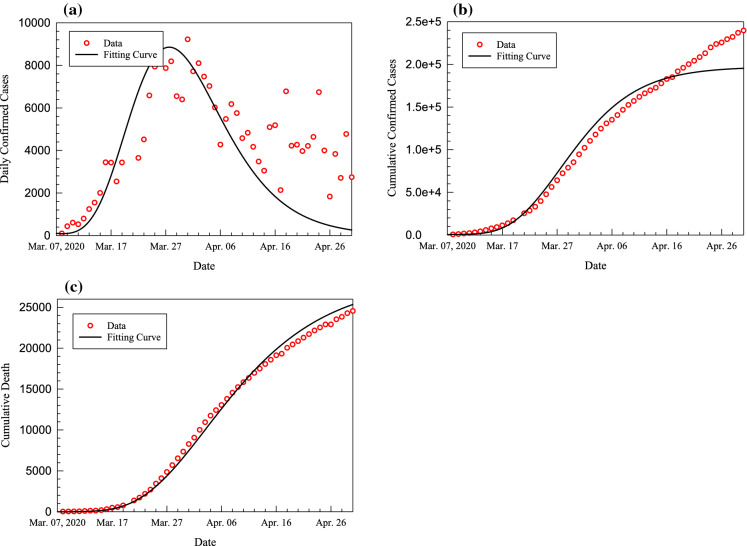
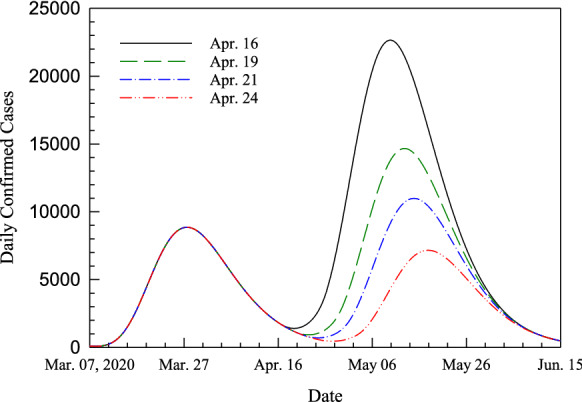
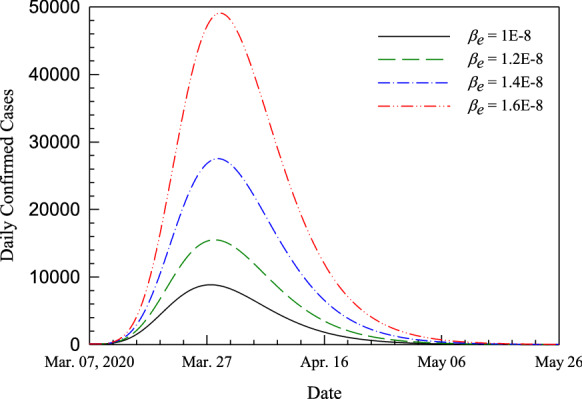
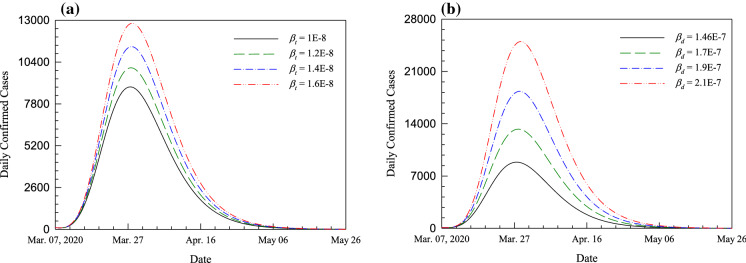
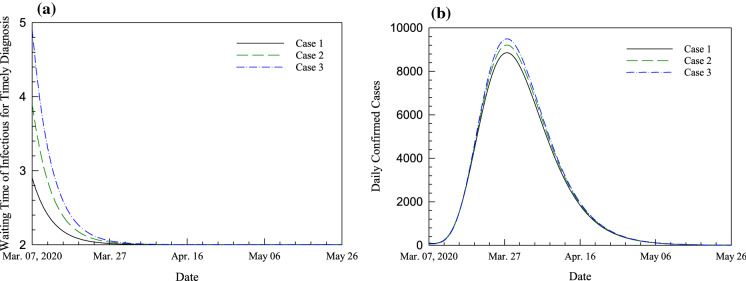
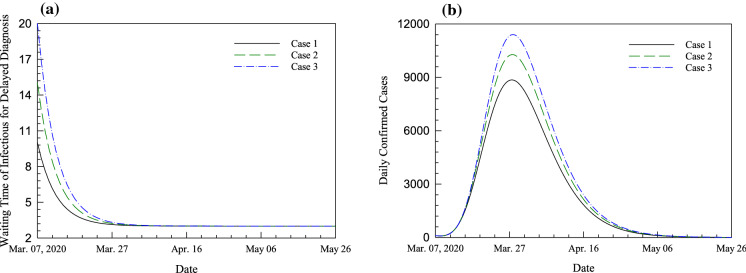
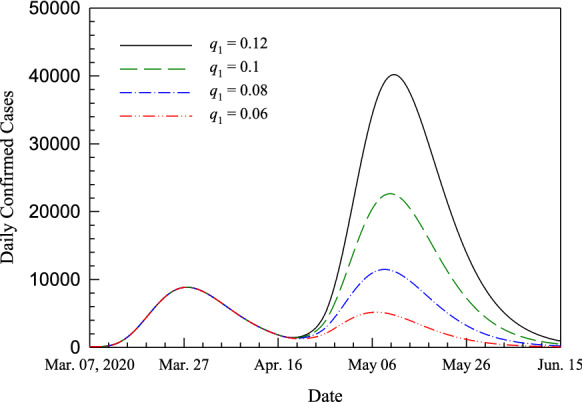
The COVID-19 disease significantly has threatened the human lives and economy. It is a dynamic system with transmission and control as factors. Modeling the dynamics of the spread of COVID-19 based on the reported data can predict the growing trend of such a disease. In this paper, the dynamic evolution of COVID-19 in Spain is studied, and a comprehensive SEIR model is adopted to fit the obtained clinical progressive data of COVID-19 in Spain. The transmission rate between the susceptible and the self-quarantine susceptible is made to be time-variant, which is reasonable. The equilibria are found, and the stability condition is given using the basic reproduction number and eigenvalues at the points. The effect on daily confirmed cases for the transmission rate from susceptible to the exposed population due to the currently exposed and infectious is extensively investigated. The risk of the easing of the control measure is investigated. The double-peak dynamic behavior of the COVID-19 system is observed. The second wave rebound shows that the daily confirmed cases of the second peak even much higher than the first peak.
新冠肺炎疫情严重威胁着人类生命和经济。它是一个以传播和防控为要素的动态系统。基于报告数据对新冠肺炎传播动态进行建模,可以预测该疾病的增长趋势。本文研究了西班牙新冠肺炎的动态演变情况,并采用综合SEIR模型对西班牙新冠肺炎的临床进展数据进行拟合。使易感人群和自我隔离易感人群之间的传播率随时间变化,这是合理的。找到了平衡点,并利用基本再生数和这些点处的特征值给出了稳定性条件。广泛研究了当前已暴露和具有传染性的人群对易感人群到暴露人群传播率的日确诊病例的影响。研究了放松防控措施的风险。观察到新冠肺炎系统的双峰动态行为。第二波反弹表明,第二个峰值的日确诊病例甚至远高于第一个峰值。