Garay Alberto, Tapia Javier, Anguita Manuel, Formiga Francesc, Almenar Luis, Crespo-Leiro María G, Manzano Luis, Muñiz Javier, Chaves José, De Frutos Trinidad, Moliner Pedro, Corbella Xavier, Enjuanes-Grau Cristina, Comín-Colet Josep, Vida-Ic Multicenter Study Investigators On Behalf Of
Unidad de Insuficiencia Cardiaca Comunitaria (UMICO), Servicio de Cardiología, Hospital Universitario de Bellvitge, L' Hospitalet de Llobregat, 08907 Barcelona, Spain.
Programa Territorial de Atención Integrada a la Insuficiencia Cardiaca Comunitaria de la Gerencia Metropolitana Sur del Instituto Catalán de la Salud, Hospital Universitario de Bellvitge, L' Hospitalet de Llobregat, 08907 Barcelona, Spain.
J Clin Med. 2020 Aug 31;9(9):2825. doi: 10.3390/jcm9092825.
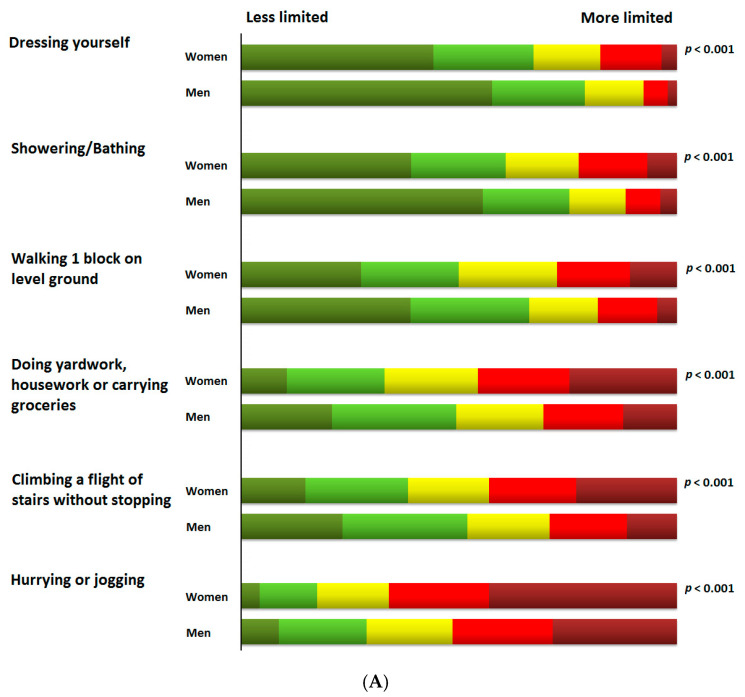
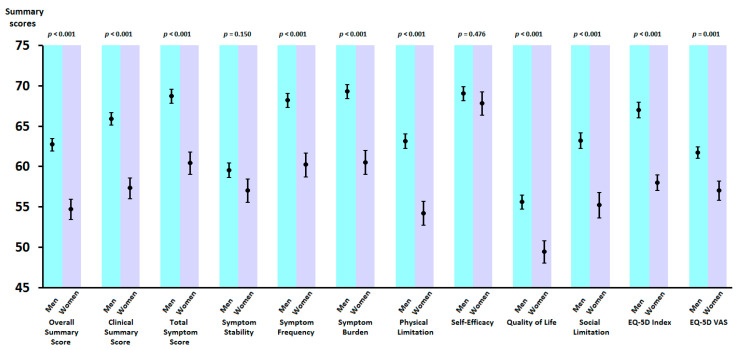
Previous studies have shown that heart failure is associated with worse health-related quality of life (HRQoL). The existence of differences according to gender remains controversial. We studied 1028 consecutive outpatients with heart failure and reduced ejection fraction (HFrEF) from a multicentre cross-sectional descriptive study across Spain that assessed HRQoL using two questionnaires (KCCQ, Kansas City Cardiomyopathy Questionnaire; and EQ-5D, EuroQoL 5 dimensions). The primary objective of the study was to describe differences in HRQoL between men and women in global scores and domains of health status of patients and explore gender differences and its interactions with heart failure related factors. In adjusted analysis women had lower scores in KCCQ overall summary scores when compared to men denoting worse HRQoL (54.7 ± 1.3 vs. 62.7 ± 0.8, < 0.0001), and specifically got lower score in domains of symptom frequency, symptoms burden, physical limitation, quality of life and social limitation. No differences were found in domains of symptom stability and self-efficacy. Women also had lower scores on all items of EQ-5D (EQ-5D index 0.58 ± 0.01 vs. 0.67 ± 0.01, < 0.0001). Finally, we analyzed interaction between gender and different clinical determinants regarding the presence of limitations in the 5Q-5D and overall summary score of KCCQ. Interestingly, there was no statistical significance for interaction for any variable. In conclusion, women with HFrEF have worse HRQoL compared to men. These differences do not appear to be mediated by clinical or biological factors classically associated with HRQoL nor with heart failure severity.
先前的研究表明,心力衰竭与健康相关生活质量(HRQoL)较差有关。根据性别存在差异这一情况仍存在争议。我们对来自西班牙一项多中心横断面描述性研究的1028例连续门诊心力衰竭且射血分数降低(HFrEF)患者进行了研究,该研究使用两份问卷(KCCQ,堪萨斯城心肌病问卷;以及EQ-5D,欧洲五维健康量表)评估HRQoL。本研究的主要目的是描述患者健康状况总体评分和领域中男性与女性在HRQoL方面的差异,并探讨性别差异及其与心力衰竭相关因素的相互作用。在调整分析中,与男性相比,女性在KCCQ总体汇总评分中得分较低,表明HRQoL较差(54.7±1.3对62.7±0.8,<0.0001),并且在症状频率、症状负担、身体限制、生活质量和社会限制等领域得分更低。在症状稳定性和自我效能领域未发现差异。女性在EQ-5D的所有项目上得分也较低(EQ-5D指数0.58±0.01对0.67±0.01,<0.0001)。最后,我们分析了性别与不同临床决定因素之间关于5Q-5D中存在限制和KCCQ总体汇总评分的相互作用。有趣的是,任何变量的相互作用均无统计学意义。总之,与男性相比,HFrEF女性的HRQoL更差。这些差异似乎不是由经典的与HRQoL相关的临床或生物学因素介导的,也不是由心力衰竭严重程度介导的。