Bio-Heart Cardiovascular Diseases Research Group, Bellvitge Biomedical Research Institute (IDIBELL), L'Hospitalet de Llobregat, Barcelona, Spain.
Department of Clinical Sciences, School of Medicine, University of Barcelona, Barcelona, Spain.
ESC Heart Fail. 2023 Apr;10(2):1090-1102. doi: 10.1002/ehf2.14260. Epub 2022 Dec 29.
There is little information about the influence of gender on quality of life (QoL) in heart failure. The purpose of this study was to evaluate whether the health-related QoL gap between men and women can be explained by the interaction between psychosocial factors and clinical determinants in a real-word cohort of patients with chronic heart failure.
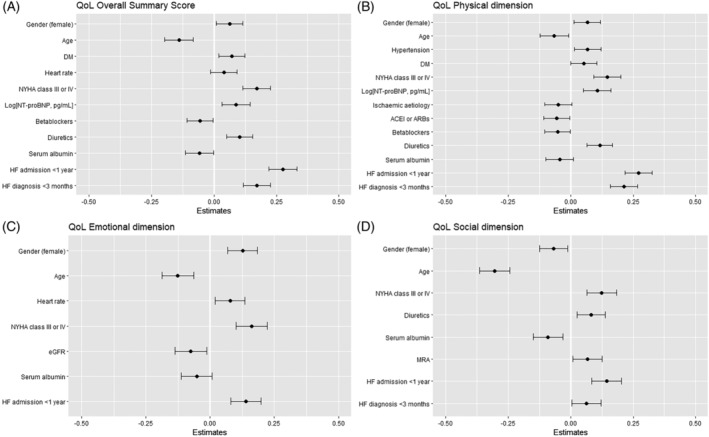
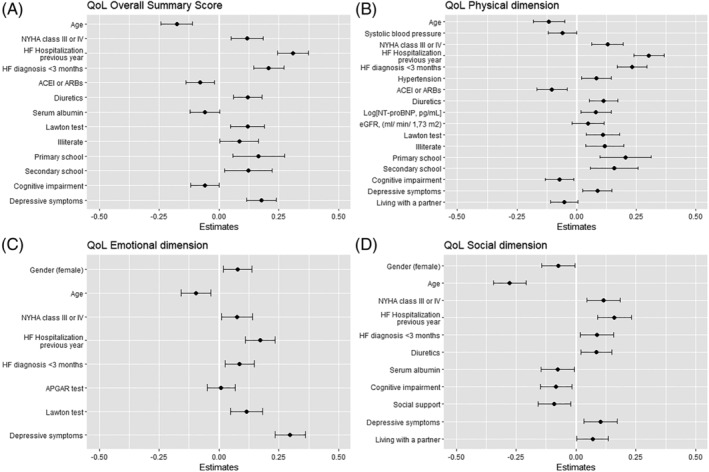
We conducted a single-centre, observational, prospective cohort study of 1236 consecutive patients diagnosed with chronic heart failure recruited between 2004 and 2014. To assess QoL, we used the Minnesota Living with Heart Failure Questionnaire (MLHFQ). Female gender was associated with worse global QoL compared to male gender (MLHFQ overall summary score: 49 ± 23 vs. 43 ± 24; P value <0.001, respectively) and similarly had poorer scores in physical and emotional dimensions but scored better on social dimension. In univariate models and in models adjusted for clinical determinants, female gender behaved as a predictor of worse global, physical and emotional QoL, and better social QoL compared with men. In models only including psychosocial determinants and in comprehensive models including all psychosocial and clinical factors, these differences according to gender were no longer significant.
In this study, we have shown that the gap in health-related QoL between men and women with chronic heart failure can be partially explained by the interaction between biological and psychosocial factors. Biological factors are the main drivers of QoL in HF patients. However, the contribution of psychosocial factors is essential to definitively understand the role of gender in this field.
关于性别对心力衰竭患者生活质量(QoL)的影响,相关信息有限。本研究旨在评估在慢性心力衰竭的真实患者队列中,心理社会因素与临床决定因素之间的相互作用是否可以解释男女之间健康相关 QoL 差距。
我们进行了一项单中心、观察性、前瞻性队列研究,共纳入了 2004 年至 2014 年间连续诊断为慢性心力衰竭的 1236 例患者。为了评估 QoL,我们使用了明尼苏达州心力衰竭生活质量问卷(MLHFQ)。与男性相比,女性的整体 QoL 较差(MLHFQ 总体综合评分:49±23 与 43±24;P 值均<0.001),且在身体和情绪维度上的评分也较差,但在社会维度上的评分较好。在单变量模型和调整了临床决定因素的模型中,与男性相比,女性的性别是整体、身体和情绪 QoL 较差,社会 QoL 较好的预测因素。在仅包括心理社会决定因素的模型和包括所有心理社会和临床因素的综合模型中,这些性别差异不再显著。
在这项研究中,我们表明,慢性心力衰竭男性和女性之间健康相关 QoL 的差距可以部分通过生物和心理社会因素之间的相互作用来解释。生物因素是 HF 患者 QoL 的主要驱动因素。然而,心理社会因素的贡献对于明确理解性别在这一领域的作用至关重要。