Alemayehu Yadeta, Demilew Demeke, Asfaw Getachew, Asfaw Henock, Alemnew Nigus, Tadesse Agitu
Mettu University, Mettu, Ethiopia.
Department of Psychiatry at University of Gondar, Gondar, Ethiopia.
Psychiatry J. 2020 Aug 17;2020:7369542. doi: 10.1155/2020/7369542. eCollection 2020.
Internalized stigma has been found to be widespread among patients with major depressive disorder. When internalized stigma exists in patients with depression at a high level, it worsens the treatment outcome and quality of life. So the aim of the study is to assess the magnitude of internalized stigma and associated factors among outpatients with major depressive disorder at Amanuel Mental Specialized Hospital, Addis Ababa, Ethiopia.
An institutional-based cross-sectional study was conducted among 415 respondents from May 6 to June 13, 2019. Internalized stigma was assessed by using the internalized stigma of mental illness scale. Data was entered to Epi-data version 3.1 and analyzed using SPSS version 20. Bivariable and multivariable binary logistic analysis was done, and values less than 0.05 were considered statistically significant with 95% CI.
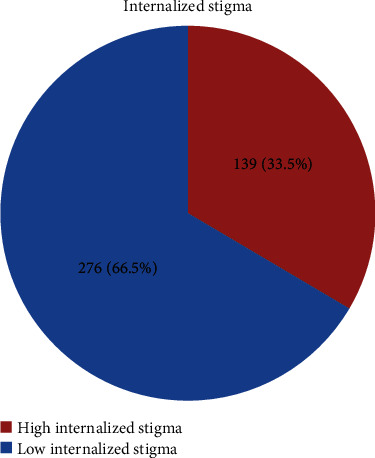
The prevalence of high internalized stigma among patients with major depressive disorder was 33.5% (95% CI: 29.2, 38.3). Being single (AOR = 2.54, 95% CI: 1.30, 4.95), having an illness greater than or equal to 2 years of duration (AOR = 3.21, 95% CI: 1.66, 6.19), history of suicidal attempt (AOR = 2.33, 95% CI: 1.35, 3.99), nonadherence to treatment (AOR = 2.93, 95% CI: 1.62, 5.29), poor social support (AOR = 4.72, 95% CI: 2.09, 10.64), and poor quality of life (AOR = 3.16, 95% CI: 1.82, 5.49) were significantly associated with high internalized stigma at value < 0.05.
The magnitude of internalized stigma was high among patients with major depressive disorder. Reduction of internalized stigma through antistigma campaigns and supports given to patients at the earliest possible time is important to improve treatment outcome and quality of life and minimize suicidal behavior in patients with major depressive disorder.
内化耻辱感在重度抑郁症患者中普遍存在。当抑郁症患者的内化耻辱感程度较高时,会使治疗效果和生活质量恶化。因此,本研究的目的是评估埃塞俄比亚亚的斯亚贝巴阿马努埃尔精神专科医院门诊重度抑郁症患者内化耻辱感的程度及相关因素。
2019年5月6日至6月13日,对415名受访者进行了一项基于机构的横断面研究。使用精神疾病内化耻辱感量表评估内化耻辱感。数据录入Epi - data 3.1版本,并使用SPSS 20版本进行分析。进行了双变量和多变量二元逻辑分析,P值小于0.05被认为具有统计学意义,95%置信区间。
重度抑郁症患者中高内化耻辱感的患病率为33.5%(95%置信区间:29.2, 38.3)。单身(比值比 = 2.54,95%置信区间:1.30, 4.95)、病程大于或等于2年(比值比 = 3.21,95%置信区间:1.66, 6.19)、有自杀未遂史(比值比 = 2.33,95%置信区间:1.35, 3.99)、不坚持治疗(比值比 = 2.93,95%置信区间:1.62, 5.29)、社会支持差(比值比 = 4.72,95%置信区间:2.09, 10.64)和生活质量差(比值比 = 3.16,95%置信区间:1.82, 5.49)与P值<0.05时的高内化耻辱感显著相关。
重度抑郁症患者内化耻辱感程度较高。通过开展反耻辱运动并尽早为患者提供支持来减少内化耻辱感,对于改善重度抑郁症患者的治疗效果和生活质量以及减少自杀行为至关重要。