Department of Biostatistics.
Center for Quantitative Sciences, Vanderbilt University Medical Center, Nashville, TN.
Tomography. 2020 Sep;6(3):301-307. doi: 10.18383/j.tom.2020.00029.
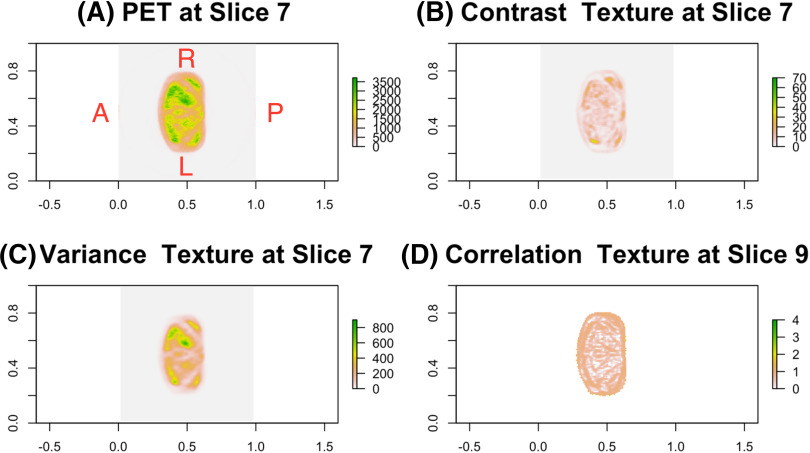
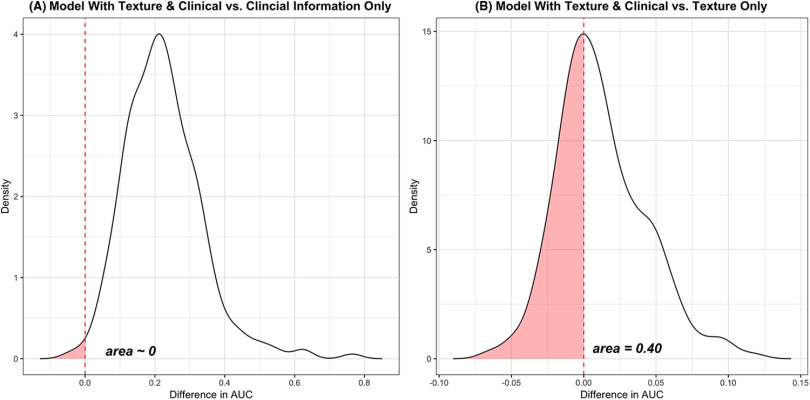
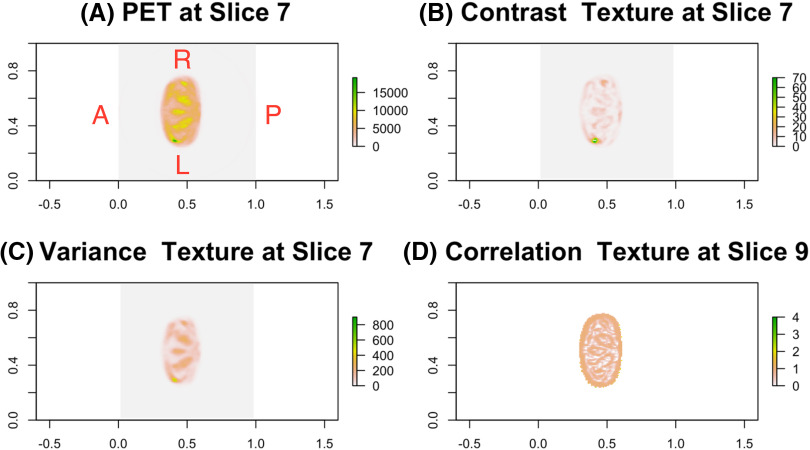
Predicting biochemical recurrence of prostate cancer is imperative for initiating early treatment, which can improve the outcome of cancer treatment. However, because of inter- and intrareader variability in interpretation of F-18 fluciclovine positron emission tomography/computed tomography (PET/CT), it is difficult to reliably discern between necrotic tissue owing to radiation therapy and tumor tissue. Our goal is to develop a computational methodology using Haralick texture analysis that can be used as an adjunct tool to improve and standardize the interpretation of F-18 fluciclovine PET/CT to identify biochemical recurrence of prostate cancer. Four main textural features were chosen by variable selection procedure using least absolute shrinkage and selection operator logistic regression and bootstrapping, and then included as predictors in subsequent logistic ridge regression model for prediction (n = 28). Age at prostatectomy, prostate-specific antigen (PSA) level before the PET/CT imaging, and number of days between the prostate-specific antigen measurement and PET/CT imaging were also included in the prediction model. The overfitting-corrected area under the curve and Brier score of the proposed model were 0.94 (95% CI: 0.81, 1.00) and 0.12 (95% CI: 0.03, 0.23), respectively. Compared with a model with textural features (TI model) and that with only clinical information (CI model), the proposed model achieved 2% and 32% increase in AUC and 8% and 48% reduction in Brier score, respectively. Combining Haralick textural features based on the PET/CT imaging data with clinical information shows a high potential of enhanced prediction of the biochemical recurrence of prostate cancer.
预测前列腺癌的生化复发对于启动早期治疗至关重要,这可以改善癌症治疗的结果。然而,由于 F-18 氟氯维西正电子发射断层扫描/计算机断层扫描(PET/CT)的解读存在读者间和读者内的变异性,因此很难可靠地区分因放射治疗而导致的坏死组织和肿瘤组织。我们的目标是开发一种使用 Haralick 纹理分析的计算方法,该方法可用作辅助工具,以改善和标准化 F-18 氟氯维西 PET/CT 的解读,从而识别前列腺癌的生化复发。通过最小绝对收缩和选择算子逻辑回归和引导选择程序选择了四个主要的纹理特征,并将其作为预测因子包含在随后的逻辑岭回归模型中(n=28)。前列腺切除术时的年龄、PET/CT 成像前的前列腺特异性抗原(PSA)水平以及 PSA 测量与 PET/CT 成像之间的天数也被纳入预测模型。该模型的校正过的曲线下面积和 Brier 评分分别为 0.94(95%置信区间:0.81,1.00)和 0.12(95%置信区间:0.03,0.23)。与仅具有纹理特征的模型(TI 模型)和仅具有临床信息的模型(CI 模型)相比,该模型的 AUC 分别提高了 2%和 32%,Brier 评分分别降低了 8%和 48%。基于 PET/CT 成像数据的 Haralick 纹理特征与临床信息相结合,显示出增强预测前列腺癌生化复发的巨大潜力。