Division of Nuclear Medicine and Molecular Imaging, Geneva University Hospital, CH-1211, Geneva, Switzerland.
Department of Radiology Technology, Shahid Beheshti University of Medical, Tehran, Iran.
Eur Radiol. 2021 Mar;31(3):1420-1431. doi: 10.1007/s00330-020-07225-6. Epub 2020 Sep 3.
The current study aimed to design an ultra-low-dose CT examination protocol using a deep learning approach suitable for clinical diagnosis of COVID-19 patients.
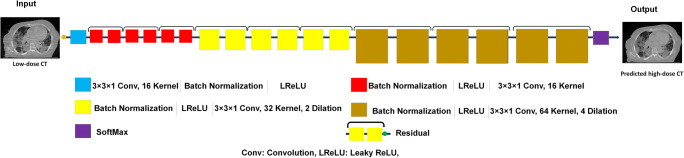
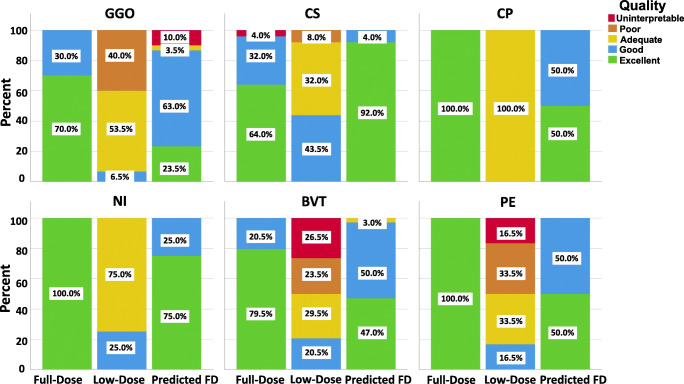
In this study, 800, 170, and 171 pairs of ultra-low-dose and full-dose CT images were used as input/output as training, test, and external validation set, respectively, to implement the full-dose prediction technique. A residual convolutional neural network was applied to generate full-dose from ultra-low-dose CT images. The quality of predicted CT images was assessed using root mean square error (RMSE), structural similarity index (SSIM), and peak signal-to-noise ratio (PSNR). Scores ranging from 1 to 5 were assigned reflecting subjective assessment of image quality and related COVID-19 features, including ground glass opacities (GGO), crazy paving (CP), consolidation (CS), nodular infiltrates (NI), bronchovascular thickening (BVT), and pleural effusion (PE).
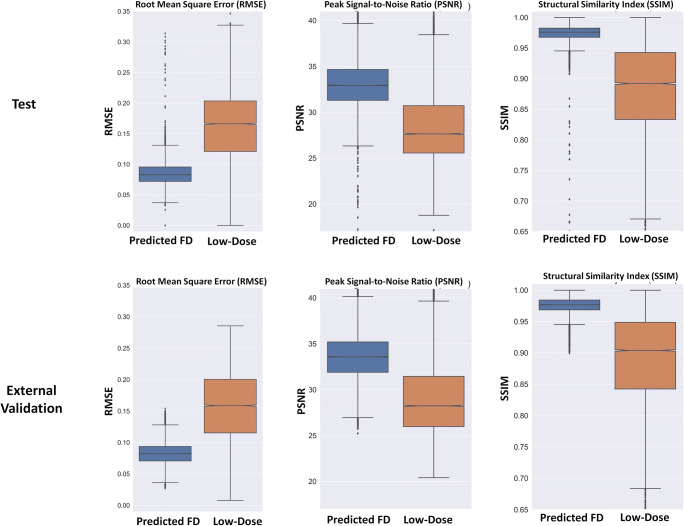
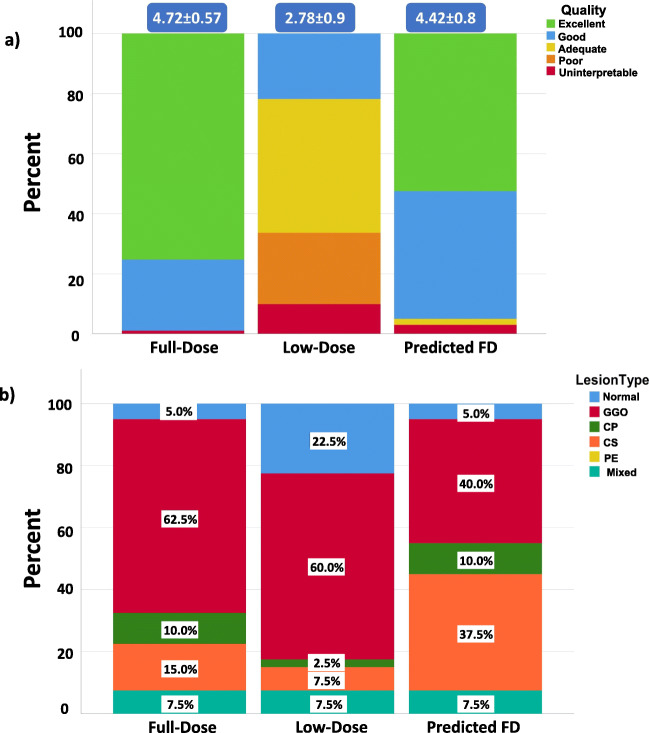
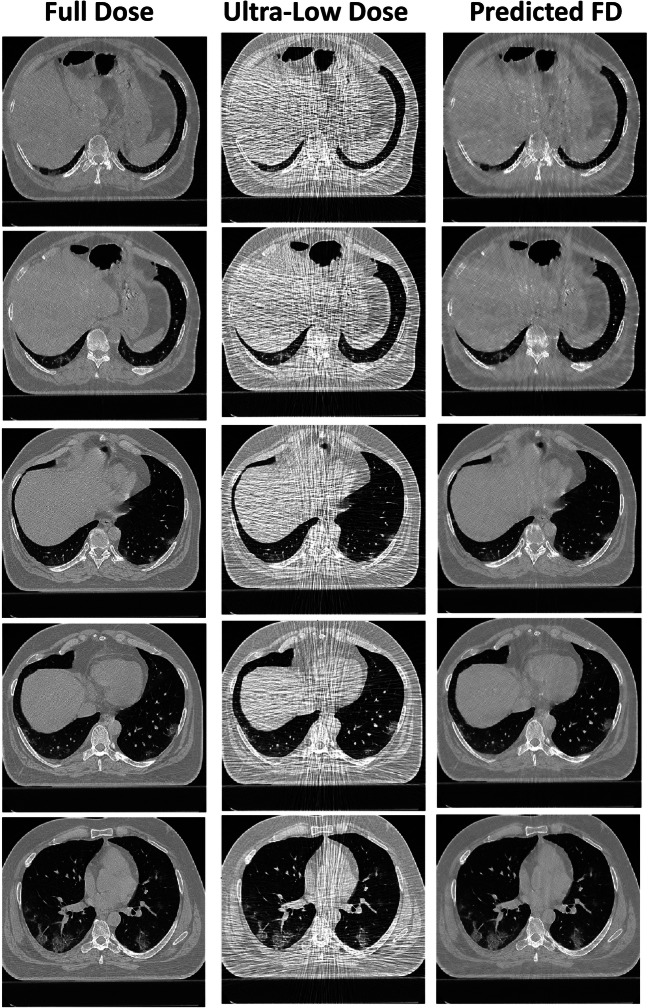
The radiation dose in terms of CT dose index (CTDI) was reduced by up to 89%. The RMSE decreased from 0.16 ± 0.05 to 0.09 ± 0.02 and from 0.16 ± 0.06 to 0.08 ± 0.02 for the predicted compared with ultra-low-dose CT images in the test and external validation set, respectively. The overall scoring assigned by radiologists showed an acceptance rate of 4.72 ± 0.57 out of 5 for reference full-dose CT images, while ultra-low-dose CT images rated 2.78 ± 0.9. The predicted CT images using the deep learning algorithm achieved a score of 4.42 ± 0.8.
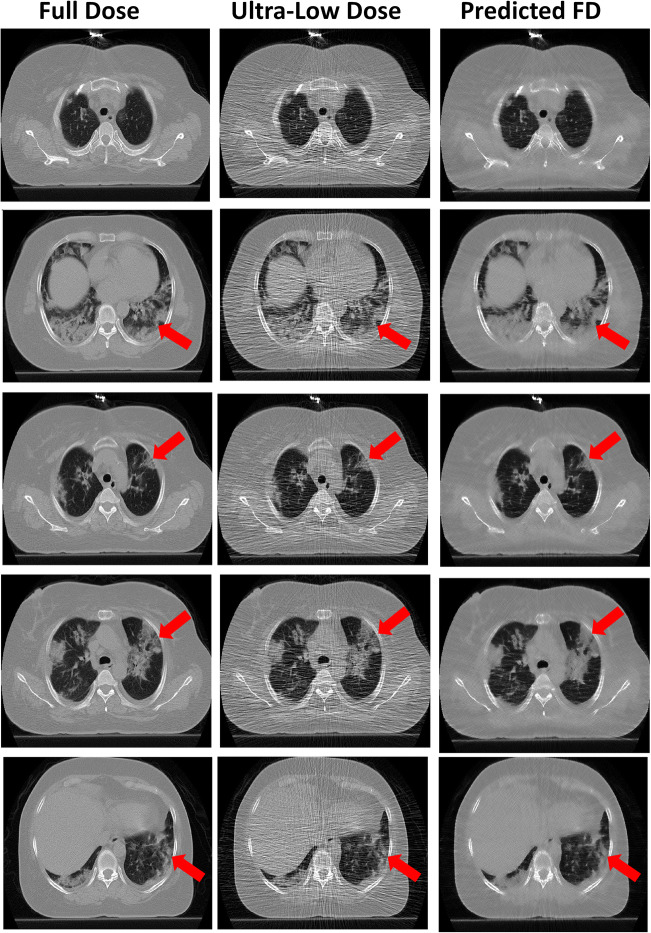
The results demonstrated that the deep learning algorithm is capable of predicting standard full-dose CT images with acceptable quality for the clinical diagnosis of COVID-19 positive patients with substantial radiation dose reduction.
• Ultra-low-dose CT imaging of COVID-19 patients would result in the loss of critical information about lesion types, which could potentially affect clinical diagnosis. • Deep learning-based prediction of full-dose from ultra-low-dose CT images for the diagnosis of COVID-19 could reduce the radiation dose by up to 89%. • Deep learning algorithms failed to recover the correct lesion structure/density for a number of patients considered outliers, and as such, further research and development is warranted to address these limitations.
本研究旨在使用深度学习方法设计一种适用于 COVID-19 患者临床诊断的超低剂量 CT 检查方案。
本研究使用 800、170 和 171 对超低剂量和全剂量 CT 图像作为输入/输出,分别进行训练、测试和外部验证集,以实现全剂量预测技术。应用残差卷积神经网络从超低剂量 CT 图像生成全剂量图像。使用均方根误差(RMSE)、结构相似性指数(SSIM)和峰值信噪比(PSNR)评估预测 CT 图像的质量。使用 1 到 5 的分数来反映图像质量和相关 COVID-19 特征的主观评估,包括磨玻璃密度(GGO)、铺路石征(CP)、实变(CS)、结节性浸润(NI)、支气管血管增厚(BVT)和胸腔积液(PE)。
以 CT 剂量指数(CTDI)表示的辐射剂量降低了 89%。与测试和外部验证集的超低剂量 CT 图像相比,预测图像的 RMSE 分别从 0.16±0.05 降至 0.09±0.02 和从 0.16±0.06 降至 0.08±0.02。放射科医生的整体评分显示,参考全剂量 CT 图像的接受率为 4.72±0.57,而超低剂量 CT 图像为 2.78±0.9。使用深度学习算法预测的 CT 图像得分为 4.42±0.8。
结果表明,深度学习算法能够以可接受的质量预测标准全剂量 CT 图像,为 COVID-19 阳性患者的临床诊断提供帮助,同时大幅降低辐射剂量。
• COVID-19 患者的超低剂量 CT 成像会导致病变类型的关键信息丢失,这可能会影响临床诊断。
• 基于深度学习的 COVID-19 全剂量 CT 图像预测可将辐射剂量降低 89%。
• 深度学习算法未能恢复一些被认为是异常值的患者的正确病变结构/密度,因此需要进一步研究和开发来解决这些限制。