Servicio Regional de Investigación y Desarrollo Agroalimentario (SERIDA), Deva Gijón, Asturias, Spain.
Animal Health Department, NEIKER-Instituto Vasco de Investigación y Desarrollo Agrario, Derio, Bizkaia, Spain.
PLoS One. 2020 Sep 3;15(9):e0236336. doi: 10.1371/journal.pone.0236336. eCollection 2020.
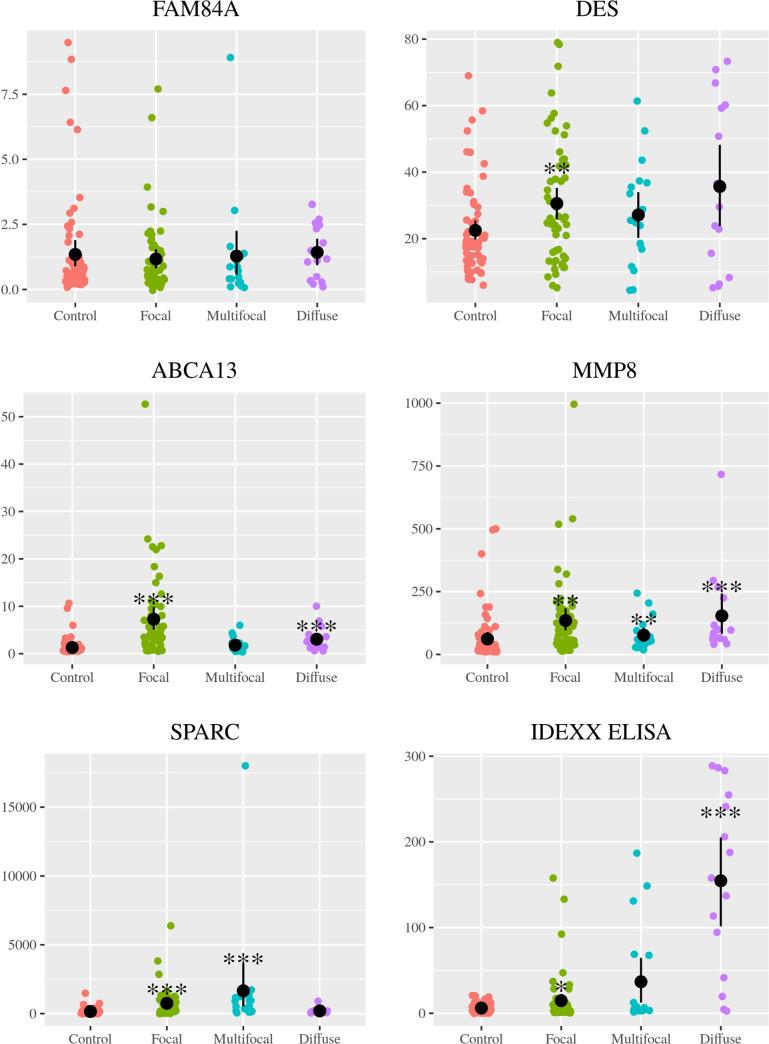
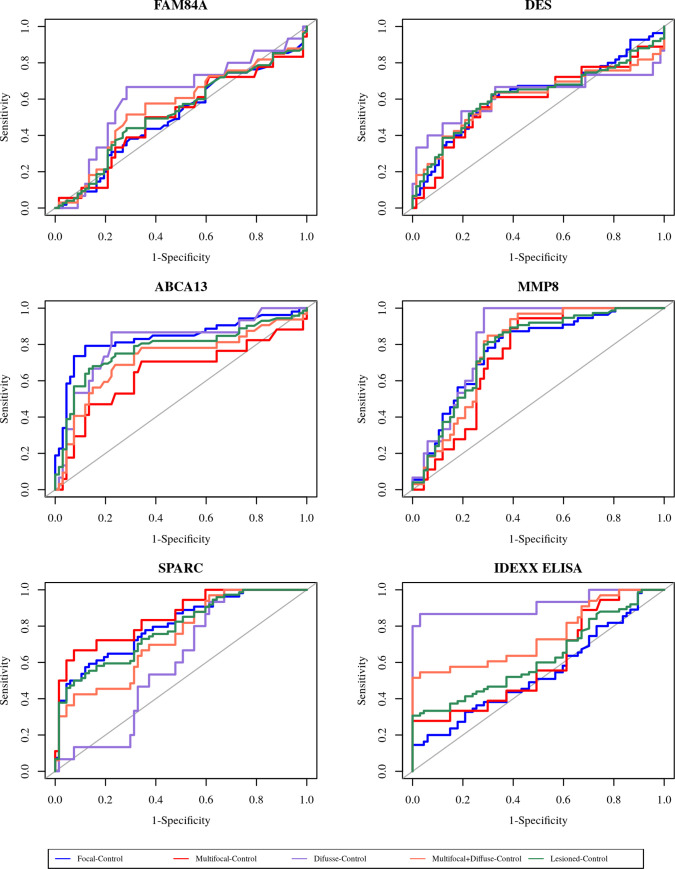
Bovine paratuberculosis (PTB) is a chronic granulomatous enteritis, caused by Mycobacterium avium subsp. paratuberculosis (MAP), responsible for important economic losses in the dairy industry. Current diagnostic methods have low sensitivities for detection of latent forms of MAP infection, defined by focal granulomatous lesions and scarce humoral response or MAP presence. In contrast, patent infections correspond to multifocal and diffuse types of enteritis where there is increased antibody production, and substantial mycobacterial load. Our previous RNA-Seq analysis allowed the selection of five candidate biomarkers overexpressed in peripheral blood of MAP infected Holstein cows with focal (ABCA13 and MMP8) and diffuse (FAM84A, SPARC and DES) lesions vs. control animals with no detectable PTB-associated lesions in intestine and regional lymph nodes. The aim of the current study was to assess the PTB diagnostic potential of commercial ELISAs designed for the specific detection of these biomarkers. The ability of these ELISAs to identify animals with latent and/or patent forms of MAP infection was investigated using serum from naturally infected cattle (n = 88) and non-infected control animals (n = 67). ROC analysis revealed that the ABCA13-based ELISA showed the highest diagnostic accuracy for the detection of infected animals with focal lesions (AUC 0.837, sensitivity 79.25% and specificity 88.06%) and with any type of histological lesion (AUC 0.793, sensitivity 69.41% and specificity 86.57%) improving on the diagnostic performance of the popular IDEXX ELISA and other conventional diagnostic methods. SPARC and MMP8 showed the highest diagnostic accuracy for the detection of animals with multifocal (AUC 0.852) and diffuse lesions (AUC 0.831), respectively. In conclusion, our results suggest that quantification of ABCA13, SPARC and MMP8 by ELISA has the potential for implementation as a diagnostic tool to reliably identify MAP infection, greatly improving early detection of MAP latent infections when antibody responses and fecal shedding are undetectable using conventional diagnostic methods.
牛副结核病(PTB)是一种由鸟分枝杆菌副结核亚种(MAP)引起的慢性肉芽肿性肠炎,给奶牛养殖业造成了重大经济损失。目前的诊断方法对潜伏性 MAP 感染的检测灵敏度较低,这种感染的特征是局灶性肉芽肿病变和很少的体液反应或 MAP 存在。相比之下,显性感染对应于多灶性和弥漫性肠炎,在这种肠炎中抗体产生增加,并且存在大量的分枝杆菌负荷。我们之前的 RNA-Seq 分析选择了五个在局灶性(ABCA13 和 MMP8)和弥漫性(FAM84A、SPARC 和 DES)病变的 MAP 感染荷斯坦奶牛的外周血中过度表达的候选生物标志物,并与在肠道和区域淋巴结中没有检测到与 PTB 相关病变的对照动物进行比较。本研究的目的是评估针对这些生物标志物特异性检测而设计的商业 ELISA 在诊断 PTB 方面的潜力。使用来自自然感染牛(n=88)和非感染对照动物(n=67)的血清,研究了这些 ELISA 识别潜伏和/或显性 MAP 感染动物的能力。ROC 分析显示,基于 ABCA13 的 ELISA 对检测局灶性病变的感染动物具有最高的诊断准确性(AUC 0.837,敏感性 79.25%,特异性 88.06%)和任何类型的组织学病变(AUC 0.793,敏感性 69.41%,特异性 86.57%),优于流行的 IDEXX ELISA 和其他常规诊断方法的诊断性能。SPARC 和 MMP8 对检测多灶性(AUC 0.852)和弥漫性病变(AUC 0.831)动物的诊断准确性最高。总之,我们的结果表明,ELISA 定量检测 ABCA13、SPARC 和 MMP8 具有作为诊断工具的潜力,可可靠地识别 MAP 感染,当使用常规诊断方法无法检测到抗体反应和粪便脱落时,极大地提高了 MAP 潜伏感染的早期检测。