• 文献检索
  • 文档翻译
  • 深度研究
  • 学术资讯
  • Suppr Zotero 插件Zotero 插件
  • 邀请有礼
  • 套餐&价格
  • 历史记录
应用&插件
Suppr Zotero 插件Zotero 插件浏览器插件Mac 客户端Windows 客户端微信小程序
定价
高级版会员购买积分包购买API积分包
服务
文献检索文档翻译深度研究API 文档MCP 服务
关于我们
关于 Suppr公司介绍联系我们用户协议隐私条款
关注我们

Suppr 超能文献

核心技术专利:CN118964589B侵权必究
粤ICP备2023148730 号-1Suppr @ 2026

文献检索

告别复杂PubMed语法,用中文像聊天一样搜索,搜遍4000万医学文献。AI智能推荐,让科研检索更轻松。

立即免费搜索

文件翻译

保留排版,准确专业,支持PDF/Word/PPT等文件格式,支持 12+语言互译。

免费翻译文档

深度研究

AI帮你快速写综述,25分钟生成高质量综述,智能提取关键信息,辅助科研写作。

立即免费体验

迈向精准公共卫生:用于为肝癌预防提供信息的地理空间分析及敏感性/特异性评估

Towards precision public health: Geospatial analytics and sensitivity/specificity assessments to inform liver cancer prevention.

作者信息

Lynch Shannon M, Wiese Daniel, Ortiz Angel, Sorice Kristen A, Nguyen Minhhuyen, González Evelyn T, Henry Kevin A

机构信息

Cancer Prevention and Control, Fox Chase Cancer Center, Philadelphia, PA, USA.

Geography and Urban Studies, Temple University, Philadelphia, PA, USA.

出版信息

SSM Popul Health. 2020 Aug 7;12:100640. doi: 10.1016/j.ssmph.2020.100640. eCollection 2020 Dec.

DOI:10.1016/j.ssmph.2020.100640
PMID:32885020
原文链接:https://pmc.ncbi.nlm.nih.gov/articles/PMC7451830/
Abstract

OBJECTIVES

Liver cancer (LC) continues to rise, partially due to limited resources for prevention. To test the precision public health (PPH) hypothesis that fewer areas in need of LC prevention could be identified by combining existing surveillance data, we compared the sensitivity/specificity of standard recommendations to target geographic areas using U.S. Census demographic data only (percent (%) Hispanic, Black, and those born 1950-1959) to an alternative approach that couples additional geospatial data, including neighborhood socioeconomic status (nSES), with LC disease statistics.

METHODS

Pennsylvania Cancer Registry data from 2007-2014 were linked to 2010 U.S. Census data at the Census tract (CT) level. CTs in the top 80th percentile for 3 standard demographic variables, %Hispanic, %Black, %born 1950-1959, were identified. Spatial scan statistics (SatScan) identified CTs with significantly elevated incident LC rates (p-value<0.05), adjusting for age, gender, diagnosis year. Sensitivity, specificity, and positive predictive value (PPV) of a CT being located in an elevated risk cluster and/or testing positive/negative for at least one standard variable were calculated. nSES variables (deprivation, stability, segregation) significantly associated with LC in regression models (p < 0.05) were systematically evaluated for improvements in sensitivity/specificity.

RESULTS

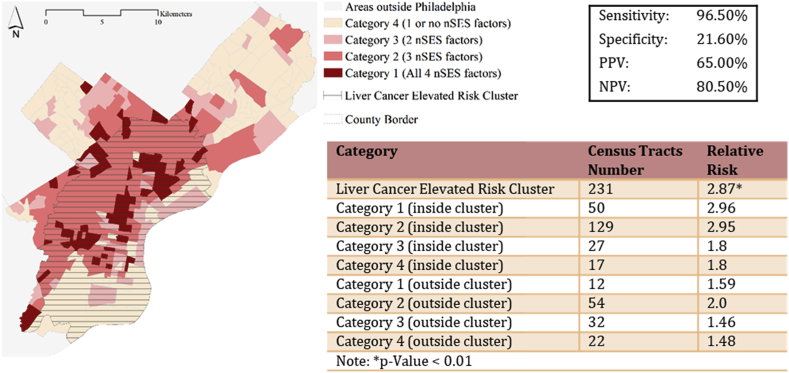
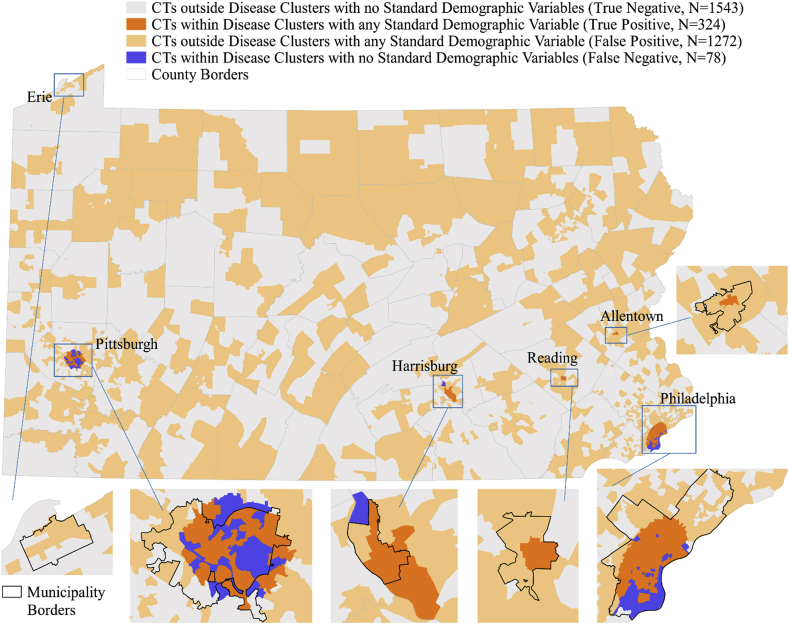
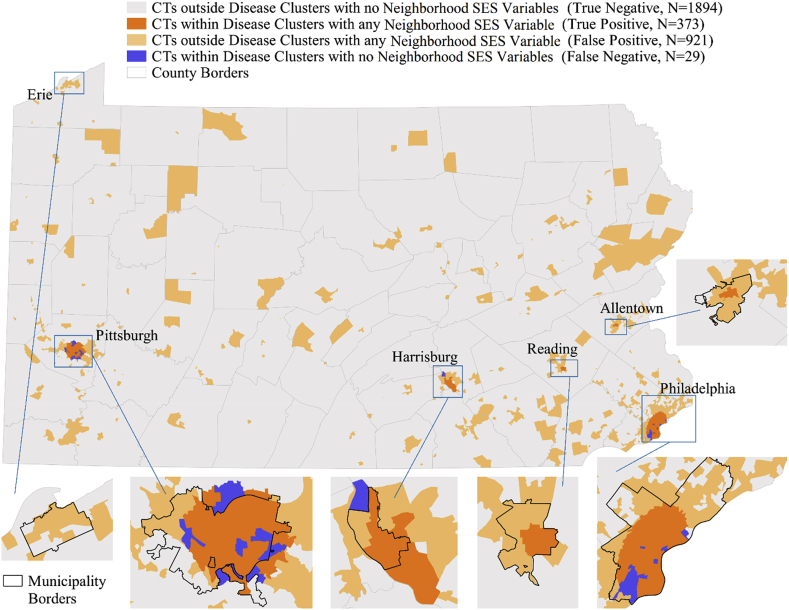
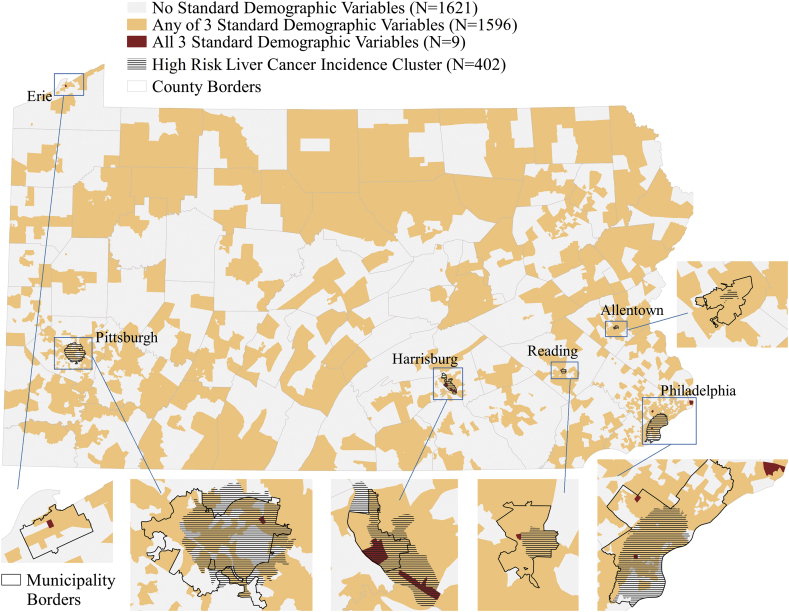
9,460 LC cases were diagnosed across 3,217 CTs. 1,596 CTs were positive for at least one of 3 standard variables. 5 significant elevated risk clusters (CTs = 402) were identified. 324 CTs were positive for a high risk cluster AND standard variable (sensitivity = 92%; specificity = 37%; PPV = 17.4%). Incorporation of 3 new nSES variables with one standard variable (%Black) further improved sensitivity (93%), specificity (62.9%), and PPV (26.3%).

CONCLUSIONS

We introduce a quantitative assessment of PPH by applying established sensitivity/specificity assessments to geospatial data. Coupling existing disease cluster and nSES data can more precisely identify intervention targets with a liver cancer burden than standard demographic variables. Thus, this approach may inform prioritization of limited resources for liver cancer prevention.

摘要

目的

肝癌(LC)的发病率持续上升,部分原因是预防资源有限。为了验证精准公共卫生(PPH)假说,即通过整合现有监测数据能够识别出更少的需要进行肝癌预防的地区,我们比较了仅使用美国人口普查人口统计数据(西班牙裔、黑人以及1950 - 1959年出生人口的百分比)来确定肝癌预防目标地理区域的标准建议的敏感性/特异性,与一种将包括邻里社会经济地位(nSES)在内的额外地理空间数据与肝癌疾病统计数据相结合的替代方法的敏感性/特异性。

方法

将2007 - 2014年宾夕法尼亚癌症登记处的数据与2010年美国人口普查数据在普查区(CT)层面进行关联。确定了在3个标准人口统计变量(西班牙裔百分比、黑人百分比、1950 - 1959年出生人口百分比)处于第80百分位以上的普查区。空间扫描统计(SatScan)识别出肝癌发病率显著升高的普查区(p值<0.05),并对年龄、性别、诊断年份进行了调整。计算了普查区位于高风险集群中和/或至少一个标准变量检测呈阳性/阴性的敏感性、特异性和阳性预测值(PPV)。对回归模型中与肝癌显著相关(p < 0.05)的nSES变量(贫困、稳定性、隔离)进行系统评估,以确定其对敏感性/特异性的改善情况。

结果

在3217个普查区共诊断出9460例肝癌病例。1596个普查区至少有一个标准变量呈阳性。识别出5个显著的高风险集群(普查区 = 402)。324个普查区高风险集群和标准变量均呈阳性(敏感性 = 92%;特异性 = 37%;PPV = 17.4%)。将3个新的nSES变量与一个标准变量(黑人百分比)相结合,进一步提高了敏感性(93%)、特异性(62.9%)和PPV(26.3%)。

结论

我们通过将既定的敏感性/特异性评估应用于地理空间数据,对精准公共卫生进行了定量评估。与标准人口统计变量相比,将现有疾病集群数据和nSES数据相结合能够更精准地识别出承担肝癌负担的干预目标。因此,这种方法可为肝癌预防有限资源的优先排序提供参考。
https://cdn.ncbi.nlm.nih.gov/pmc/blobs/619f/7451830/aea4870cb151/gr4.jpg
https://cdn.ncbi.nlm.nih.gov/pmc/blobs/619f/7451830/24957be05282/gr1.jpg
https://cdn.ncbi.nlm.nih.gov/pmc/blobs/619f/7451830/7586aa8a31c2/gr2.jpg
https://cdn.ncbi.nlm.nih.gov/pmc/blobs/619f/7451830/7073fc27c02d/gr3.jpg
https://cdn.ncbi.nlm.nih.gov/pmc/blobs/619f/7451830/aea4870cb151/gr4.jpg
https://cdn.ncbi.nlm.nih.gov/pmc/blobs/619f/7451830/24957be05282/gr1.jpg
https://cdn.ncbi.nlm.nih.gov/pmc/blobs/619f/7451830/7586aa8a31c2/gr2.jpg
https://cdn.ncbi.nlm.nih.gov/pmc/blobs/619f/7451830/7073fc27c02d/gr3.jpg
https://cdn.ncbi.nlm.nih.gov/pmc/blobs/619f/7451830/aea4870cb151/gr4.jpg

相似文献

1
Towards precision public health: Geospatial analytics and sensitivity/specificity assessments to inform liver cancer prevention.迈向精准公共卫生:用于为肝癌预防提供信息的地理空间分析及敏感性/特异性评估
SSM Popul Health. 2020 Aug 7;12:100640. doi: 10.1016/j.ssmph.2020.100640. eCollection 2020 Dec.
2
Liver Cancer Incidence and Area-Level Geographic Disparities in Pennsylvania-A Geo-Additive Approach.宾夕法尼亚州的肝癌发病率和地区层面的地理差异——一种地理加性方法。
Int J Environ Res Public Health. 2020 Oct 16;17(20):7526. doi: 10.3390/ijerph17207526.
3
Geovisual analytics to enhance spatial scan statistic interpretation: an analysis of U.S. cervical cancer mortality.用于增强空间扫描统计解释的地理可视化分析:美国宫颈癌死亡率分析
Int J Health Geogr. 2008 Nov 7;7:57. doi: 10.1186/1476-072X-7-57.
4
Investigating disparities: the effect of social environment on pancreatic cancer survival in metastatic patients.调查差异:社会环境对转移性胰腺癌患者生存的影响
J Gastrointest Oncol. 2020 Aug;11(4):633-643. doi: 10.21037/jgo-20-39.
5
The Association Between Neighborhood Environment and Mortality: Results from a National Study of Veterans.邻里环境与死亡率之间的关联:一项退伍军人全国性研究的结果
J Gen Intern Med. 2017 Apr;32(4):416-422. doi: 10.1007/s11606-016-3905-x. Epub 2016 Nov 4.
6
Identifying priority populations for lung cancer screening intervention using neighborhood-level factors and cancer registry data.利用邻里层面因素和癌症登记数据确定肺癌筛查干预的优先人群。
Prev Oncol Epidemiol. 2024;2(1). doi: 10.1080/28322134.2024.2398014. Epub 2024 Sep 11.
7
Geo-epidemiologic and molecular characterization to identify social, cultural, and economic factors where targeted tuberculosis control activities can reduce incidence in Maryland, 2004-2010.2004-2010 年马里兰州基于地理流行病学和分子特征分析确定目标结核病控制活动可降低发病率的社会、文化和经济因素。
Public Health Rep. 2013 Nov;128 Suppl 3(Suppl 3):104-14. doi: 10.1177/00333549131286S314.
8
9
Race/ethnicity, neighborhood socioeconomic status and cardio-metabolic risk.种族/民族、邻里社会经济地位与心血管代谢风险。
SSM Popul Health. 2020 Jul 23;11:100634. doi: 10.1016/j.ssmph.2020.100634. eCollection 2020 Aug.
10
Neighborhood context and non-small cell lung cancer outcomes in Florida non-elderly patients by race/ethnicity.佛罗里达州非老年患者按种族/族裔划分的邻里环境与非小细胞肺癌结局。
Lung Cancer. 2020 Apr;142:20-27. doi: 10.1016/j.lungcan.2020.01.012. Epub 2020 Jan 16.

引用本文的文献

1
Neighborhood Factors Related to Cancer Screening in Texas: A Spatioecological Study.德克萨斯州与癌症筛查相关的邻里因素:一项空间生态学研究。
Am J Prev Med. 2025 Apr;68(4):695-706. doi: 10.1016/j.amepre.2024.12.012. Epub 2024 Dec 24.
2
Data-driven insights into neighborhood adherence to cancer prevention guidelines in Philadelphia.数据驱动的费城社区癌症预防指南遵循情况洞察。
PLoS One. 2024 Nov 20;19(11):e0313334. doi: 10.1371/journal.pone.0313334. eCollection 2024.
3
Reducing Breast Cancer Disparities with Precision Public Health: A New Strategy to Improve Prevention and Advance Health Equity in Delaware Hotspots.

本文引用的文献

1
The Impact of Neighborhood Economic and Racial Inequalities on the Spatial Variation of Breast Cancer Survival in New Jersey.新泽西州邻里经济和种族不平等对乳腺癌生存空间变化的影响。
Cancer Epidemiol Biomarkers Prev. 2019 Dec;28(12):1958-1967. doi: 10.1158/1055-9965.EPI-19-0416. Epub 2019 Oct 24.
2
GIScience and cancer: State of the art and trends for cancer surveillance and epidemiology.地理信息科学与癌症:癌症监测和流行病学的现状与趋势。
Cancer. 2019 Aug 1;125(15):2544-2560. doi: 10.1002/cncr.32052. Epub 2019 May 30.
3
Population Health Assessment in NCI-Designated Cancer Center Catchment Areas.
通过精准公共卫生减少乳腺癌差异:改善特拉华热点地区预防工作并促进健康公平的新策略。
Dela J Public Health. 2024 Aug 28;10(3):46-50. doi: 10.32481/djph.2024.08.11. eCollection 2024 Aug.
4
A Novel Approach for Conducting a Catchment Area Analysis of Breast Cancer by Age and Stage for a Community Cancer Center.一种用于社区癌症中心的基于年龄和阶段的乳腺癌集水区分析的新方法。
Cancer Epidemiol Biomarkers Prev. 2024 May 1;33(5):646-653. doi: 10.1158/1055-9965.EPI-23-1125.
5
Effect of neighborhood and individual-level socioeconomic factors on breast cancer screening adherence in a multi-ethnic study.社区和个体社会经济因素对多民族研究中乳腺癌筛查依从性的影响。
BMC Public Health. 2024 Jan 2;24(1):63. doi: 10.1186/s12889-023-17252-9.
6
Feasibility of visualizing cancer incidence data at sub-county level: Findings from 21 National Program of Cancer Registries.以县级为单位可视化癌症发病数据的可行性:来自 21 个全国癌症登记项目的结果。
Spat Spatiotemporal Epidemiol. 2023 Jun;45:100564. doi: 10.1016/j.sste.2023.100564. Epub 2023 Jan 14.
7
Data Science and Precision Oncology Nursing: Creating an Analytic Ecosystem to Support Personalized Supportive Care across the Trajectory of Illness.数据科学与精准肿瘤护理学:构建分析生态系统,在疾病全程提供个性化支持性照护。
Semin Oncol Nurs. 2023 Jun;39(3):151432. doi: 10.1016/j.soncn.2023.151432. Epub 2023 May 5.
8
Actionable Solutions to Achieve Health Equity in Chronic Liver Disease.实现慢性肝脏疾病健康公平的可行解决方案。
Clin Gastroenterol Hepatol. 2023 Jul;21(8):1992-2000. doi: 10.1016/j.cgh.2023.03.043. Epub 2023 Apr 13.
9
Tools to Measure the Impact of Structural Racism and Discrimination on Gastrointestinal and Hepatology Disease Outcomes: A Scoping Review.衡量结构性种族主义和歧视对胃肠道和肝病结果影响的工具:范围综述。
Clin Gastroenterol Hepatol. 2023 Oct;21(11):2759-2788.e6. doi: 10.1016/j.cgh.2022.12.002. Epub 2022 Dec 20.
10
The Geographic Context of Racial Disparities in Aggressive Endometrial Cancer Subtypes: Integrating Social and Environmental Aspects to Discern Biological Outcomes.种族差异在侵袭性子宫内膜癌亚型中的地理背景:整合社会和环境方面以辨别生物学结果。
Int J Environ Res Public Health. 2022 Jul 15;19(14):8613. doi: 10.3390/ijerph19148613.
国家癌症研究所指定癌症中心集水区的人口健康评估。
Cancer Epidemiol Biomarkers Prev. 2019 Mar;28(3):428-430. doi: 10.1158/1055-9965.EPI-18-0811. Epub 2019 Jan 15.
4
Using Gini coefficient to determining optimal cluster reporting sizes for spatial scan statistics.使用基尼系数确定空间扫描统计的最佳聚类报告规模。
Int J Health Geogr. 2016 Aug 3;15(1):27. doi: 10.1186/s12942-016-0056-6.
5
Improved survival of patients with hepatocellular carcinoma and disparities by age, race, and socioeconomic status by decade, 1983-2012.1983 - 2012年期间,肝细胞癌患者生存率的提高以及按年龄、种族和社会经济地位划分的十年间差异情况。
Oncotarget. 2016 Sep 13;7(37):59820-59833. doi: 10.18632/oncotarget.10930.
6
Future of Hepatocellular Carcinoma Incidence in the United States Forecast Through 2030.美国肝细胞癌发病率至2030年的预测前景
J Clin Oncol. 2016 May 20;34(15):1787-94. doi: 10.1200/JCO.2015.64.7412. Epub 2016 Apr 4.
7
Population attributable fractions of risk factors for hepatocellular carcinoma in the United States.美国肝细胞癌风险因素的人群归因分数
Cancer. 2016 Jun 1;122(11):1757-65. doi: 10.1002/cncr.29971. Epub 2016 Mar 21.
8
Annual Report to the Nation on the Status of Cancer, 1975-2012, featuring the increasing incidence of liver cancer.《1975 - 2012年美国癌症现状年度报告》,重点关注肝癌发病率上升情况
Cancer. 2016 May 1;122(9):1312-37. doi: 10.1002/cncr.29936. Epub 2016 Mar 9.
9
Public Health Monitoring of Privilege and Deprivation With the Index of Concentration at the Extremes.运用极端值集中指数对特权与剥夺进行公共卫生监测。
Am J Public Health. 2016 Feb;106(2):256-63. doi: 10.2105/AJPH.2015.302955. Epub 2015 Dec 21.
10
The impact of neighborhood social and built environment factors across the cancer continuum: Current research, methodological considerations, and future directions.邻里社会和建筑环境因素对癌症全程的影响:当前研究、方法学考量及未来方向。
Cancer. 2015 Jul 15;121(14):2314-30. doi: 10.1002/cncr.29345. Epub 2015 Apr 6.