Gómez-Álvarez Enrique, Verdejo Juan, Ocampo Salvador, Ponte-Negretti Carlos I, Ruíz Emilio, Ríos Marco Martínez
Servicio de Cardiología del Centro Médico Nacional 20 de Noviembre, Instituto de Seguridad y Servicios Sociales de los Trabajadores del Estado, Ciudad de México, Mexico.
Departamento de Cardiología, Instituto Nacional de Cardiología Ignacio Chávez, Ciudad de México, Mexico.
Int J Cardiol Heart Vasc. 2020 Jun 3;29:100545. doi: 10.1016/j.ijcha.2020.100545. eCollection 2020 Aug.
In many patients, the risk of cardiovascular (CV) events persists despite statin treatment and attaining target LDL-c levels. This residual risk is in part attributed to atherogenic dyslipidemia (AD). We studied the clinical effectiveness of the CNIC-polypill in improving the lipid profile, and lipid ratios and indices indicative of AD that are more accurate in predicting lipid-related CV risk.
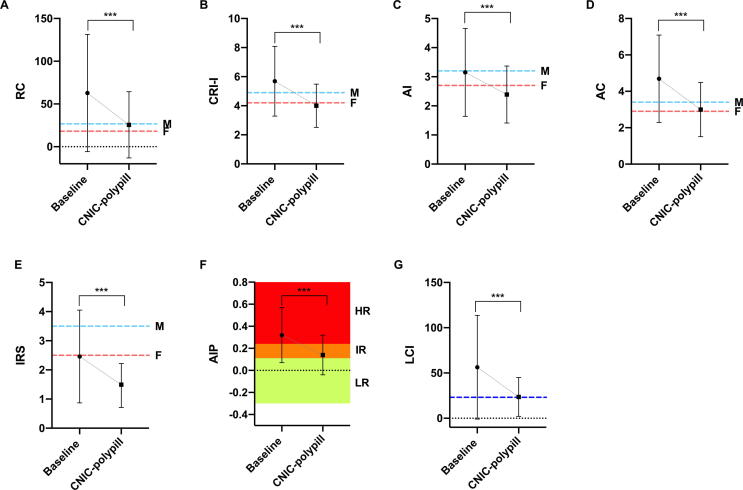
Post-hoc analysis of a multicenter, observational, non-comparative, prospective registry in 533 patients in Mexico. We evaluated blood lipids at baseline (usual care) and after 12 months of treatment with the CNIC-polypill (Sincronium®), including total cholesterol (TC), triglycerides (TG), cholesterol low-density lipoproteins (LDL-c), cholesterol high-density lipoproteins (HDL-c), and cholesterol non-high-density lipoproteins (non-HDL-c). We also calculated and compared AD-related lipid ratios and indices, including remnant cholesterol (RC), Castelli's risk index-I (CRI-I), atherogenic index (AI), atherogenic coefficient (AC), a surrogate of insulin resistance (IRS), atherogenic index of plasma (AIP), and lipoprotein combined index (LCI).
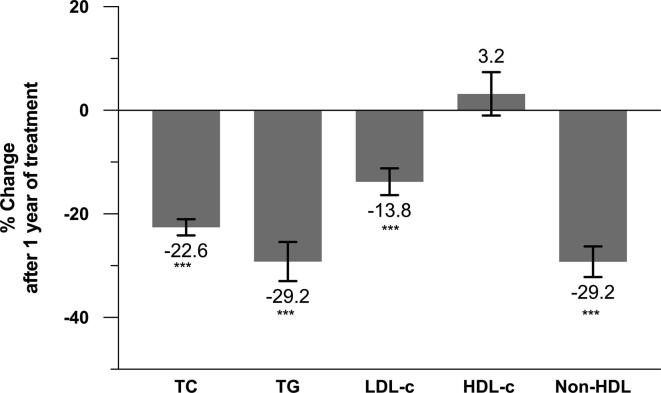
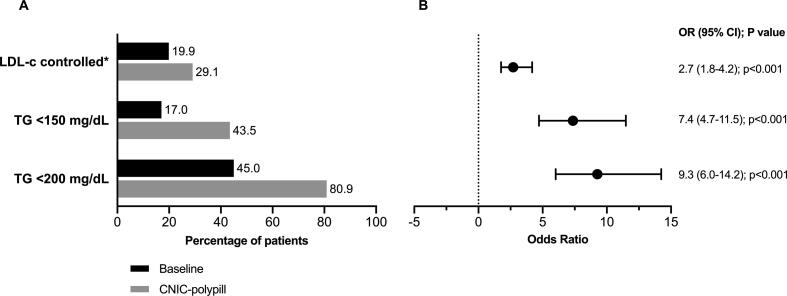
At 1 year of treatment, there was a significant reduction in the levels of TC (-22.6%), TG (-29.2%), LDL-c (-13.8%), and non-HDL-c (-29.2%) (all < 0.001). The likelihood that patients attained their corresponding target LDL-c and TG levels was almost three-fold and seven-fold higher, respectively ( < 0.001). The values of the AD-related ratios RC, CRI-I, AI, AC, AIP, and LCI were all significantly lower ( < 0.001) after one year of treatment.
In patients with or at high risk of CVD, one-year treatment with the CNIC-polypill significantly lowered lipid ratios indicative of AD compared to baseline.
在许多患者中,尽管接受了他汀类药物治疗并达到了目标低密度脂蛋白胆固醇(LDL-c)水平,但心血管(CV)事件的风险仍然存在。这种残余风险部分归因于致动脉粥样硬化性血脂异常(AD)。我们研究了CNIC复方制剂在改善血脂谱以及在预测脂质相关CV风险方面更准确的AD相关脂质比率和指标方面的临床效果。
对墨西哥533例患者进行的多中心、观察性、非对比性、前瞻性登记研究的事后分析。我们评估了基线(常规治疗)时以及使用CNIC复方制剂(Sincronium®)治疗12个月后的血脂,包括总胆固醇(TC)、甘油三酯(TG)、低密度脂蛋白胆固醇(LDL-c)、高密度脂蛋白胆固醇(HDL-c)和非高密度脂蛋白胆固醇(non-HDL-c)。我们还计算并比较了与AD相关的脂质比率和指标,包括残余胆固醇(RC)、卡斯泰利风险指数-I(CRI-I)、致动脉粥样硬化指数(AI)、致动脉粥样硬化系数(AC)、胰岛素抵抗替代指标(IRS)、血浆致动脉粥样硬化指数(AIP)和脂蛋白综合指数(LCI)。
治疗1年后,TC(-22.6%)、TG(-29.2%)、LDL-c(-13.8%)和non-HDL-c(-29.2%)水平显著降低(均P<0.001)。患者达到相应目标LDL-c和TG水平的可能性分别高出近三倍和七倍(P<0.001)。治疗1年后,与AD相关的比率RC、CRI-I、AI、AC、AIP和LCI的值均显著降低(P<0.001)。
在患有心血管疾病或心血管疾病高危患者中,与基线相比,使用CNIC复方制剂治疗1年可显著降低指示AD的脂质比率。