Cai Gaojun, Shi Ganwei, Xue Sheliang, Lu Wei
Department of Cardiology, Wujin Hospital affiliated to Jiangsu University, Changzhou, Jiangsu Province, China.
Medicine (Baltimore). 2017 Sep;96(37):e8058. doi: 10.1097/MD.0000000000008058.
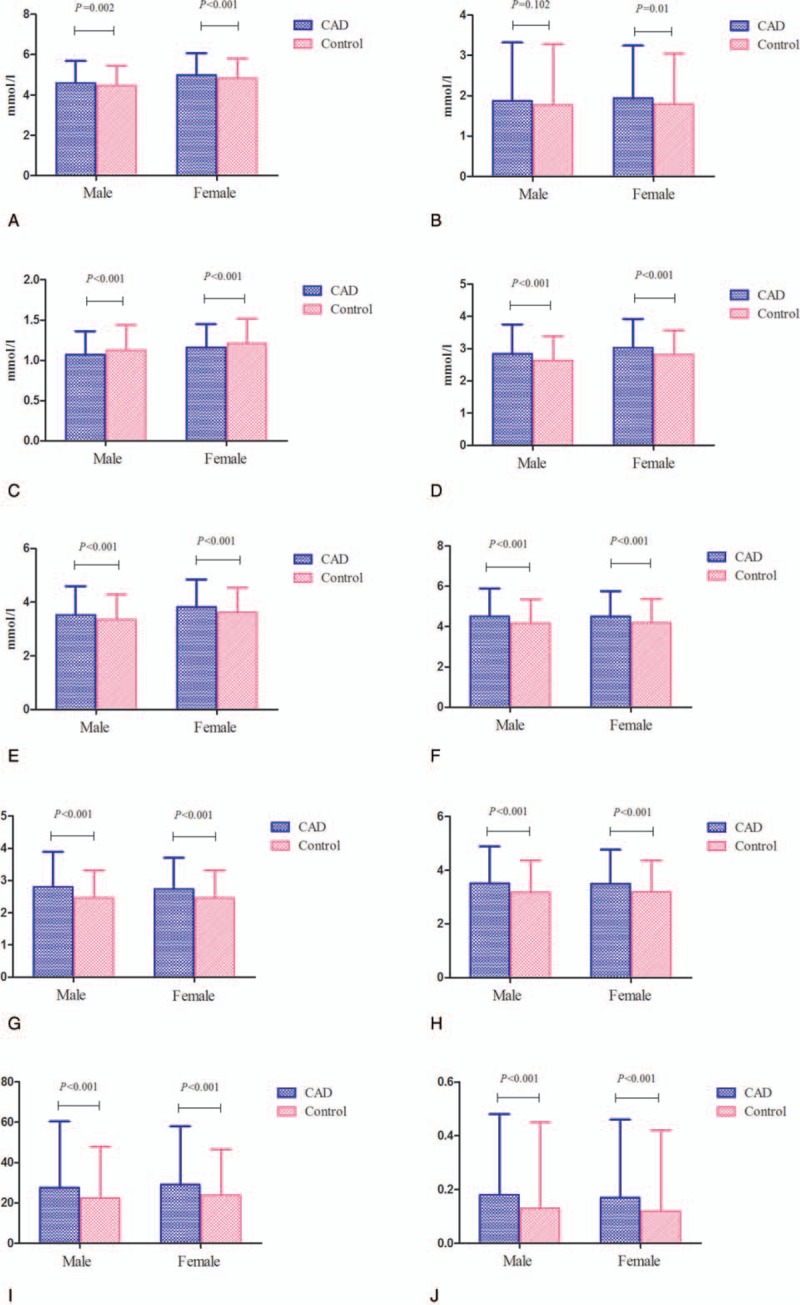
Dyslipidemia is one of the most important factors for coronary artery disease (CAD). The atherogenic index of plasma (AIP), a new comprehensive lipid index, might be a strong marker for predicting the risk of CAD.A hospital-based case-control study including 2936 CAD patients and 2451 controls was conducted in a Chinese population. Traditional lipid parameters were detected, and nontraditional lipid comprehensive indexes were calculated.Compared with controls, CAD patients had higher levels of total cholesterol (TC), triglyceride (TG), and low-density lipoprotein cholesterol (LDL-C). By contrast, the level of high-density lipoprotein cholesterol (HDL-C) was lower in CAD patients. The values of nontraditional lipid profiles, including non-HDL-C, TC/HDL-C, LDL-C/HDL-C, non-HDL-C/HDL-C (atherogenic index, AI), TCTGLDL/HDL-C (lipoprotein combine index, LCI), and lg (TG/HDL-C) (AIP), were all significantly higher in the cases than in the controls. The results of Pearson correlation analyses indicated that AIP was positively and significantly correlated with TC (r = 0.125, P < .001), TG (r = 0.810, P < .001), LDL-C (r = 0.035, P < .001), non-HDL-C (r = 0.322, P < .001), TC/HDL-C (r = 0.669, P < .001), LDL-C/HDL-C (r = 0.447, P < .001), AI (r = 0.669, P < .001), and LCI (r = 0.688, P < .001) and was negatively correlated with age (r = -0.122, P < .001) and HDL-C (r = -0.632, P < .001). In the univariate logistic regression analysis, AIP was the lipid parameter that was most strongly associated with CAD, with an unadjusted odds ratio of 1.782 (95% confidence interval: 1.490-2.131, P < .001), for an increase of 1-SD. Multivariate logistic regression analyses revealed that AIP was an independent risk factor for CAD.AIP might be a strong and independent predictor for CAD in the Chinese Han population.
血脂异常是冠状动脉疾病(CAD)最重要的因素之一。血浆致动脉粥样硬化指数(AIP)是一种新的综合血脂指标,可能是预测CAD风险的有力标志物。在中国人群中开展了一项基于医院的病例对照研究,纳入2936例CAD患者和2451例对照。检测了传统血脂参数,并计算了非传统血脂综合指标。与对照组相比,CAD患者的总胆固醇(TC)、甘油三酯(TG)和低密度脂蛋白胆固醇(LDL-C)水平较高。相比之下,CAD患者的高密度脂蛋白胆固醇(HDL-C)水平较低。非传统血脂指标的值,包括非HDL-C、TC/HDL-C、LDL-C/HDL-C、非HDL-C/HDL-C(致动脉粥样硬化指数,AI)、TCTGLDL/HDL-C(脂蛋白综合指数,LCI)和lg(TG/HDL-C)(AIP),病例组均显著高于对照组。Pearson相关分析结果表明,AIP与TC(r = 0.125,P <.001)、TG(r = 0.810,P <.001)、LDL-C(r = 0.035,P <.001)、非HDL-C(r = 0.322,P <.001)、TC/HDL-C(r = 0.669,P <.001)、LDL-C/HDL-C(r = 0.447,P <.001)、AI(r = 0.669,P <.001)和LCI(r = 0.688,P <.001)呈正相关,与年龄(r = -0.122,P <.001)和HDL-C(r = -0.632,P <.001)呈负相关。在单因素逻辑回归分析中,AIP是与CAD关联最密切的血脂参数,每增加1个标准差,未调整的比值比为1.782(95%置信区间:1.490 - 2.131,P <.001)。多因素逻辑回归分析显示,AIP是CAD的独立危险因素。AIP可能是中国汉族人群中CAD的一个强有力的独立预测指标。