Population Dynamics and Sexual and Reproductive Health, Africa Population and Health Research Center, Off Kirawa Road, Manga Close, Nairobi, Kenya.
Faculty of Health Sciences, Simon Fraser University, Burnaby, British Columbia, Canada.
BMC Public Health. 2020 Sep 7;20(1):1370. doi: 10.1186/s12889-020-09488-6.
Unintended pregnancy has dire consequences on the health and socioeconomic wellbeing of adolescent girls and young women (AGYW) (aged 15-24 years). While most studies tend to focus on lack of access to contraceptive information and services, and poverty as the main contributing factor to early-unintended pregnancies, the influence of sexual violence has received limited attention. Understanding the link between sexual violence and unintended pregnancy is critical towards developing a multifaceted intervention to reduce unintended pregnancies among AGYW in South Africa, a country with high teenage pregnancy rate. Thus, we estimated the magnitude of unintended pregnancy among AGYW and also examined the effect of sexual violence on unintended pregnancy.
Our study adopted a cross-sectional design, and data were obtained from AGYW in a South African university between June and November 2018. A final sample of 451 girls aged 17-24 years, selected using stratified sampling, were included in the analysis. We used adjusted and unadjusted logistic regression analysis to examine the effect of sexual violence on unintended pregnancy.
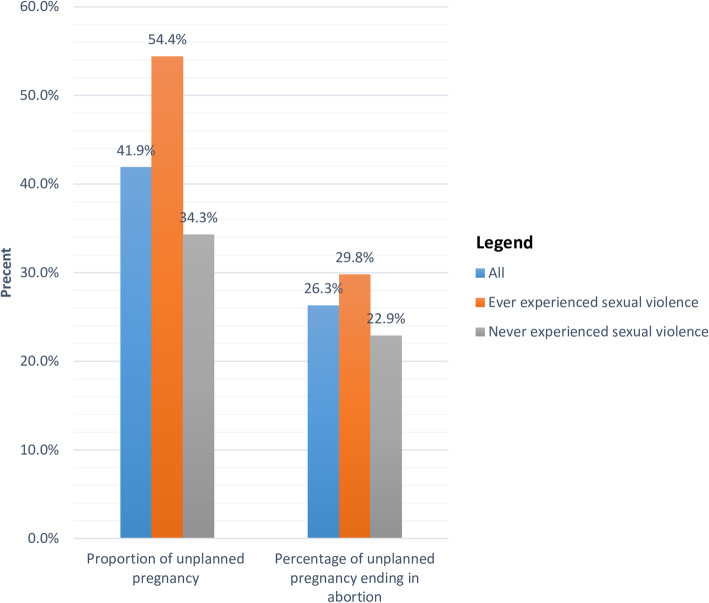
The analysis shows that 41.9% of all respondents had experienced an unintended pregnancy, and 26.3% of those unintended pregnancies ended in abortions. Unintended pregnancy was higher among survivors of sexual violence (54.4%) compared to those who never experienced sexual abuse (34.3%). In the multivariable analysis, sexual violence was consistently and robustly associated with increased odds of having an unintended pregnancy (AOR:1.70; 95% CI: 1.08-2.68).
Our study found a huge magnitude of unintended pregnancy among AGYW. Sexual violence is an important predictor of unintended pregnancy in this age cohort. Thus, addressing unintended pregnancies among AGYW in South Africa requires interventions that not only increase access to contraceptive information and services but also reduce sexual violence and cater for survivors.
意外怀孕对少女和年轻妇女(15-24 岁)的健康和社会经济福利有严重影响。虽然大多数研究倾向于关注缺乏避孕信息和服务以及贫困是导致意外早育的主要因素,但性暴力的影响却受到了有限的关注。了解性暴力与意外怀孕之间的联系对于制定多方面的干预措施以减少南非少女和年轻妇女意外怀孕至关重要,南非的青少年怀孕率很高。因此,我们估计了少女和年轻妇女意外怀孕的规模,并研究了性暴力对意外怀孕的影响。
我们的研究采用了横断面设计,数据来自 2018 年 6 月至 11 月期间南非一所大学的少女和年轻妇女。使用分层抽样选择了 451 名年龄在 17-24 岁的女孩作为最终样本进行分析。我们使用调整和未调整的逻辑回归分析来检验性暴力对意外怀孕的影响。
分析表明,所有受访者中有 41.9%经历过意外怀孕,其中 26.3%的意外怀孕以堕胎告终。与从未遭受过性虐待的人相比,性暴力幸存者的意外怀孕率更高(54.4%)。在多变量分析中,性暴力与意外怀孕的几率增加始终相关(AOR:1.70;95%CI:1.08-2.68)。
我们的研究发现少女和年轻妇女中意外怀孕的比例很高。性暴力是该年龄组意外怀孕的一个重要预测因素。因此,要解决南非少女和年轻妇女的意外怀孕问题,需要采取干预措施,不仅要增加获得避孕信息和服务的机会,还要减少性暴力并为幸存者提供服务。