Lester Sarah, Khatwa Meena, Sutcliffe Katy
EPPI-Centre, Social Science Research Unit, Institute of Education, University College London, 18 Woburn Square, London WC1H 0NR, United Kingdom.
Child Youth Serv Rev. 2020 Nov;118:105429. doi: 10.1016/j.childyouth.2020.105429. Epub 2020 Sep 3.
Adverse Childhood Experiences (ACEs) such as, physical and sexual abuse, neglect, or living in a household with domestic violence or substance misuse, can have negative impacts on mental and physical health across the lifecourse. A deeper understanding of the kinds of services that people affected by ACEs feel they need to overcome these negative impacts is required.
How do people affected by ACEs between the ages of 3 to 18 experience support and services in the UK? What are their needs relating to services and support?
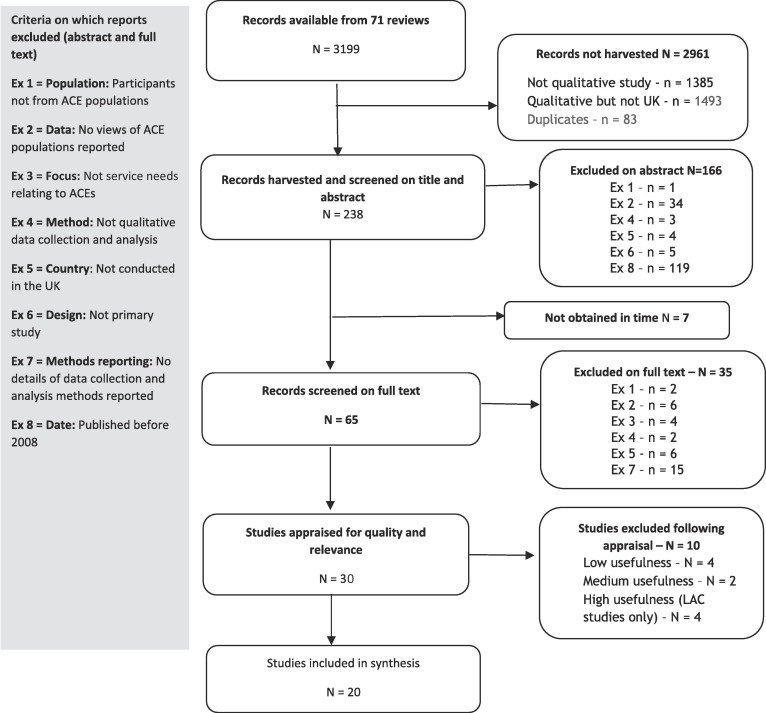
Systematic review of qualitative evidence. We harvested relevant studies from existing systematic reviews of qualitative evidence located through a search of 18 databases. Included studies needed to be published in or after 2008, conducted in the UK, and report the views of people exposed to ACEs relating to their service needs. We included studies with participants who were affected by ACEs between 3 and 18 years old with no restriction on the age at which they accessed services.
We identified 71 reviews from which we harvested 238 references on title and abstract screening. Following full text screening and quality and relevance appraisal we included 20 studies. Each of the included studies focussed on a specific ACE population. Almost half focused on young people who were fostered, looked-after or leaving care. No studies focussed on parental incarceration or divorce. Young people value emotional and practical support. Service providers were most valued for displaying empathy, being non-judgemental, and being active listeners. Supportive relationships, especially with adults, are a key factor in feeling understood.
People affected by ACEs describe the importance of stability and continuity in the support they receive. These factors are important for allowing necessary time to overcome obstacles and build up trust. Research often frames response to ACE in terms of short term individual psychological outcomes but these findings highlight the importance of focussing on wider social factors to encourage meaningful engagement with services.
童年不良经历(ACEs),如身体虐待、性虐待、忽视,或生活在遭受家庭暴力或药物滥用的家庭中,会对一生的身心健康产生负面影响。需要更深入地了解受童年不良经历影响的人认为他们需要哪些服务来克服这些负面影响。
在英国,3至18岁受童年不良经历影响的人如何体验支持和服务?他们对服务和支持有哪些需求?
对定性证据进行系统综述。我们从通过搜索18个数据库找到的现有定性证据系统综述中收集相关研究。纳入的研究需在2008年或之后发表,在英国进行,并报告接触童年不良经历者对其服务需求的看法。我们纳入了参与者年龄在3至18岁之间受童年不良经历影响且对其获得服务的年龄无限制的研究。
我们确定了71篇综述,通过标题和摘要筛选从中收集了238篇参考文献。经过全文筛选以及质量和相关性评估,我们纳入了20项研究。每项纳入研究都聚焦于特定的童年不良经历人群。几乎一半的研究聚焦于被寄养、受照料或离开照料机构的年轻人。没有研究聚焦于父母监禁或离婚。年轻人重视情感和实际支持。服务提供者因其表现出同理心、不评判和积极倾听而最受重视。支持性的关系,尤其是与成年人的关系,是感到被理解的关键因素。
受童年不良经历影响的人描述了他们所获得支持中稳定性和连续性的重要性。这些因素对于留出必要时间克服障碍和建立信任很重要。研究通常从短期个体心理结果的角度来构建对童年不良经历的应对,但这些发现凸显了关注更广泛社会因素以鼓励与服务进行有意义互动的重要性。