García Martínez Juan B, Egbejimba Joseph, Throup James, Matassa Silvio, Pearce Joshua M, Denkenberger David C
Alliance to Feed the Earth in Disasters (ALLFED), Fairbanks, AK, United States.
University of Alaska Fairbanks, Fairbanks, AK 99775, United States.
Sustain Prod Consum. 2021 Jan;25:234-247. doi: 10.1016/j.spc.2020.08.011. Epub 2020 Aug 29.
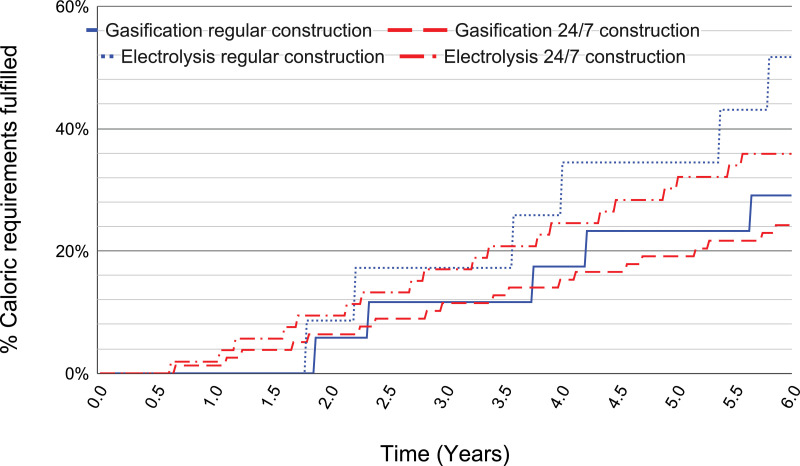
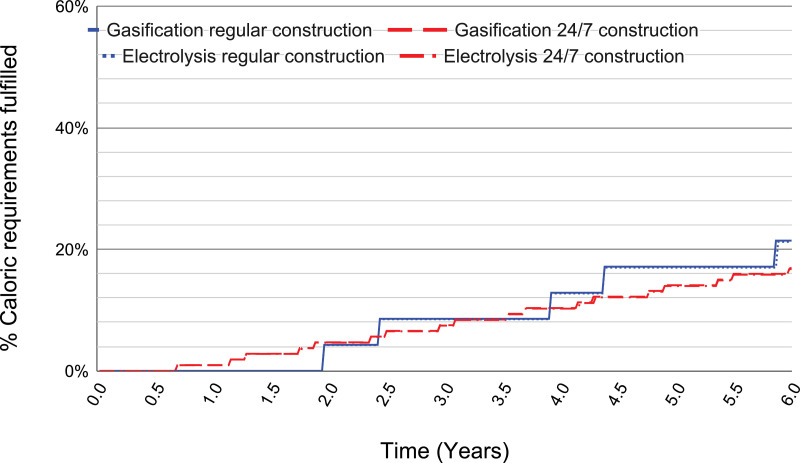
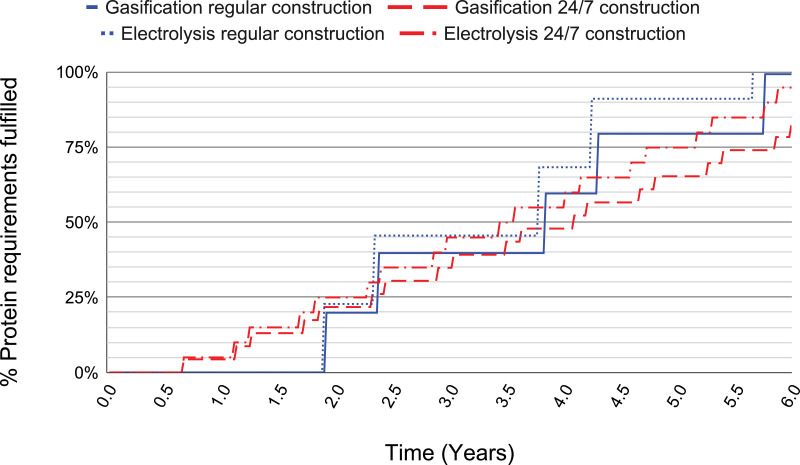
Human civilization's food production system is currently unprepared for catastrophes that would reduce global food production by 10% or more, such as nuclear winter, supervolcanic eruptions or asteroid impacts. Alternative foods that do not require much or any sunlight have been proposed as a more cost-effective solution than increasing food stockpiles, given the long duration of many global catastrophic risks (GCRs) that could hamper conventional agriculture for 5 to 10 years. Microbial food from single cell protein (SCP) produced via hydrogen from both gasification and electrolysis is analyzed in this study as alternative food for the most severe food shock scenario: a sun-blocking catastrophe. Capital costs, resource requirements and ramp up rates are quantified to determine its viability. Potential bottlenecks to fast deployment of the technology are reviewed. The ramp up speed of food production for 24/7 construction of the facilities over 6 years is estimated to be lower than other alternatives (3-10% of the global protein requirements could be fulfilled at end of first year), but the nutritional quality of the microbial protein is higher than for most other alternative foods for catastrophes. Results suggest that investment in SCP ramp up should be limited to the production capacity that is needed to fulfill only the minimum recommended protein requirements of humanity during the catastrophe. Further research is needed into more uncertain concerns such as transferability of labor and equipment production. This could help reduce the negative impact of potential food-related GCRs.
人类文明的粮食生产系统目前尚未为可能导致全球粮食产量减少10%或更多的灾难做好准备,比如核冬天、超级火山爆发或小行星撞击。鉴于许多全球灾难性风险(GCR)的持续时间很长,可能会使传统农业陷入5到10年的困境,因此有人提出,与增加粮食储备相比,不需要太多或根本不需要阳光的替代食物是一种更具成本效益的解决方案。本研究分析了通过气化和电解产生的氢气生产单细胞蛋白(SCP)所得到的微生物食物,将其作为应对最严峻粮食冲击情景——太阳遮挡灾难的替代食物。对资本成本、资源需求和增产率进行了量化,以确定其可行性。审查了该技术快速部署的潜在瓶颈。估计在6年内全天候建设这些设施的粮食生产增产速度低于其他替代方案(在第一年末可满足全球蛋白质需求的3%-10%),但微生物蛋白的营养质量高于大多数其他应对灾难的替代食物。结果表明,对SCP增产的投资应仅限于满足灾难期间人类最低推荐蛋白质需求所需的生产能力。对于劳动力和设备生产的可转移性等更不确定的问题,还需要进一步研究。这有助于减少潜在的与粮食相关的全球灾难性风险的负面影响。