García Martínez Juan B, Pearce Joshua M, Throup James, Cates Jacob, Lackner Maximilian, Denkenberger David C
Alliance to Feed the Earth in Disasters (ALLFED), Fairbanks, AK, United States.
Department of Electrical and Computer Engineering, Western University, London, ON, Canada.
Front Bioeng Biotechnol. 2022 Jul 25;10:906704. doi: 10.3389/fbioe.2022.906704. eCollection 2022.
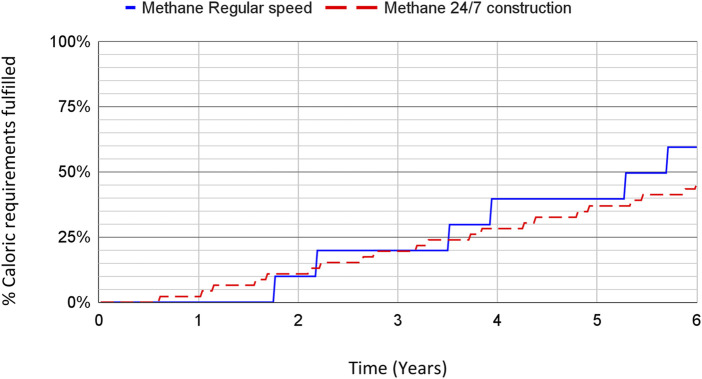
Global catastrophes such as a supervolcanic eruption, asteroid impact, or nuclear winter could cause global agricultural collapse due to reduced sunlight reaching the Earth's surface. The human civilization's food production system is unprepared to respond to such events, but methane single cell protein (SCP) could be a key part of the solution. Current preparedness centers around food stockpiling, an excessively expensive solution given that an abrupt sunlight reduction scenario (ASRS) could hamper conventional agriculture for 5-10 years. Instead, it is more cost-effective to consider resilient food production techniques requiring little to no sunlight. This study analyses the potential of SCP produced from methane (natural gas and biogas) as a resilient food source for global catastrophic food shocks from ASRS. The following are quantified: global production potential of methane SCP, capital costs, material and energy requirements, ramp-up rates, and retail prices. In addition, potential bottlenecks for fast deployment are considered. While providing a more valuable, protein-rich product than its alternatives, the production capacity could be slower to ramp up. Based on 24/7 construction of facilities, 7%-11% of the global protein requirements could be fulfilled at the end of the first year. Despite significant remaining uncertainties, methane SCP shows significant potential to prevent global protein starvation during an ASRS at an affordable price-US$3-5/kg dry.
诸如超级火山爆发、小行星撞击或核冬天等全球性灾难,可能会因到达地球表面的阳光减少而导致全球农业崩溃。人类文明的粮食生产系统对这类事件毫无应对准备,但甲烷单细胞蛋白(SCP)可能是解决方案的关键部分。目前的应对措施主要围绕粮食储备,鉴于突然的阳光减少情景(ASRS)可能会使传统农业遭受5至10年的影响,这是一种成本过高的解决方案。相反,考虑几乎不需要阳光的弹性粮食生产技术则更具成本效益。本研究分析了由甲烷(天然气和沼气)生产的SCP作为应对ASRS引发的全球灾难性粮食冲击的弹性食物来源的潜力。对以下各项进行了量化:甲烷SCP的全球生产潜力、资本成本、材料和能源需求、产能提升率以及零售价格。此外,还考虑了快速部署的潜在瓶颈。虽然甲烷SCP比其他替代品能提供更有价值、富含蛋白质的产品,但其产能提升可能较慢。基于设施全天候建设,在第一年年底可满足全球7%至11%的蛋白质需求。尽管仍存在重大不确定性,但甲烷SCP显示出以3至5美元/千克干重的可承受价格防止ASRS期间全球蛋白质饥饿的巨大潜力。