Thomas Alison M, Fahim Daniel K, Gemechu Jickssa M
Department of Neurosurgery, Oakland University William Beaumont School of Medicine, Rochester, MI 48309, USA.
Department of Foundational Medical Studies, Oakland University William Beaumont School of Medicine, Rochester, MI 48309, USA.
Diagnostics (Basel). 2020 Sep 4;10(9):670. doi: 10.3390/diagnostics10090670.
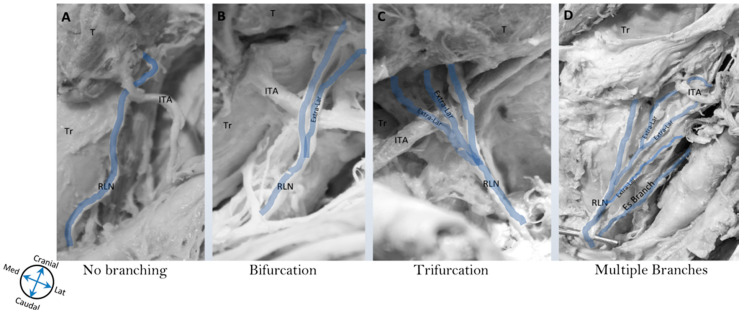
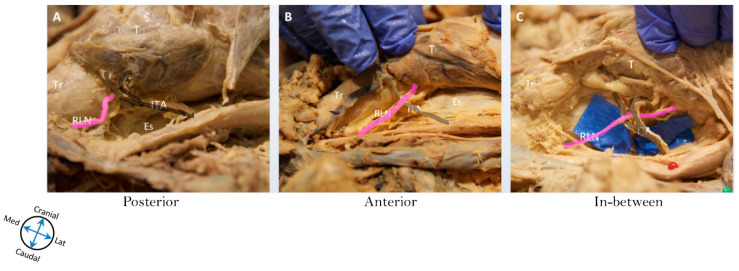
Accurate knowledge of anatomical variations of the recurrent laryngeal nerve (RLN) provides information to prevent inadvertent intraoperative injury and ultimately guide best clinical and surgical practices. The present study aims to assess the potential anatomical variability of RLN pertaining to its course, branching pattern, and relationship to the inferior thyroid artery, which makes it vulnerable during surgical procedures of the neck. Fifty-five formalin-fixed cadavers were carefully dissected and examined, with the course of the RLN carefully evaluated and documented bilaterally. Our findings indicate that extra-laryngeal branches coming off the RLN on both the right and left side innervate the esophagus, trachea, and mainly intrinsic laryngeal muscles. On the right side, 89.1% of the cadavers demonstrated 2-5 extra-laryngeal branches. On the left, 74.6% of the cadavers demonstrated 2-3 extra-laryngeal branches. In relation to the inferior thyroid artery (ITA), 67.9% of right RLNs were located anteriorly, while 32.1% were located posteriorly. On the other hand, 32.1% of left RLNs were anterior to the ITA, while 67.9% were related posteriorly. On both sides, 3-5% of RLN crossed in between the branches of the ITA. Anatomical consideration of the variations in the course, branching pattern, and relationship of the RLNs is essential to minimize complications associated with surgical procedures of the neck, especially thyroidectomy and anterior cervical discectomy and fusion (ACDF) surgery. The information gained in this study emphasizes the need to preferentially utilize left-sided approaches for ACDF surgery whenever possible.
准确了解喉返神经(RLN)的解剖变异可为预防术中意外损伤提供信息,并最终指导最佳的临床和手术操作。本研究旨在评估喉返神经在走行、分支模式及其与甲状腺下动脉的关系方面可能存在的解剖变异,这些变异使其在颈部手术过程中容易受到损伤。对55具用福尔马林固定的尸体进行了仔细解剖和检查,双侧仔细评估并记录了喉返神经的走行。我们的研究结果表明,左右两侧喉返神经发出的喉外分支支配食管、气管以及主要的喉内肌。在右侧,89.1%的尸体有2 - 5支喉外分支。在左侧,74.6%的尸体有2 - 3支喉外分支。关于甲状腺下动脉(ITA),67.9%的右侧喉返神经位于其前方,而32.1%位于其后方。另一方面,32.1%的左侧喉返神经位于甲状腺下动脉前方,而67.9%与之相关位于后方。在两侧,3 - 5%的喉返神经在甲状腺下动脉分支之间穿过。对喉返神经走行变异、分支模式及其关系进行解剖学考量,对于尽量减少与颈部手术相关的并发症至关重要,尤其是甲状腺切除术和颈椎前路椎间盘切除融合术(ACDF)。本研究获得的信息强调,在可能的情况下,ACDF手术应优先采用左侧入路。