Craine Evan B, Murphy Kevin M
Department of Crop and Soil Sciences, Washington State University, Pullman, WA, United States.
Front Nutr. 2020 Aug 12;7:126. doi: 10.3389/fnut.2020.00126. eCollection 2020.
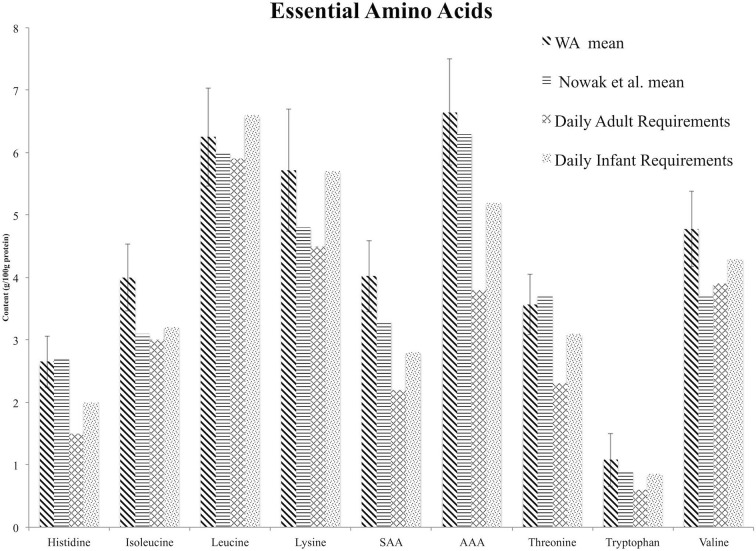
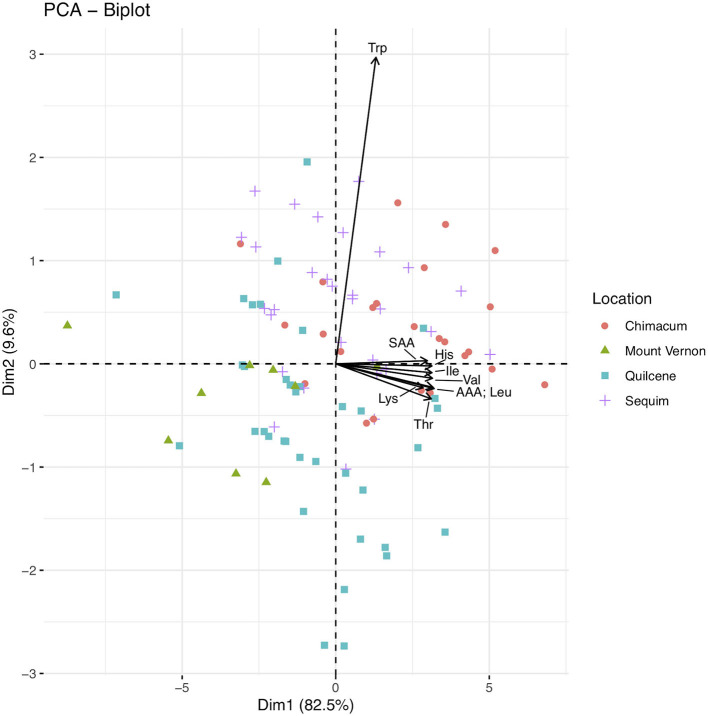
Quinoa ( Willd.) is a pseudocereal celebrated for its excellent nutritional quality and potential to improve global food security, especially in marginal environments. However, minimal information is available on how genotype influences seed composition, and thus, nutritional quality. This study aimed to provide a baseline for nutritional quality of Washington grown quinoa and test the hypothesis that these samples contain adequate amounts of essential amino acids to meet daily requirements set by the World Health Organization (WHO). One hundred samples, representing commercial varieties and advanced breeding lines adapted to Washington State, were analyzed for content of 23 amino acids, as well as crude protein, ash, moisture, and crude fat. Mean essential amino acid values for Washington grown quinoa met the daily requirements for all age groups for all essential amino acids, except for the amount of leucine required by infants. We found that only nine genotypes met the leucine requirements for all age groups. A total of 52 and 94 samples met the lysine and tryptophan requirements for all age groups, respectively. Mean values for isoleucine, leucine, lysine, tryptophan, valine, and the sulfur and aromatic amino acids are higher for Washington grown samples than those reported previously reported in the literature. Our results show that not all Washington grown quinoa samples meet daily requirements of essential amino acids, and we identify limiting amino acids for the germplasm and environments investigated. This study provides the first report of leucine as a limiting amino acid in quinoa. Additional research is needed to better understand variation in quinoa nutritional composition, identify varieties that meet daily requirements, and explore how genotype, environment, and management interactions influence nutritional quality.
藜麦(Chenopodium quinoa Willd.)是一种假谷物,因其卓越的营养品质以及改善全球粮食安全的潜力而闻名,特别是在边缘环境中。然而,关于基因型如何影响种子成分进而影响营养品质的信息却非常有限。本研究旨在为华盛顿州种植的藜麦的营养品质提供一个基线,并检验以下假设:这些样本含有足够量的必需氨基酸,以满足世界卫生组织(WHO)设定的每日需求。对代表适应华盛顿州的商业品种和先进育种系的100个样本进行了23种氨基酸含量的分析,同时还分析了粗蛋白、灰分、水分和粗脂肪。华盛顿州种植的藜麦的必需氨基酸平均含量满足了所有年龄组对所有必需氨基酸的每日需求,但婴儿所需的亮氨酸量除外。我们发现只有9个基因型满足所有年龄组对亮氨酸的需求。分别有52个和94个样本满足所有年龄组对赖氨酸和色氨酸的需求。华盛顿州种植的样本中异亮氨酸、亮氨酸、赖氨酸、色氨酸、缬氨酸以及含硫和芳香族氨基酸的平均值高于文献中先前报道的值。我们的结果表明,并非所有华盛顿州种植的藜麦样本都能满足必需氨基酸的每日需求,并且我们确定了所研究种质和环境中的限制性氨基酸。本研究首次报道了亮氨酸是藜麦中的限制性氨基酸。需要进一步的研究来更好地理解藜麦营养成分的变异,确定满足每日需求的品种,并探索基因型、环境和管理相互作用如何影响营养品质。