Grossman Ephraim S, Hoffman Yaakov S G, Palgi Yuval, Shrira Amit
Department of Education, Ariel University, Ariel 40700, Israel.
Interdisciplinary Department of Social Sciences, Bar-Ilan University, Ramat-Gan 5290002, Israel.
Pers Individ Dif. 2021 Jan 1;168:110371. doi: 10.1016/j.paid.2020.110371. Epub 2020 Aug 28.
Older adults may experience loneliness due to social distancing and isolation during the Coronavirus disease 2019 (COVID-19) pandemic. Loneliness may further catalyze numerous poor health outcomes including impaired sleep. This study aimed to assess COVID-19 related worries and resilience as potential moderators of the loneliness-sleep problems link.
In the midst of the lock-down period of COVID-19, we collected data using a web-based public platform from 243 Israeli older adults (mean age = 69.76, = 6.69, age range = 60-92). Participants completed measures of COVID-19 related loneliness, sleep problems, COVID-related worries, and resilience.
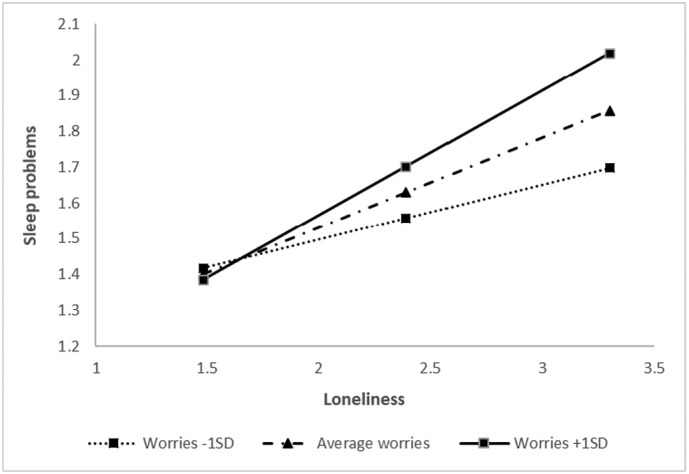
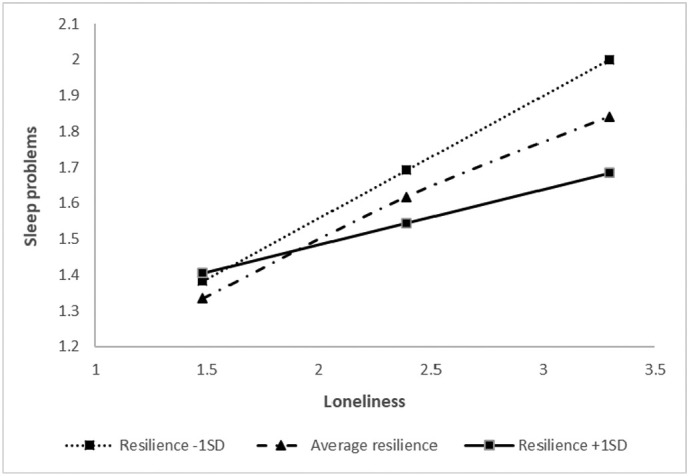
COVID-19 related loneliness was related to more sleep problems. The loneliness-sleep association was especially strong among those with more COVID-19 related worries or among those with lower resilience.
The relationship between COVID-19 related loneliness and sleep problems is not uniform across older adults. The subjective sleep quality of those with more COVID-19 related worries or less resilience (i.e., feeling less being able to adapt to the challenging circumstances) is more susceptible to feeling lonely. Considering these variables may facilitate detection of and intervention for older adults vulnerable to aversive results in the context of COVID-19.
在2019年冠状病毒病(COVID-19)大流行期间,老年人可能因社交距离和隔离而感到孤独。孤独可能会进一步引发许多不良健康后果,包括睡眠障碍。本研究旨在评估与COVID-19相关的担忧和心理韧性,作为孤独与睡眠问题之间联系的潜在调节因素。
在COVID-19封锁期间,我们通过一个基于网络的公共平台收集了243名以色列老年人(平均年龄 = 69.76,标准差 = 6.69,年龄范围 = 60 - 92岁)的数据。参与者完成了与COVID-19相关的孤独感、睡眠问题、与COVID相关的担忧以及心理韧性的测量。
与COVID-19相关的孤独感与更多的睡眠问题有关。在那些与COVID-19相关担忧较多或心理韧性较低的人群中,孤独与睡眠的关联尤为强烈。
COVID-19相关孤独感与睡眠问题之间的关系在老年人中并不一致。那些与COVID-19相关担忧较多或心理韧性较低(即感觉较难适应具有挑战性的环境)的人,其主观睡眠质量更容易受到孤独感的影响。考虑这些变量可能有助于在COVID-19背景下,对易出现不良后果的老年人进行检测和干预。