Jia Yitong, Shrestha Niti, Wang Xiaodi, Wang Tao, Luo Fang
Department of Anesthesiology, Xuanwu Hospital, Capital Medical University, Beijing, People's Republic of China.
Department of Pain Management, Beijing Tiantan Hospital, Capital Medical University, Beijing, People's Republic of China.
J Pain Res. 2020 Aug 18;13:2093-2102. doi: 10.2147/JPR.S259994. eCollection 2020.
Safer and minimal invasive treatment options with minor side effects are in great demand in the treatment of glossopharyngeal neuralgia (GPN). Pulsed radiofrequency (PRF) is a micro-destructive procedure that could be applied repeatedly without irreversible damage to target tissue. However, few studies have reported the long-term clinical outcomes of PRF in the management of idiopathic GPN patients.
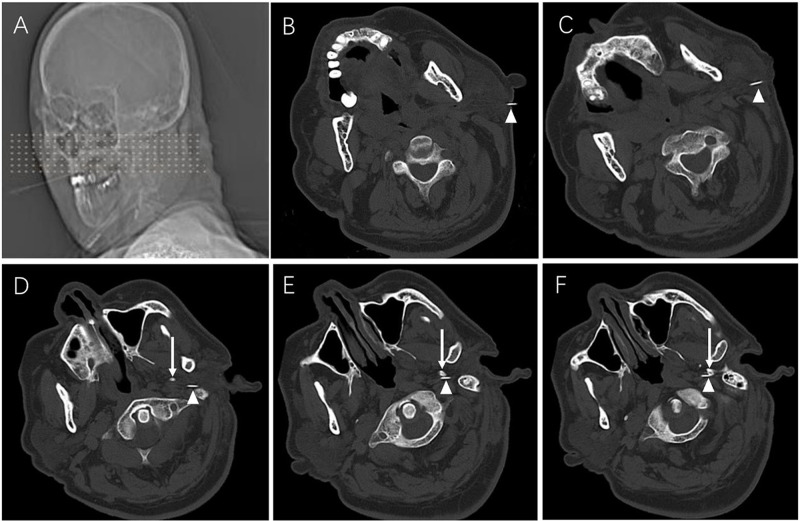
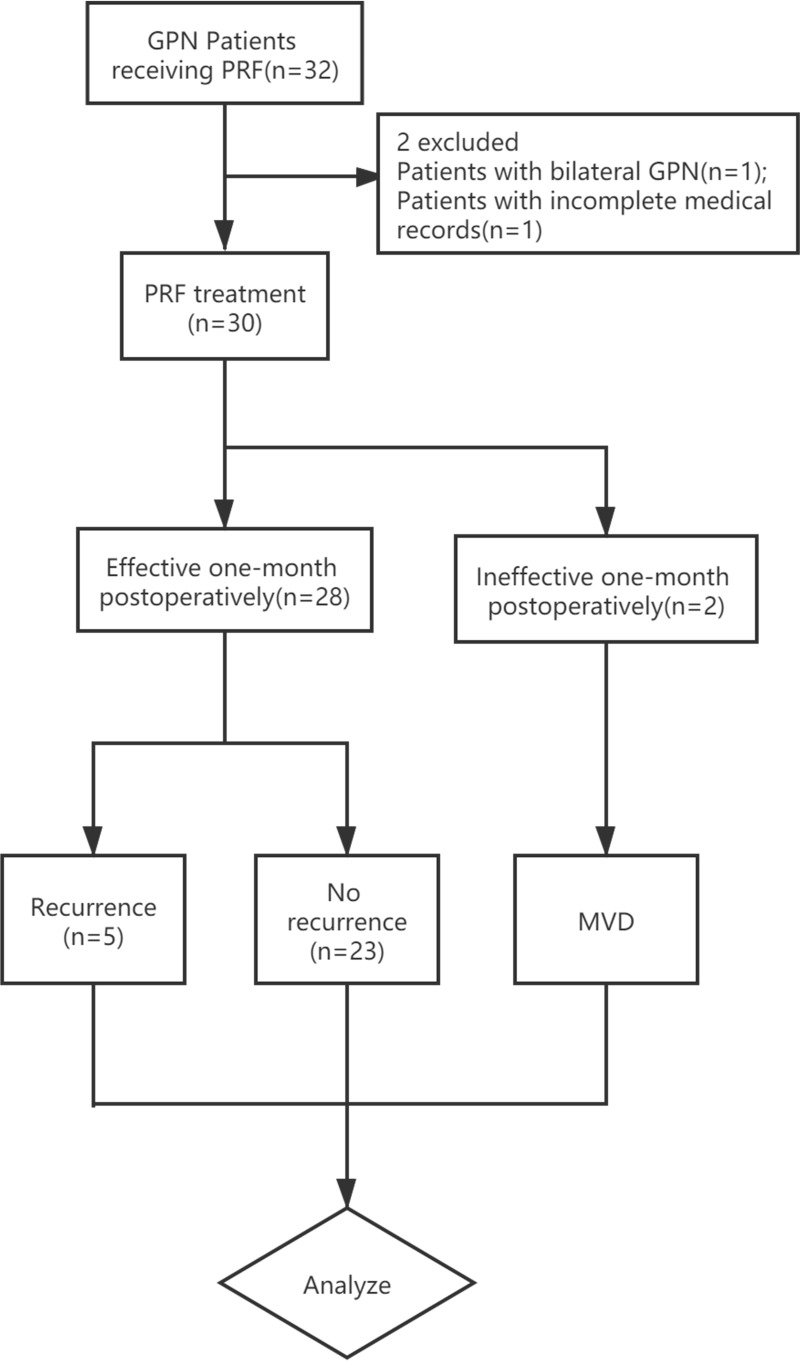
We retrospectively investigated the efficacy and safety of computed tomography (CT)-guided PRF in the treatment of 30 patients with idiopathic GPN in a multi-center clinical study. Numeric rating scale (NRS) score was used to evaluate pain intensity before and after PRF treatment. The effective rate was defined as the percentage of patients with NRS reduction of more than 50%. Baseline characteristics, surgical records, initial pain relief, time to take effect, long-term outcomes, patient satisfaction using a five-level Likert Scale, the incidence of recurrence as well as subsequent treatment choices, intraoperative and postoperative complications were retrieved from electronic medical records.
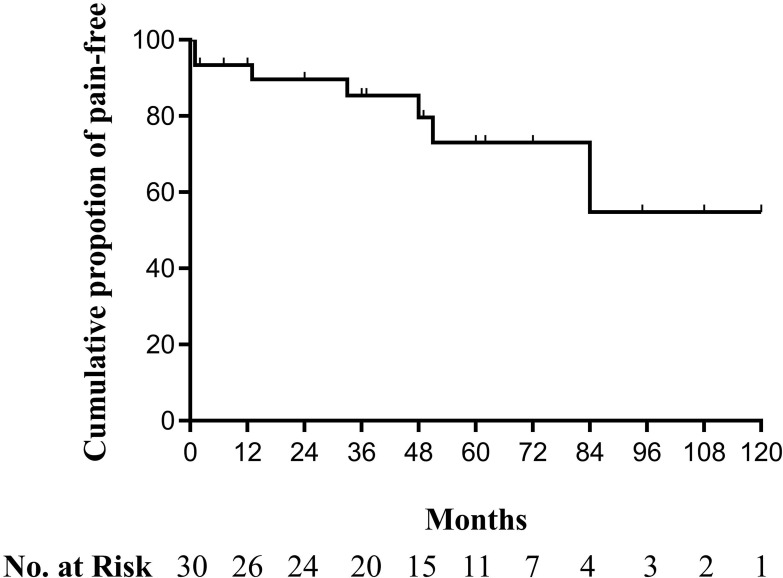
A total of 30 idiopathic GPN patients who received PRF under CT-guidance were included in our study and the initial effective rate was 93.3%. The cumulative proportion of patients with satisfactory pain relief survival was 93.3% at 12 months, 89.6% at 24 months, 85.3% at 36 months, 79.6% at 48 months, 73.0% at 60 months and 72 months, and 54.8% at 84 months, 108 months as well as 120 months. No serious morbidity or mortality were observed in any of the cases. The median patient satisfaction in Likert scale rating was 4.0 (IQR, 3.0-5.0).
According to our results, PRF is an effective and safe therapy for patients with idiopathic GPN. This minimally invasive, micro-destructive, neuro-modulatory technique could be a potential intervention of choice for the treatment of GPN patients who respond poorly to pharmacological treatment.
在舌咽神经痛(GPN)的治疗中,人们迫切需要更安全、微创且副作用小的治疗方案。脉冲射频(PRF)是一种微破坏性手术,可重复应用且不会对靶组织造成不可逆损伤。然而,很少有研究报道PRF治疗特发性GPN患者的长期临床结果。
在一项多中心临床研究中,我们回顾性调查了计算机断层扫描(CT)引导下PRF治疗30例特发性GPN患者的疗效和安全性。采用数字评分量表(NRS)评分评估PRF治疗前后的疼痛强度。有效率定义为NRS降低超过50%的患者百分比。从电子病历中检索基线特征、手术记录、初始疼痛缓解情况、起效时间、长期结果、使用五级李克特量表的患者满意度、复发率以及后续治疗选择、术中和术后并发症。
本研究共纳入30例在CT引导下接受PRF治疗的特发性GPN患者,初始有效率为93.3%。疼痛缓解满意的患者累积生存率在12个月时为93.3%,24个月时为89.6%,36个月时为85.3%,48个月时为79.6%,60个月和72个月时为73.0%,84个月、108个月和120个月时为54.8%。所有病例均未观察到严重的发病率或死亡率。李克特量表评分中患者满意度的中位数为4.0(四分位间距,3.0 - 5.0)。
根据我们的结果,PRF是治疗特发性GPN患者的一种有效且安全的疗法。这种微创、微破坏性的神经调节技术可能是药物治疗反应不佳的GPN患者的潜在首选干预措施。