Nomura Shosaku, Taniura Takehito, Ito Tomoki
First Department of Internal Medicine, Kansai Medical University, Hirakata, Japan.
Division of Internal Medicine, Daiwa Hospital, Suita, Japan.
Int J Gen Med. 2020 Aug 26;13:559-568. doi: 10.2147/IJGM.S265865. eCollection 2020.
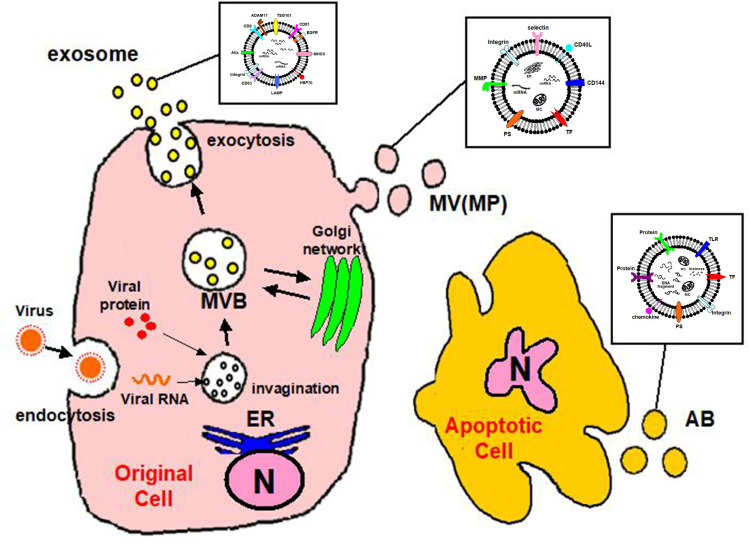
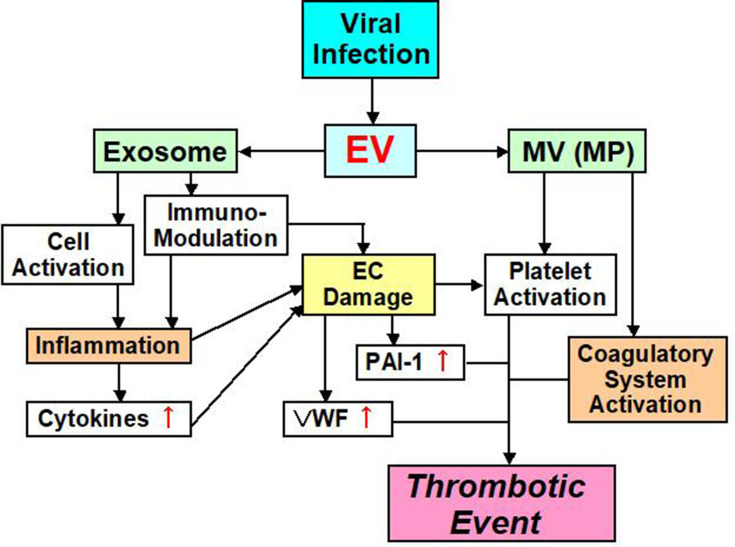
Although the outcomes of viral infectious diseases are remarkably varied, most infections cause acute diseases after a short period. Novel coronavirus disease 2019, which recently spread worldwide, is no exception. Extracellular vesicles (EVs) are small circulating membrane-enclosed entities shed from the cell surface in response to cell activation or apoptosis. EVs transport various kinds of bioactive molecules between cells, including functional RNAs, such as viral RNAs and proteins. Therefore, when EVs are at high levels, changes in cell activation, inflammation, angioplasty and transportation suggest that EVs are associated with various diseases. Clinical research on EVs includes studies on the coagulatory system. In particular, abnormal enhancement of the coagulatory system through EVs can cause thrombosis. In this review, we address the functions of EVs, thrombosis, and their involvement in viral infection.
尽管病毒感染性疾病的结果差异很大,但大多数感染在短时间后会引发急性疾病。最近在全球范围内传播的2019年新型冠状病毒病也不例外。细胞外囊泡(EVs)是细胞表面在细胞激活或凋亡时脱落的小的循环膜封闭实体。EVs在细胞之间运输各种生物活性分子,包括功能性RNA,如病毒RNA和蛋白质。因此,当EVs水平升高时,细胞激活、炎症、血管成形术和运输的变化表明EVs与各种疾病有关。关于EVs的临床研究包括对凝血系统的研究。特别是,通过EVs导致的凝血系统异常增强可引起血栓形成。在这篇综述中,我们阐述了EVs的功能、血栓形成及其在病毒感染中的作用。