Department of Surgery, Duke University, Durham, NC, United States.
Front Immunol. 2018 Feb 8;9:190. doi: 10.3389/fimmu.2018.00190. eCollection 2018.
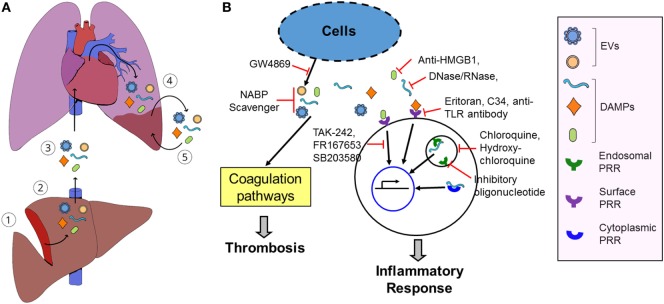
Despite significant improvements in injury prevention and emergency response, injury-related death and morbidity continues to increase in the US and worldwide. Patients with trauma, invasive operations, anti-cancer treatment, and organ transplantation produce a host of danger signals and high levels of pro-inflammatory and pro-thrombotic mediators, such as damage-associated molecular patterns (DAMPs) and extracellular vesicles (EVs). DAMPs (e.g., nucleic acids, histone, high-mobility group box 1 protein, and S100) are molecules released from injured, stressed, or activated cells that act as endogenous ligands of innate immune receptors, whereas EVs (e.g., microparticle and exosome) are membranous vesicles budding off from plasma membranes and act as messengers between cells. DAMPs and EVs can stimulate multiple innate immune signaling pathways and coagulation cascades, and uncontrolled DAMP and EV production causes systemic inflammatory and thrombotic complications and secondary organ failure (SOF). Thus, DAMPs and EVs represent potential therapeutic targets and diagnostic biomarkers for SOF. High plasma levels of DAMPs and EVs have been positively correlated with mortality and morbidity of patients or animals with trauma or surgical insults. Blocking or neutralizing DAMPs using antibodies or small molecules has been demonstrated to ameliorate sepsis and SOF in animal models. Furthermore, a membrane immobilized with nucleic acid-binding polymers captured and removed multiple DAMPs and EVs from extracellular fluids, thereby preventing the onset of DAMP- and EV-induced inflammatory and thrombotic complications and . In this review, we will summarize the current state of knowledge of DAMPs, EVs, and SOF and discuss potential therapeutics and preventive intervention for organ failure secondary to trauma, surgery, anti-cancer therapy, and allogeneic transplantation.
尽管在伤害预防和应急响应方面取得了重大进展,但美国和全球的伤害相关死亡和发病率仍在持续上升。创伤、有创操作、抗癌治疗和器官移植的患者会产生大量危险信号以及高水平的促炎和促血栓形成介质,如损伤相关分子模式(DAMPs)和细胞外囊泡(EVs)。DAMPs(例如核酸、组蛋白、高迁移率族蛋白 B1 蛋白和 S100)是从受损、应激或激活的细胞中释放的分子,作为先天免疫受体的内源性配体,而 EVs(例如微颗粒和外泌体)是从质膜出芽的膜囊泡,充当细胞间的信使。DAMPs 和 EVs 可以刺激多种先天免疫信号通路和凝血级联反应,而不受控制的 DAMPs 和 EV 产生会导致全身炎症和血栓并发症以及继发性器官衰竭(SOF)。因此,DAMPs 和 EVs 是 SOF 的潜在治疗靶点和诊断生物标志物。高血浆 DAMPs 和 EVs 水平与创伤或手术损伤患者或动物的死亡率和发病率呈正相关。使用抗体或小分子阻断或中和 DAMPs 已被证明可改善动物模型中的脓毒症和 SOF。此外,一种带有核酸结合聚合物的膜固定化物从细胞外液中捕获和去除了多种 DAMPs 和 EVs,从而防止了 DAMPs 和 EV 诱导的炎症和血栓并发症的发生。在这篇综述中,我们将总结 DAMPs、EVs 和 SOF 的当前知识状态,并讨论创伤、手术、抗癌治疗和同种异体移植继发器官衰竭的潜在治疗方法和预防干预措施。