Richter Katrin, Ogiemwonyi-Schaefer Raymond, Wilker Sigrid, Chaveiro Anna I, Agné Alisa, Hecker Matthias, Reichert Martin, Amati Anca-Laura, Schlüter Klaus-Dieter, Manzini Ivan, Schmalzing Günther, McIntosh J Michael, Padberg Winfried, Grau Veronika, Hecker Andreas
Department of General and Thoracic Surgery, Laboratory of Experimental Surgery, Justus-Liebig-University Giessen, German Center for Lung Research, 35392 Giessen, Germany.
Department of Internal Medicine, Justus-Liebig-University Giessen, 35392 Giessen, Germany.
J Clin Med. 2020 Sep 7;9(9):2887. doi: 10.3390/jcm9092887.
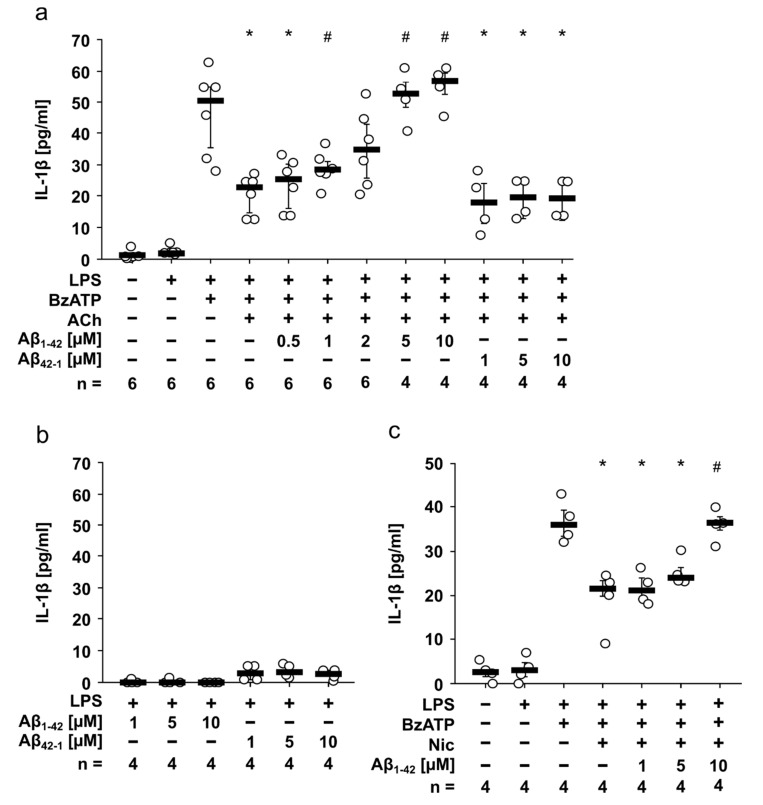
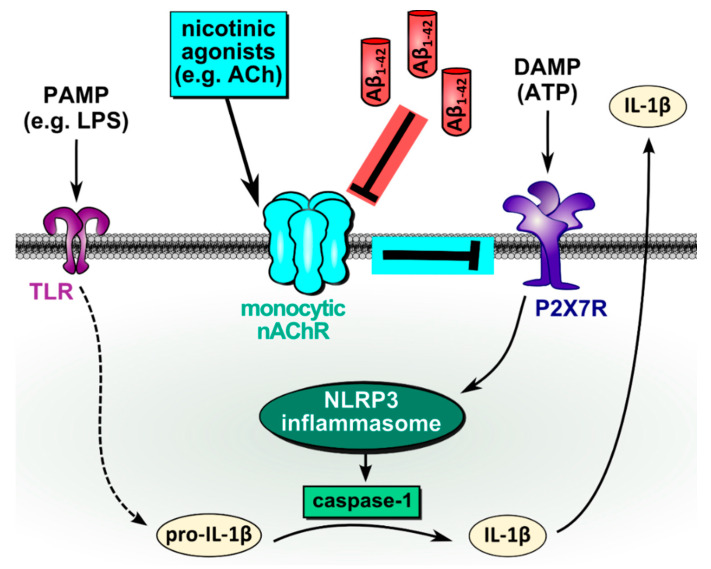
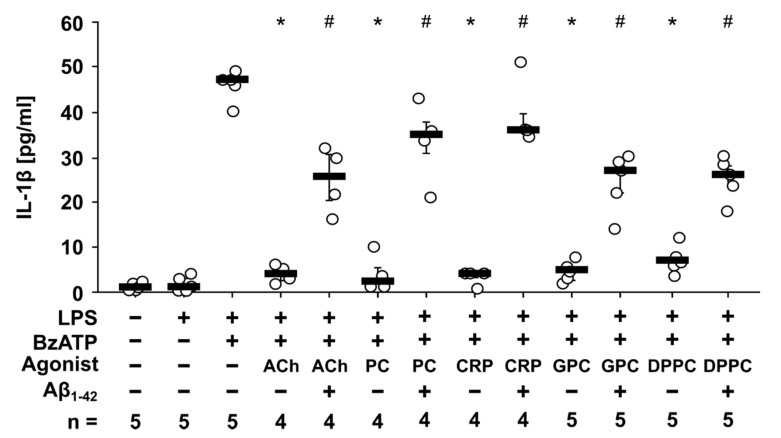
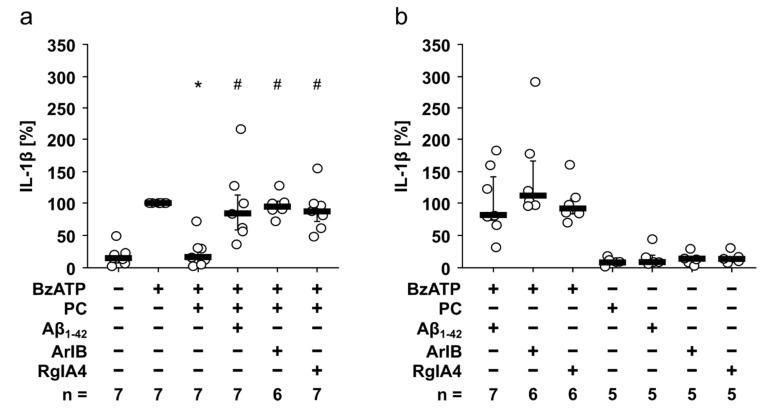
Amyloid-β peptide (Aβ), the cleavage product of the evolutionary highly conserved amyloid precursor protein, presumably plays a pathogenic role in Alzheimer's disease. Aβ can induce the secretion of the pro-inflammatory cytokine intereukin-1β (IL-1β) in immune cells within and out of the nervous system. Known interaction partners of Aβ are α7 nicotinic acetylcholine receptors (nAChRs). The physiological functions of Aβ are, however, not fully understood. Recently, we identified a cholinergic mechanism that controls monocytic release of IL-1β by canonical and non-canonical agonists of nAChRs containing subunits α7, α9, and/or α10. Here, we tested the hypothesis that Aβ modulates this inhibitory cholinergic mechanism. Lipopolysaccharide-primed monocytic U937 cells and human mononuclear leukocytes were stimulated with the P2X7 receptor agonist 2'(3')-O-(4-benzoylbenzoyl)adenosine-5'-triphosphate triethylammonium salt (BzATP) in the presence or absence of nAChR agonists and Aβ. IL-1β concentrations were measured in the supernatant. Aβ dose-dependently (IC = 2.54 µM) reversed the inhibitory effect of canonical and non-canonical nicotinic agonists on BzATP-mediated IL-1β-release by monocytic cells, whereas reverse Aβ was ineffective. In conclusion, we discovered a novel pro-inflammatory Aβ function that enables monocytic IL-1β release in the presence of nAChR agonists. These findings provide evidence for a novel physiological function of Aβ in the context of sterile systemic inflammation.
淀粉样β肽(Aβ)是进化上高度保守的淀粉样前体蛋白的裂解产物,可能在阿尔茨海默病中发挥致病作用。Aβ可诱导神经系统内外免疫细胞分泌促炎细胞因子白细胞介素-1β(IL-1β)。已知Aβ的相互作用伙伴是α7烟碱型乙酰胆碱受体(nAChRs)。然而,Aβ的生理功能尚未完全明确。最近,我们发现了一种胆碱能机制,该机制通过含有α7、α9和/或α10亚基的nAChRs的经典和非经典激动剂来控制单核细胞释放IL-1β。在此,我们检验了Aβ调节这种抑制性胆碱能机制的假说。在用或不用nAChR激动剂和Aβ的情况下,用P2X7受体激动剂2'(3')-O-(4-苯甲酰苯甲酰)腺苷-5'-三磷酸三乙铵盐(BzATP)刺激脂多糖预处理的单核U937细胞和人单核白细胞。测量上清液中的IL-1β浓度。Aβ呈剂量依赖性(IC = 2.54 µM)逆转了经典和非经典烟碱激动剂对单核细胞BzATP介导的IL-1β释放的抑制作用,而反向Aβ则无效。总之,我们发现了Aβ的一种新的促炎功能,即在存在nAChR激动剂的情况下使单核细胞释放IL-1β。这些发现为Aβ在无菌性全身炎症背景下的新生理功能提供了证据。