Department of Predictive Toxicology, Korea Institute of Toxicology, Daejeon 34114, Korea.
Center for Convergent Research of Emerging Virus Infection, Korea Research Institute of Chemical Technology, Daejeon 34114, Korea.
Molecules. 2020 Sep 7;25(18):4089. doi: 10.3390/molecules25184089.
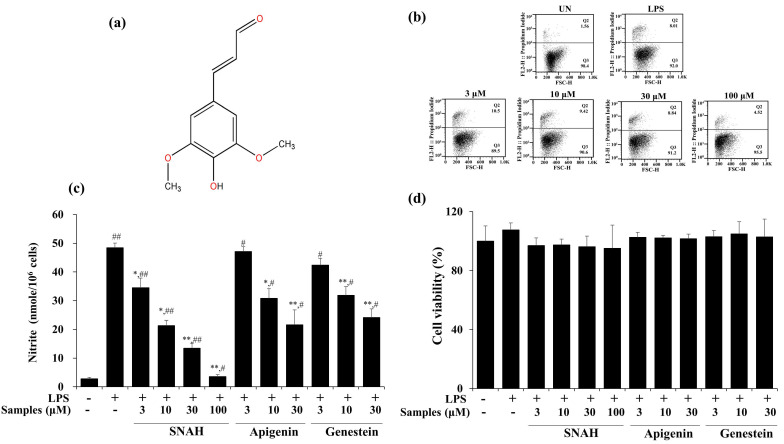
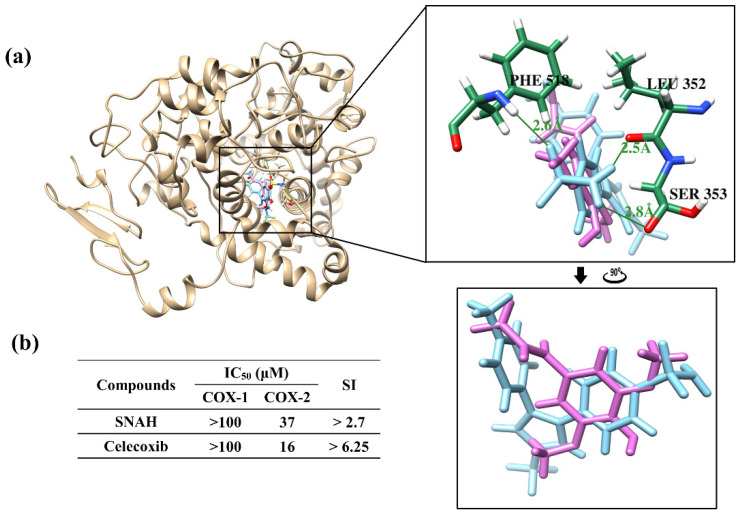
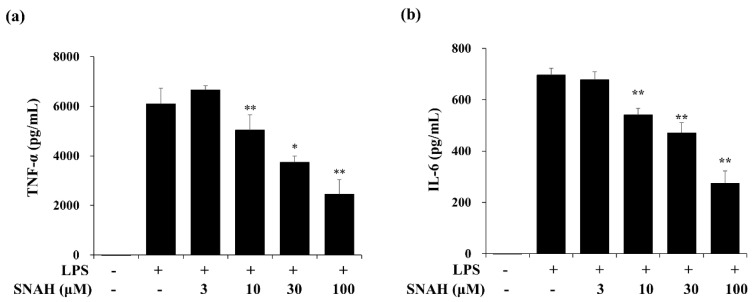
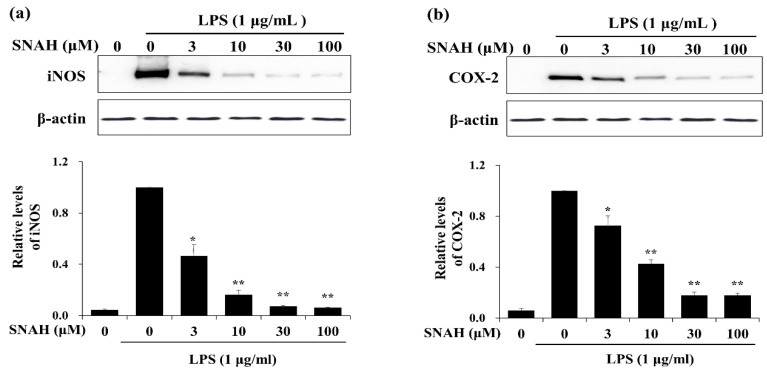
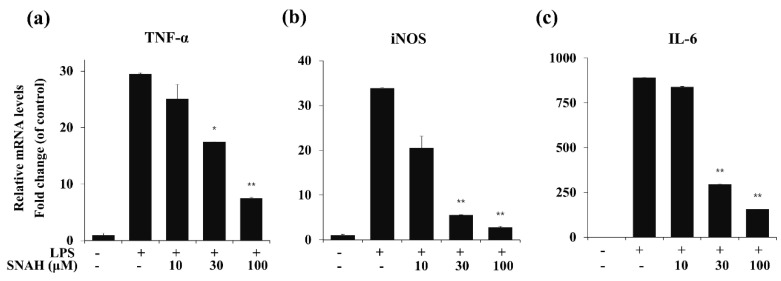
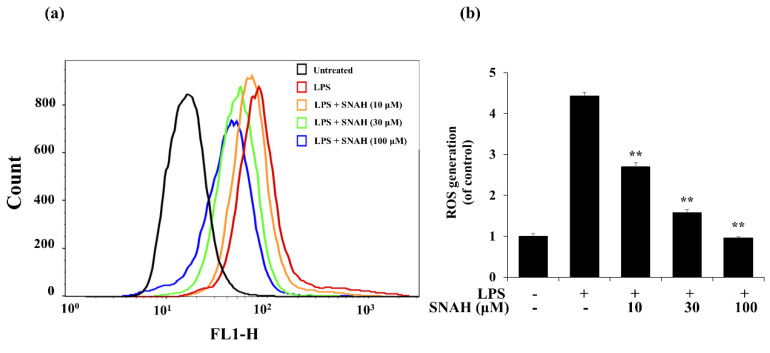
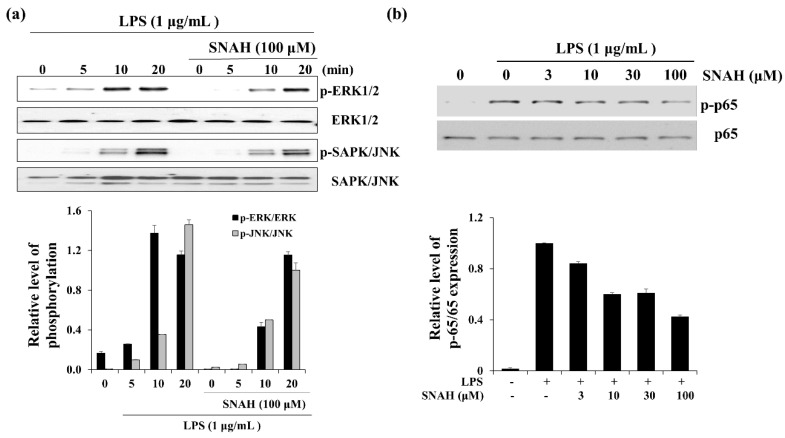
We evaluated the anti-inflammatory effects of SNAH in lipopolysaccharide (LPS)-stimulated RAW 264.7 macrophages by performing nitric oxide (NO) assays, cytokine enzyme-linked immunosorbent assays, Western blotting, and real-time reverse transcription-polymerase chain reaction analysis. SNAH inhibited the production of NO (nitric oxide), reactive oxygen species (ROS), tumor necrosis factor (TNF)-α, and interleukin (IL)-6. Additionally, 100 μM SNAH significantly inhibited total NO and ROS inhibitory activity by 93% ( < 0.001) and 34% ( < 0.05), respectively. Protein expression of inducible nitric oxide synthase (iNOS) and cyclooxygenase-2 (COX-2) stimulated by LPS were also decreased by SNAH. Moreover, SNAH significantly ( < 0.001) downregulated the TNF-α, IL-6, and iNOS mRNA expression upon LPS stimulation. In addition, 3-100 µM SNAH was not cytotoxic. Docking simulations and enzyme inhibitory assays with COX-2 revealed binding scores of -6.4 kcal/mol (IC = 47.8 μM) with SNAH compared to -11.1 kcal/mol (IC = 0.45 μM) with celecoxib, a known selective COX-2 inhibitor. Our results demonstrate that SNAH exerts anti-inflammatory effects via suppression of ROS and NO by COX-2 inhibition. Thus, SNAH may be useful as a pharmacological agent for treating inflammation-related diseases.
我们通过进行一氧化氮(NO)测定、细胞因子酶联免疫吸附试验、Western blot 和实时逆转录聚合酶链反应分析,评估了 SNAH 在脂多糖(LPS)刺激的 RAW 264.7 巨噬细胞中的抗炎作用。SNAH 抑制了 NO(一氧化氮)、活性氧(ROS)、肿瘤坏死因子(TNF)-α和白细胞介素(IL)-6 的产生。此外,100 μM SNAH 分别显著抑制总 NO 和 ROS 抑制活性达 93%(<0.001)和 34%(<0.05)。LPS 刺激诱导型一氧化氮合酶(iNOS)和环氧化酶-2(COX-2)的蛋白表达也被 SNAH 下调。此外,SNAH 显著(<0.001)下调了 LPS 刺激后的 TNF-α、IL-6 和 iNOS mRNA 表达。此外,3-100 μM SNAH 无细胞毒性。与已知的选择性 COX-2 抑制剂塞来昔布(COX-2)的 -11.1 kcal/mol(IC = 0.45 μM)相比,SNAH 与 COX-2 的结合评分为 -6.4 kcal/mol(IC = 47.8 μM)。我们的结果表明,SNAH 通过抑制 COX-2 来发挥抗炎作用,从而抑制 ROS 和 NO 的产生。因此,SNAH 可能可用作治疗炎症相关疾病的药理学药物。