Benjamens Stan, Rijkse Elsaline, Te Velde-Keyzer Charlotte A, Berger Stefan P, Moers Cyril, de Borst Martin H, Yakar Derya, Slart Riemer H J A, Dor Frank J M F, Minnee Robert C, Pol Robert A
Department of Surgery, Division of Transplant Surgery, University of Groningen, University Medical Center Groningen, 9713 GZ Groningen, The Netherlands.
Medical Imaging Center, Department of Nuclear Medicine and Molecular Imaging & Department of Radiology, University of Groningen, University Medical Center Groningen, 9713 GZ Groningen, The Netherlands.
J Clin Med. 2020 Sep 7;9(9):2893. doi: 10.3390/jcm9092893.
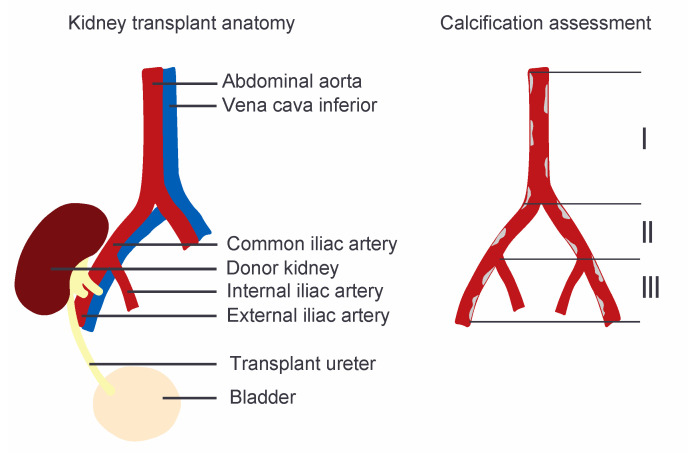
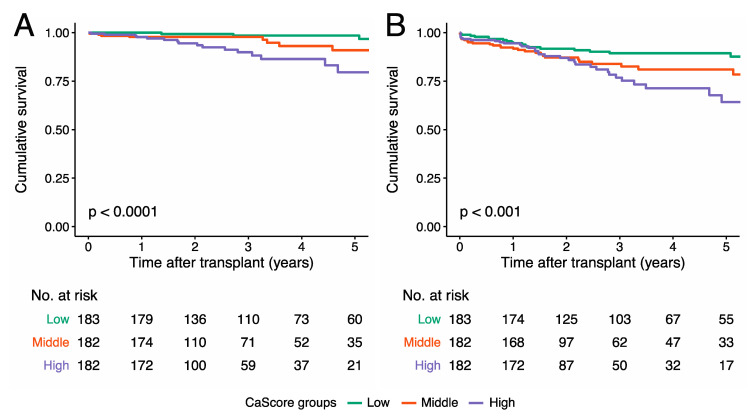
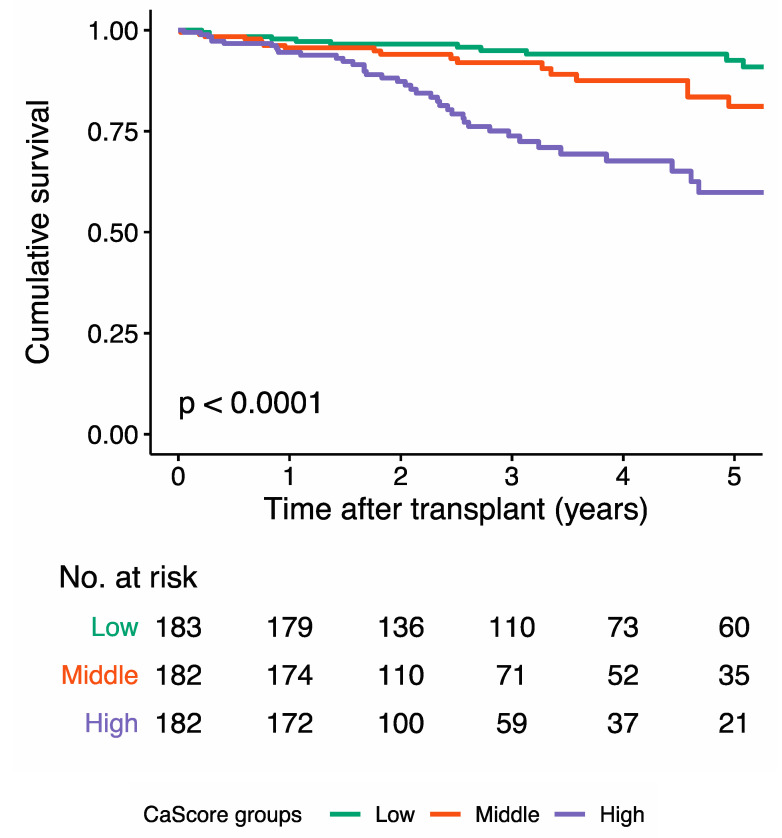
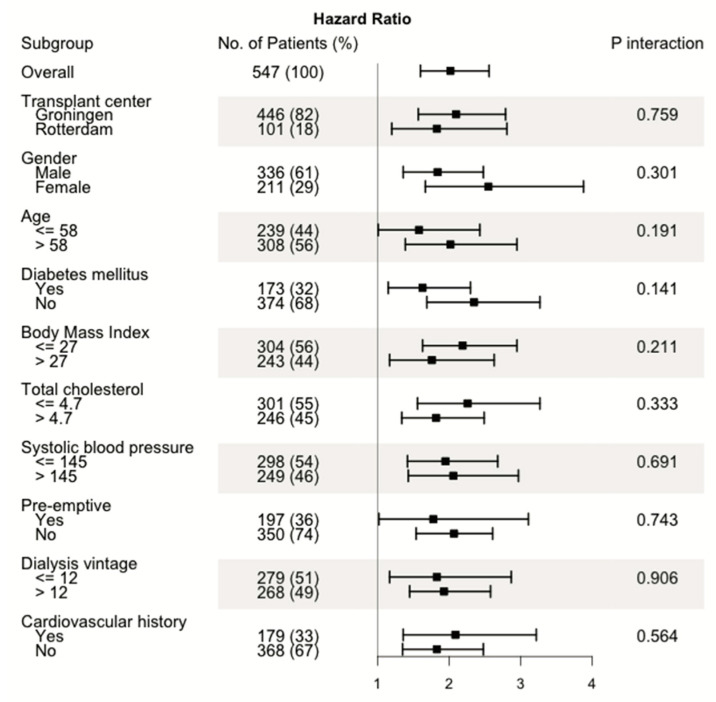
As vascular calcification is common in kidney transplant candidates, aorto-iliac vessel imaging is performed for surgical planning. The aim of the present study was to investigate whether a novel non-contrast enhanced computed tomography-based quantification technique for aorto-iliac calcification can be used for cardiovascular risk stratification prior to kidney transplantation. In this dual-center cohort study, we measured the aorto-iliac calcium score (CaScore) of 547 patients within three years prior to transplantation (2005-2018). During a median (interquartile range) follow-up of 3.1 (1.4, 5.2) years after transplantation, 80 (14.7%) patients died, of which 32 (40.0%) died due to cardiovascular causes, and 84 (15.5%) patients had a cardiovascular event. Kaplan-Meier survival curves showed significant differences between the CaScore tertiles for cumulative overall-survival (Log-rank test < 0.0001), cardiovascular survival ( < 0.0001), and cardiovascular event-free survival ( < 0.001). In multivariable Cox regression, the aorto-iliac CaScore was associated with all-cause mortality (hazard ratio 1.53, 95%CI 1.14-2.06, = 0.005), cardiovascular mortality (2.04, 1.20-3.45, = 0.008), and cardiovascular events (1.35, 1.01-1.80, = 0.042). These independent associations of the aorto-iliac CaScore with the outcome measures can improve the identification of patients at risk for (cardiovascular) death and those who could potentially benefit from stringent cardiovascular monitoring to improve their prognosis after transplantation.
由于血管钙化在肾移植候选者中很常见,因此需进行腹主动脉-髂血管成像以制定手术计划。本研究的目的是调查一种基于非增强计算机断层扫描的新型腹主动脉-髂血管钙化量化技术是否可用于肾移植前的心血管风险分层。在这项双中心队列研究中,我们测量了547例患者在移植前三年(2005 - 2018年)的腹主动脉-髂血管钙化评分(CaScore)。在移植后的中位(四分位间距)随访3.1(1.4,5.2)年期间,80例(14.7%)患者死亡,其中32例(40.0%)死于心血管原因,84例(15.5%)患者发生了心血管事件。Kaplan-Meier生存曲线显示,CaScore三分位数在累积总生存率(对数秩检验<0.0001)、心血管生存率(<0.0001)和无心血管事件生存率(<0.001)方面存在显著差异。在多变量Cox回归中,腹主动脉-髂血管CaScore与全因死亡率(风险比1.53,95%CI 1.14 - 2.06,P = 0.005)、心血管死亡率(2.04,1.20 - 3.45,P = 0.008)和心血管事件(1.35,1.01 - 1.80,P = 0.042)相关。腹主动脉-髂血管CaScore与结局指标的这些独立关联可改善对有(心血管)死亡风险患者以及可能从严格心血管监测中获益以改善移植后预后患者的识别。