Clotworthy Amy, Dissing Agnete Skovlund, Nguyen Tri-Long, Jensen Andreas Kryger, Andersen Thea Otte, Bilsteen Josephine Funck, Elsenburg Leonie K, Keller Amélie, Kusumastuti Sasmita, Mathisen Jimmi, Mehta Amar, Pinot de Moira Angela, Rod Morten Hulvej, Skovdal Morten, Strandberg-Larsen Katrine, Tapager Ingrid Willaing, Varga Tibor V, Vinther Johan Lerbech, Xu Tianwei, Hoeyer Klaus, Hulvej Rod Naja
Department of Public Health, University of Copenhagen Faculty of Health and Medical Sciences, Denmark.
Statistics Denmark, Copenhagen, Denmark.
Scand J Public Health. 2021 Feb;49(1):79-87. doi: 10.1177/1403494820956445. Epub 2020 Sep 10.
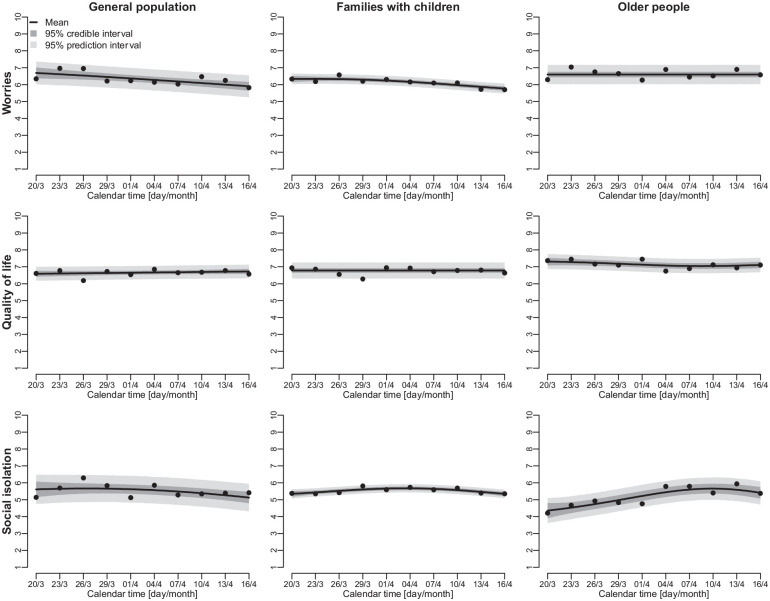
There is a need to document the mental-health effects of the COVID-19 pandemic and its associated societal lockdowns. We initiated a large mixed-methods data collection, focusing on crisis-specific worries and mental-health indicators during the lockdown in Denmark. The study incorporated five data sources, including quantitative surveys and qualitative interviews. The surveys included a time series of cross-sectional online questionnaires starting on 20 March 2020, in which 300 (3×100) Danish residents were drawn every three days from three population groups: the general population (=1046), families with children (=1032) and older people (=1059). These data were analysed by trend analysis. Semi-structured interviews were conducted with 32 people aged 24-83 throughout Denmark to provide context to the survey results and to gain insight into people's experiences of the lockdown. Absolute level of worries, quality of life and social isolation were relatively stable across all population groups during the lockdown, although there was a slight deterioration in older people's overall mental health. Many respondents were worried about their loved ones' health (74-76%) and the potential long-term economic consequences of the pandemic (61-66%). The qualitative interviews documented significant variation in people's experiences, suggesting that the lockdown's effect on everyday life had not been altogether negative.
有必要记录新冠疫情及其相关社会封锁措施对心理健康的影响。我们启动了一项大规模的混合方法数据收集工作,重点关注丹麦封锁期间特定于危机的担忧和心理健康指标。该研究纳入了五个数据源,包括定量调查和定性访谈。调查包括从2020年3月20日开始的一系列横断面在线问卷,每三天从三个群体中抽取300名(3×100)丹麦居民:普通人群(=1046)、有孩子的家庭(=1032)和老年人(=1059)。这些数据通过趋势分析进行了分析。对丹麦各地32名年龄在24至83岁之间的人进行了半结构化访谈,以便为调查结果提供背景信息,并深入了解人们在封锁期间的经历。在封锁期间,所有群体的担忧绝对水平、生活质量和社会隔离情况相对稳定,尽管老年人的整体心理健康略有恶化。许多受访者担心亲人的健康(74%-76%)以及疫情可能带来的长期经济后果(61%-66%)。定性访谈记录了人们经历的显著差异,表明封锁对日常生活的影响并非完全负面。