School of Life and Environmental Sciences, Faculty of Science, The University of Sydney, Sydney, NSW, Australia.
Charles Perkins Centre, The University of Sydney, John Hopkins Drive, Camperdown, NSW, 2006, Australia.
Nutr J. 2020 Sep 10;19(1):97. doi: 10.1186/s12937-020-00617-w.
Transitioning towards sustainable food systems for the health of the population and planet will require governments and institutions to develop effective governance to support the adoption of sustainable food practices. The aim of the paper is to describe current governance within Australian and New Zealand universities designed to support sustainable food systems.
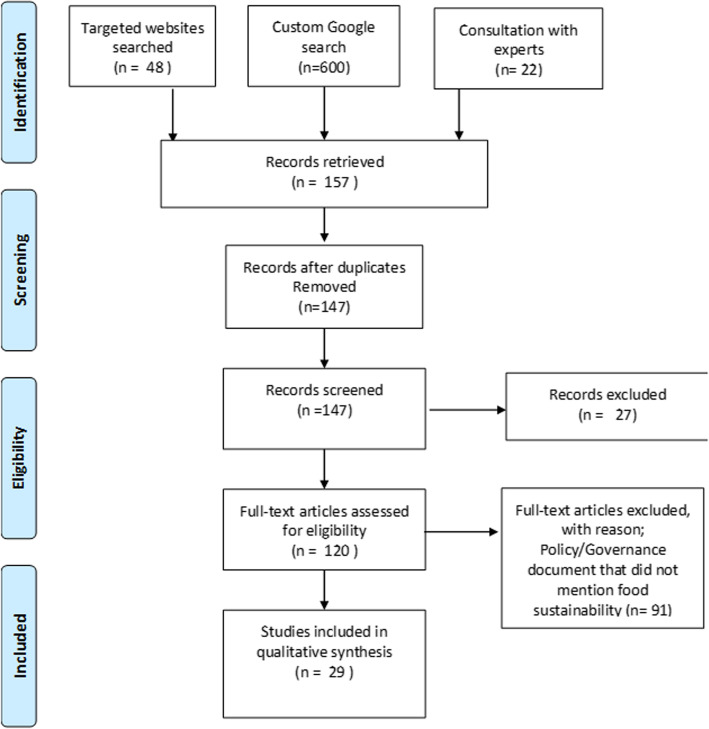
A systematic search of governance documents to support sustainable food systems within Australian and New Zealand universities was conducted. Data were obtained from 1) targeted websites 2) internet search engines and 3) expert consultations. Inclusion criteria consisted of university governance documents including by-laws, policies, guidelines, frameworks, and procedures that support sustainable food systems.
Twenty-nine governance documents across nineteen Australian and New Zealand universities were included for synthesis, including waste management policies (n = 3), fair-trade/procurement policies (n = 6), catering and or event guidelines (n = 7) and catering policies (n = 2), and environmental management plans (n = 11). The main strategies adopted by universities were sustainable waste management and prevention (e.g. reducing landfill, reducing wasted food, (27%)), ethical procurement practices (i.e. fair-trade (27%)) and environmentally sustainable food consumption (e.g. local, seasonal, organic, vegetarian food supply (14.5%)). Only 12.5% of universities addressed all three of the main strategies identified.
This study indicates that while sustainable food systems are considered in some university governance documents, efforts are predominantly focused on aspects such as waste management or procurement of fair-trade items which as stand-alone practices are likely to have minimal impact. This review highlights the scope of universities to provide strong leadership in promoting and supporting sustainable food systems through holistic institutional policies and governance mechanisms.
为了促进人口和地球健康,向可持续的食物系统过渡需要政府和机构制定有效的治理措施,以支持可持续食物实践的采用。本文旨在描述澳大利亚和新西兰大学中支持可持续食物系统的现有治理措施。
对澳大利亚和新西兰大学中支持可持续食物系统的治理文件进行了系统搜索。从以下三个来源获取数据:1)目标网站;2)互联网搜索引擎;3)专家咨询。纳入标准包括支持可持续食物系统的大学治理文件,如章程、政策、准则、框架和程序。
共纳入了 19 所澳大利亚和新西兰大学的 29 份治理文件进行综合分析,其中包括废物管理政策(n=3)、公平贸易/采购政策(n=6)、餐饮和/或活动准则(n=7)和餐饮政策(n=2),以及环境管理计划(n=11)。大学采用的主要策略包括可持续的废物管理和预防措施(例如减少垃圾填埋场、减少食物浪费,占 27%)、道德采购实践(即公平贸易,占 27%)和环境可持续的食物消费(例如,当地、季节性、有机、素食食品供应,占 14.5%)。只有 12.5%的大学采取了所有三个主要策略。
本研究表明,尽管可持续食物系统在一些大学治理文件中得到了考虑,但努力主要集中在废物管理或公平贸易物品采购等方面,这些孤立的措施可能只会产生最小的影响。本综述突出了大学通过全面的机构政策和治理机制,在促进和支持可持续食物系统方面提供强有力领导的范围。