Nishiyama Masahiro, Yamaguchi Hiroshi, Ishida Yusuke, Tomioka Kazumi, Takeda Hiroki, Nishimura Noriyuki, Nozu Kandai, Mishina Hiroki, Iijima Kazumoto, Nagase Hiroaki
Department of Pediatrics, Kobe University Graduate School of Medicine, Kobe, Japan
Department of Pediatrics, Kobe University Graduate School of Medicine, Kobe, Japan.
BMJ Open. 2020 Sep 10;10(9):e035977. doi: 10.1136/bmjopen-2019-035977.
To investigate the prevalence of seizures/febrile seizures in children up to 3 years of age and examine the effects of gestational age at birth on the risk for febrile seizures.
Retrospective longitudinal population-based cohort study.
Kobe City public health center, Kobe, Japan, from 2010 to 2018.
Children who underwent a medical check-up at 3 years of age.
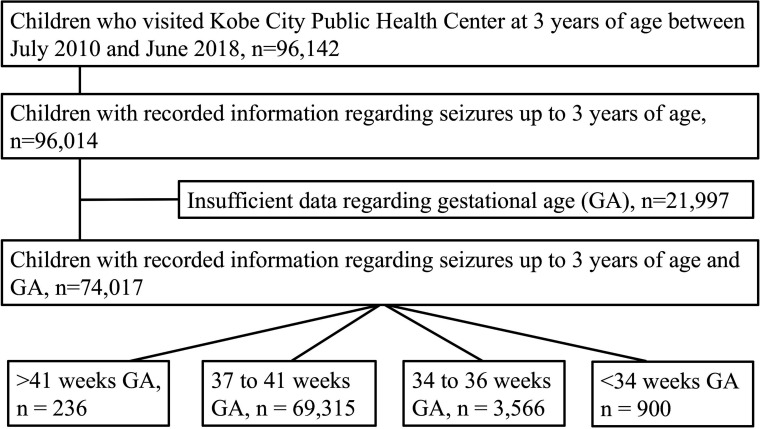
Information regarding seizures was collected from the parents of 96 014 children. We identified the occurrence of seizure/febrile seizure in 74 017 children, whose gestational ages at birth were noted. We conducted a multivariate analysis with the parameter, gestational age at birth, to analyse the risk of seizure. We also stratified the samples by sex and birth weight (<2500 g or not) and compared the prevalence of seizure between those with the term and late preterm births.
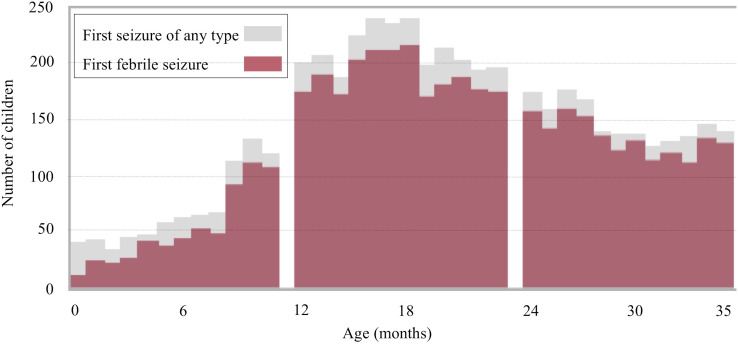
The prevalence of seizure was 12.1% (11.8%-12.3%), 13.2% (12.2%-14.4%), 14.6% (12.4%-17.7%) and 15.7% (10.5%-22.8%) in children born at 37-41, 34-36, 28-33 and 22-27 gestational weeks, respectively. The prevalence of febrile seizures was 9.0% (8.8%-9.2%), 10.5% (9.5%-11.5%), 11.8% (9.7%-14.5%) and 11.2% (6.9%-17.7%) in children born at 37-41, 34-36, 28-33 and 22-27 gestational weeks, respectively. Male was an independent risk factor for seizures (OR: 1.15, 95% CI 1.09 to 1.20; absolute risk increase 0.014, 95% CI 0.010 to 0.019) and febrile seizures (OR: 1.21, 95% CI 1.15 to 1.28; absolute risk increase 0.016, 95% CI 0.012 to 0.020), respectively. Late preterm birth was not associated with an increased risk of seizure/febrile seizure.
Although very preterm birth may increase the risk of seizure/febrile seizure, the risk associated with late preterm birth is considerably small and less than that associated with male.
调查3岁以下儿童癫痫发作/热性惊厥的患病率,并研究出生时的孕周对热性惊厥风险的影响。
基于人群的回顾性纵向队列研究。
2010年至2018年,日本神户市公共卫生中心。
3岁时接受体检的儿童。
收集了96014名儿童家长关于癫痫发作的信息。我们在74017名记录了出生孕周的儿童中确定了癫痫发作/热性惊厥的发生情况。我们对出生孕周这一参数进行多变量分析,以分析癫痫发作的风险。我们还按性别和出生体重(<2500 g与否)对样本进行分层,并比较足月儿和晚期早产儿癫痫发作的患病率。
出生孕周为37 - 41周、34 - 36周、28 - 33周和22 - 27周的儿童癫痫发作患病率分别为12.1%(11.8% - 12.3%)、13.2%(12.2% - 14.4%)、14.6%(12.4% - 17.7%)和15.7%(10.5% - 22.8%)。出生孕周为37 - 41周、34 - 36周、28 - 33周和22 - 27周的儿童热性惊厥患病率分别为9.0%(8.8% - 9.2%)、10.5%(9.5% - 11.5%)、11.8%(9.7% - 14.5%)和11.2%(6.9% - 17.7%)。男性分别是癫痫发作(比值比:1.15,95%置信区间1.09至1.20;绝对风险增加0.014,95%置信区间0.010至0.019)和热性惊厥(比值比:1.21,95%置信区间1.15至1.28;绝对风险增加0.016,95%置信区间0.012至0.020)的独立危险因素。晚期早产与癫痫发作/热性惊厥风险增加无关。
虽然极早产可能增加癫痫发作/热性惊厥的风险,但与晚期早产相关的风险相当小,且小于与男性相关的风险。