Department of Emergency Medicine, Chi Mei Medical Center, Liouying, Tainan, Taiwan.
Department of Emergency Medicine, Chi Mei Medical Center, 901 Zhonghua Road, Yongkang District, Tainan City, 710, Taiwan.
Scand J Trauma Resusc Emerg Med. 2020 Sep 11;28(1):93. doi: 10.1186/s13049-020-00786-x.
A big-data-driven and artificial intelligence (AI) with machine learning (ML) approach has never been integrated with the hospital information system (HIS) for predicting major adverse cardiac events (MACE) in patients with chest pain in the emergency department (ED). Therefore, we conducted the present study to clarify it.
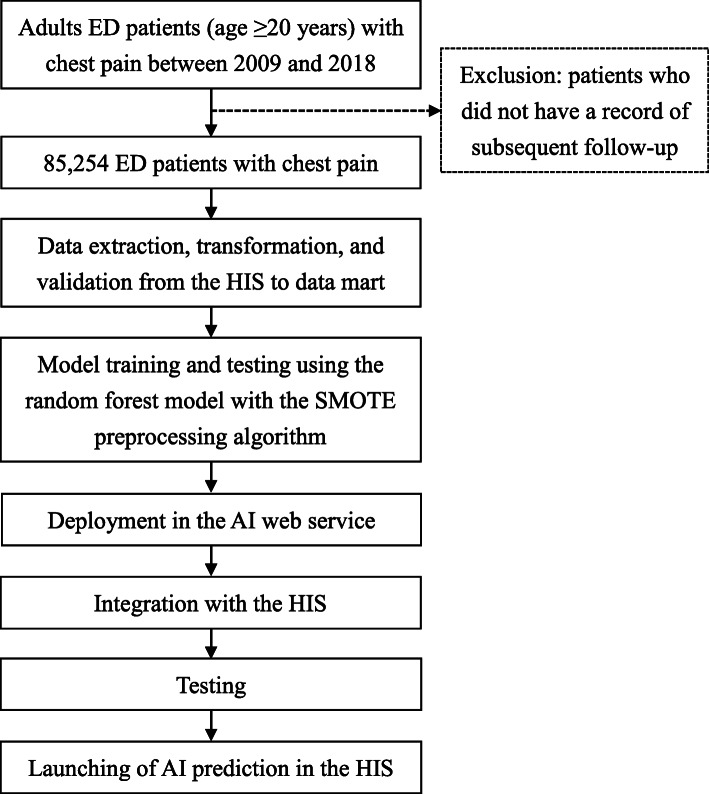
In total, 85,254 ED patients with chest pain in three hospitals between 2009 and 2018 were identified. We randomized the patients into a 70%/30% split for ML model training and testing. We used 14 clinical variables from their electronic health records to construct a random forest model with the synthetic minority oversampling technique preprocessing algorithm to predict acute myocardial infarction (AMI) < 1 month and all-cause mortality < 1 month. Comparisons of the predictive accuracies among random forest, logistic regression, support-vector clustering (SVC), and K-nearest neighbor (KNN) models were also performed.
Predicting MACE using the random forest model produced areas under the curves (AUC) of 0.915 for AMI < 1 month and 0.999 for all-cause mortality < 1 month. The random forest model had better predictive accuracy than logistic regression, SVC, and KNN. We further integrated the AI prediction model with the HIS to assist physicians with decision-making in real time. Validation of the AI prediction model by new patients showed AUCs of 0.907 for AMI < 1 month and 0.888 for all-cause mortality < 1 month.
An AI real-time prediction model is a promising method for assisting physicians in predicting MACE in ED patients with chest pain. Further studies to evaluate the impact on clinical practice are warranted.
大数据驱动和人工智能(AI)与机器学习(ML)方法从未与医院信息系统(HIS)集成,以预测急诊科(ED)胸痛患者的主要不良心脏事件(MACE)。因此,我们进行了本研究以阐明这一点。
总共确定了三家医院 2009 年至 2018 年间 85254 名 ED 胸痛患者。我们将患者随机分为 70%/30%的比例进行 ML 模型训练和测试。我们使用来自电子健康记录的 14 个临床变量,使用随机森林模型和合成少数过采样技术预处理算法构建随机森林模型,以预测 1 个月内急性心肌梗死(AMI)和 1 个月内全因死亡率。还比较了随机森林、逻辑回归、支持向量聚类(SVC)和 K 最近邻(KNN)模型的预测精度。
使用随机森林模型预测 MACE 的曲线下面积(AUC)分别为 0.915(1 个月内 AMI)和 0.999(1 个月内全因死亡率)。随机森林模型的预测准确性优于逻辑回归、SVC 和 KNN。我们进一步将 AI 预测模型与 HIS 集成,以帮助医生实时做出决策。新患者对 AI 预测模型的验证显示 AUC 分别为 0.907(1 个月内 AMI)和 0.888(1 个月内全因死亡率)。
AI 实时预测模型是一种很有前途的方法,可以帮助医生预测 ED 胸痛患者的 MACE。需要进一步的研究来评估其对临床实践的影响。