Coppock Alexander, Hill Seth J, Vavreck Lynn
Department of Political Science, Yale University, New Haven, CT, USA.
Department of Political Science, University of California, San Diego, San Diego, CA, USA.
Sci Adv. 2020 Sep 2;6(36). doi: 10.1126/sciadv.abc4046. Print 2020 Sep.
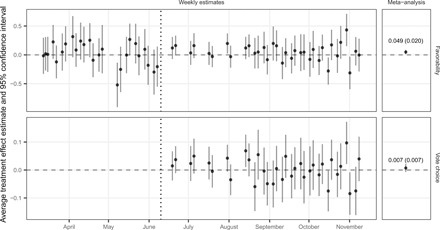
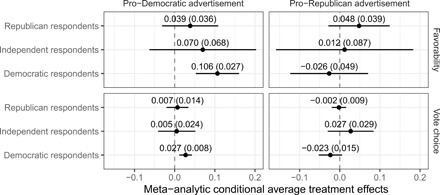
Evidence across social science indicates that average effects of persuasive messages are small. One commonly offered explanation for these small effects is heterogeneity: Persuasion may only work well in specific circumstances. To evaluate heterogeneity, we repeated an experiment weekly in real time using 2016 U.S. presidential election campaign advertisements. We tested 49 political advertisements in 59 unique experiments on 34,000 people. We investigate heterogeneous effects by sender (candidates or groups), receiver (subject partisanship), content (attack or promotional), and context (battleground versus non-battleground, primary versus general election, and early versus late). We find small average effects on candidate favorability and vote. These small effects, however, do not mask substantial heterogeneity even where theory from political science suggests that we should find it. During the primary and general election, in battleground states, for Democrats, Republicans, and Independents, effects are similarly small. Heterogeneity with large offsetting effects is not the source of small average effects.
社会科学领域的证据表明,说服性信息的平均效果很小。对于这些微小效果,一种常见的解释是异质性:说服可能仅在特定情况下才有效。为了评估异质性,我们每周实时重复一项实验,使用2016年美国总统大选竞选广告。我们在针对34000人的59个独特实验中测试了49个政治广告。我们按发送者(候选人或团体)、接收者(受测对象的党派性)、内容(攻击性或宣传性)和背景(摇摆州与非摇摆州、初选与大选、早期与后期)来研究异质性影响。我们发现对候选人好感度和投票的平均影响很小。然而,即使在政治学理论表明我们应该能发现异质性的情况下,这些微小影响也并未掩盖显著的异质性。在初选和大选期间,在摇摆州,对于民主党人、共和党人和无党派人士来说,影响同样很小。具有大的抵消作用的异质性并非平均效果微小的根源。