Wisconsin Institute for Discovery, University of Wisconsin-Madison, Madison, WI, USA.
Department of Cell and Regenerative Biology, University of Wisconsin-Madison, Madison, WI, USA.
Nat Commun. 2023 May 27;14(1):3064. doi: 10.1038/s41467-023-38637-9.
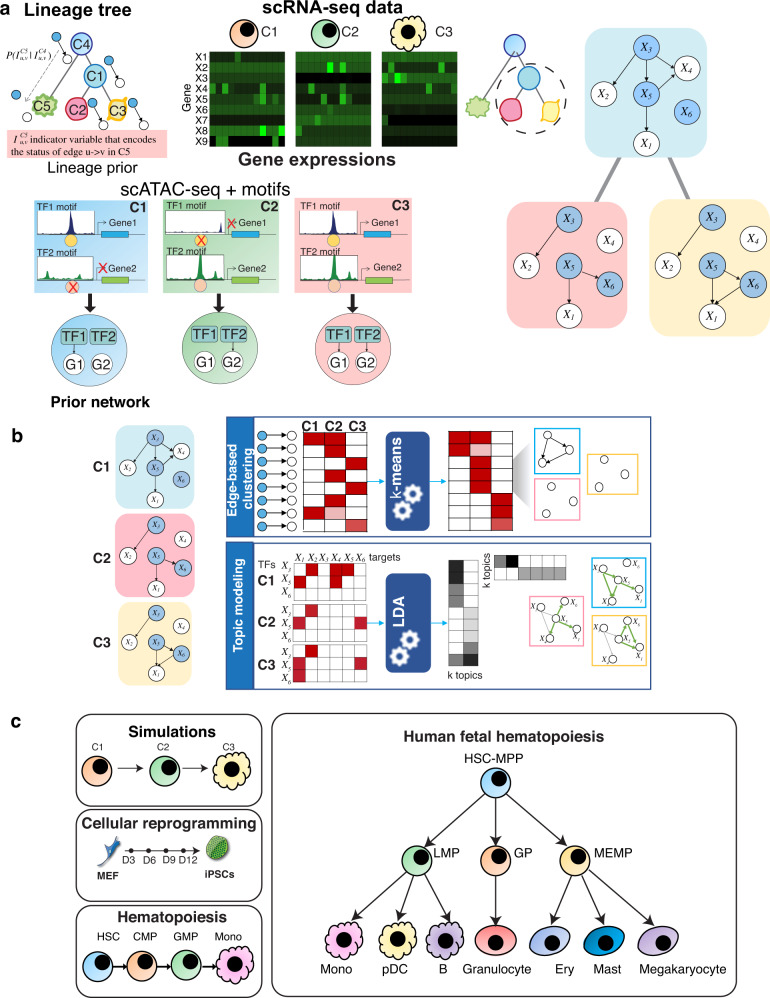
Cell type-specific gene expression patterns are outputs of transcriptional gene regulatory networks (GRNs) that connect transcription factors and signaling proteins to target genes. Single-cell technologies such as single cell RNA-sequencing (scRNA-seq) and single cell Assay for Transposase-Accessible Chromatin using sequencing (scATAC-seq), can examine cell-type specific gene regulation at unprecedented detail. However, current approaches to infer cell type-specific GRNs are limited in their ability to integrate scRNA-seq and scATAC-seq measurements and to model network dynamics on a cell lineage. To address this challenge, we have developed single-cell Multi-Task Network Inference (scMTNI), a multi-task learning framework to infer the GRN for each cell type on a lineage from scRNA-seq and scATAC-seq data. Using simulated and real datasets, we show that scMTNI is a broadly applicable framework for linear and branching lineages that accurately infers GRN dynamics and identifies key regulators of fate transitions for diverse processes such as cellular reprogramming and differentiation.
细胞类型特异性基因表达模式是转录基因调控网络(GRN)的输出,连接转录因子和信号蛋白与靶基因。单细胞技术,如单细胞 RNA 测序(scRNA-seq)和单细胞转座酶可及染色质测序(scATAC-seq),可以以前所未有的细节研究细胞类型特异性基因调控。然而,目前推断细胞类型特异性 GRN 的方法在整合 scRNA-seq 和 scATAC-seq 测量以及对细胞谱系上的网络动态进行建模方面的能力有限。为了解决这个挑战,我们开发了单细胞多任务网络推断(scMTNI),这是一种从 scRNA-seq 和 scATAC-seq 数据推断谱系中每个细胞类型的 GRN 的多任务学习框架。使用模拟和真实数据集,我们表明 scMTNI 是一个适用于线性和分支谱系的广泛框架,它可以准确推断 GRN 动态,并识别细胞重编程和分化等多种过程中命运转变的关键调节剂。