Circulatory Health Research Laboratory, College of Health Sciences, University of Abuja, Abuja, NG.
Department of Community Health, University of Uyo Teaching Hospital, Uyo, Akwa Ibom, NG.
Glob Heart. 2020 Jul 10;15(1):47. doi: 10.5334/gh.848.
Previous studies that evaluated the prevalence, awareness and treatment of hypertension in Nigeria were either localized to some specific regions of the country or non-standardized thereby making evaluation of trend in hypertension care difficult.
We used the World Health Organization (WHO) STEPwise approach to chronic disease risk factor surveillance to evaluate in a nationally representative sample of 4192 adult Nigerians selected from a rural and an urban community in one state in each of the six geo-political zones of the country.
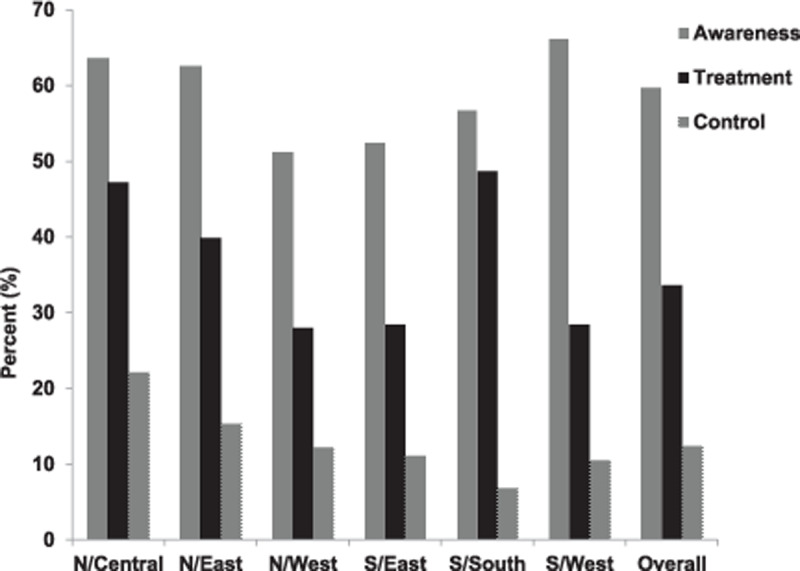
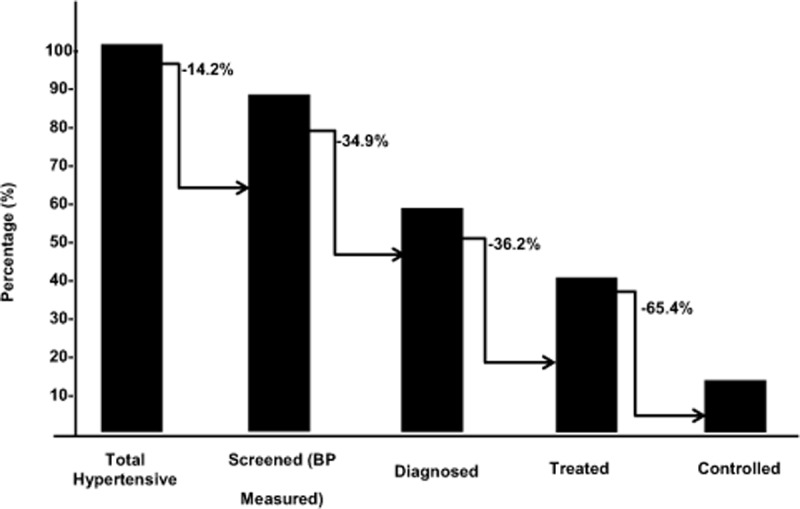
The overall age-standardized prevalence of hypertension was 38.1% and this varied across the geo-political zones as follows: North-Central, 20.9%; North-East, 27.5%; North-West, 26.8%; South-East, 52.8%; South-South, 44.6%; and South-West, 42.1%. Prevalence rate did not differ significantly (p > 0.05) according to place of residence; 39.2% versus 37.5 %; urban vs rural. Prevalence of hypertension increased from 6.8% among subjects less than 30 years to 63.0% among those aged 70 years and above. Awareness was better (62.2% vs. 56.6%; P = 0.0272); treatment rate significantly higher (40.9 % vs. 30.8%; P < 0.0001) and control similar (14 vs. 10.8%) among urban compared to rural residents. Women were more aware of (63.3% vs. 52.8%; P < 0.0001); had similar (P > 0.05) treatment (36.7 vs. 34.3%) and control (33.9% vs. 35.5%) rates of hypertension compared to men.
Our results suggest a large burden of hypertension in Nigeria and a closing up of the rural-urban gap previously reported. This calls for a change in public health policies anchored on a primary health care system to address the emerging disease burden occasioned by hypertension.
以前评估尼日利亚高血压患病率、知晓率和治疗率的研究要么局限于该国的某些特定地区,要么不规范,因此难以评估高血压治疗趋势。
我们使用世界卫生组织(WHO)慢性病危险因素监测 STEPwise 方法,在该国六个地理政治区的每个区的一个州的农村和城市社区中选择了 4192 名成年尼日利亚人的全国代表性样本中进行评估。
高血压的总体年龄标准化患病率为 38.1%,在各地理政治区之间有所不同,如下所示:中北部,20.9%;东北部,27.5%;西北部,26.8%;东南部,52.8%;南部南部,44.6%;西南部,42.1%。根据居住地,高血压的患病率没有显著差异(p>0.05);39.2%对 37.5%;城市对农村。高血压患病率从 30 岁以下人群的 6.8%增加到 70 岁及以上人群的 63.0%。知晓率更高(62.2%对 56.6%;P=0.0272);城市居民的治疗率明显更高(40.9%对 30.8%;P<0.0001),而农村居民的控制率相似(14%对 10.8%)。与男性相比,女性对高血压的知晓率更高(63.3%对 52.8%;P<0.0001);治疗(36.7%对 34.3%)和控制(33.9%对 35.5%)率相似。
我们的结果表明,尼日利亚的高血压负担很大,并且以前报道的城乡差距正在缩小。这需要改变以初级卫生保健系统为基础的公共卫生政策,以应对高血压引起的新出现的疾病负担。