Division of Epidemiology, Department of Medicine, Vanderbilt-Ingram Cancer Center, Vanderbilt University Medical Center, Nashville, TN, 37203, USA.
The Kidney Disease Center, the First Affiliated Hospital, Institute of Translational Medicine, Zhejiang University School of Medicine, Hangzhou, 310029, China.
BMC Cancer. 2020 Sep 14;20(1):880. doi: 10.1186/s12885-020-07368-1.
Tobacco smoking is associated with a unique mutational signature in the human cancer genome. It is unclear whether tobacco smoking-altered DNA methylations and gene expressions affect smoking-related mutational signature.
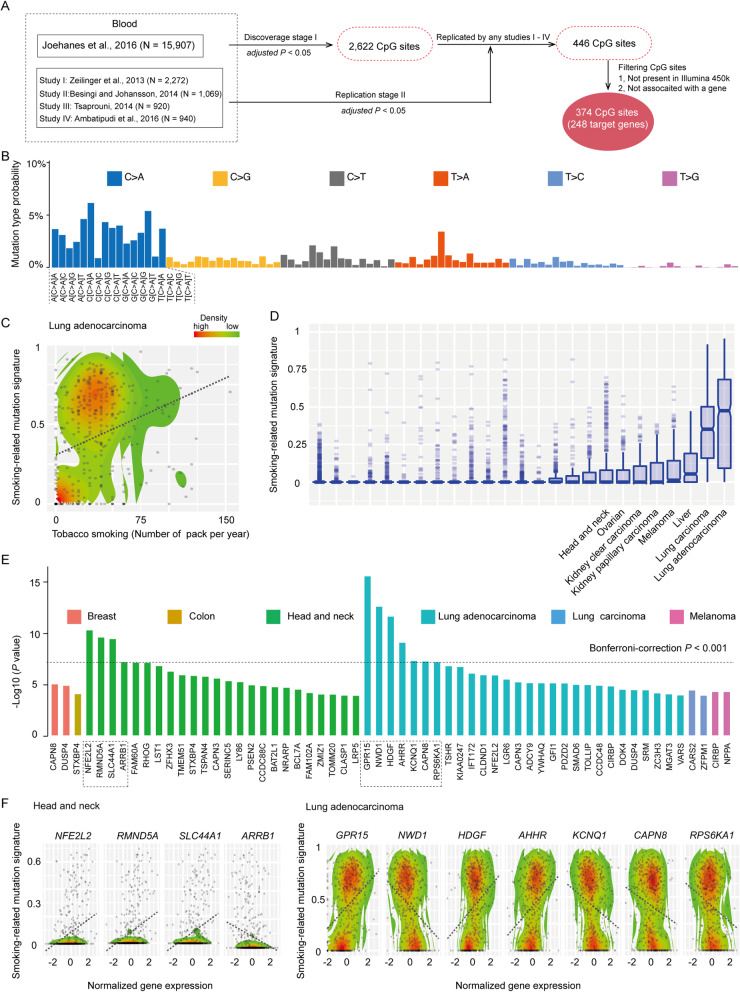
We systematically analyzed the smoking-related DNA methylation sites reported from five previous casecontrol studies in peripheral blood cells to identify possible target genes. Using the mediation analysis approach, we evaluated whether the association of tobacco smoking with mutational signature is mediated through altered DNA methylation and expression of these target genes in lung adenocarcinoma tumor tissues.
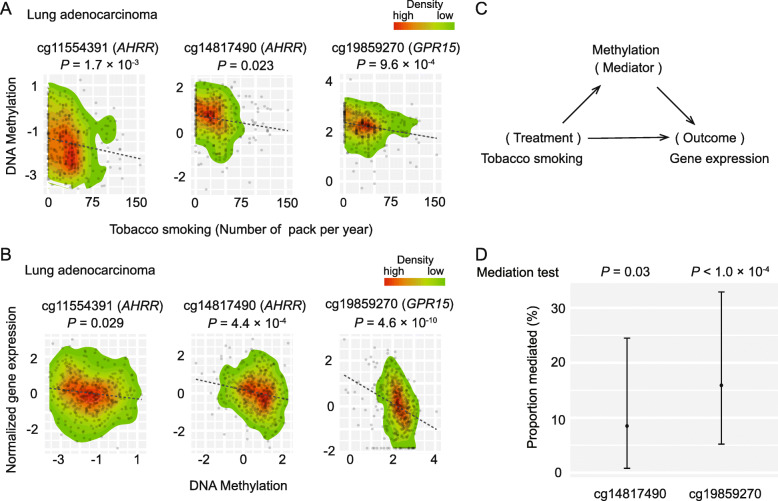
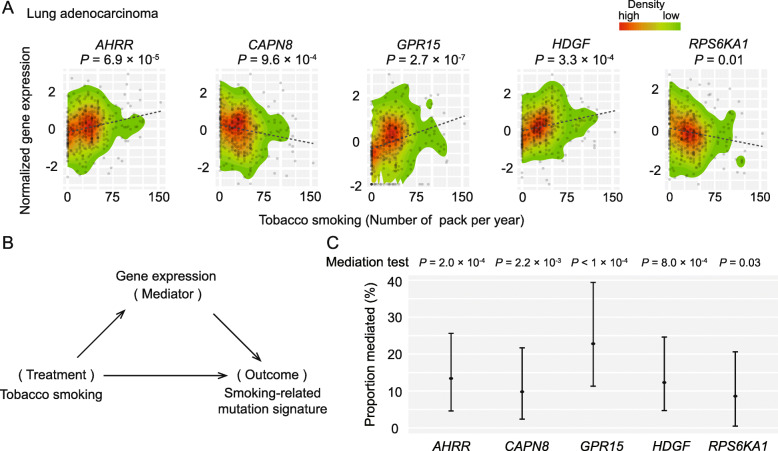
Based on data obtained from 21,108 blood samples, we identified 374 smoking-related DNA methylation sites, annotated to 248 target genes. Using data from DNA methylations, gene expressions and smoking-related mutational signature generated from ~ 7700 tumor tissue samples across 26 cancer types from The Cancer Genome Atlas (TCGA), we found 11 of the 248 target genes whose expressions were associated with smoking-related mutational signature at a Bonferroni-correction P < 0.001. This included four for head and neck cancer, and seven for lung adenocarcinoma. In lung adenocarcinoma, our results showed that smoking increased the expression of three genes, AHRR, GPR15, and HDGF, and decreased the expression of two genes, CAPN8, and RPS6KA1, which were consequently associated with increased smoking-related mutational signature. Additional evidence showed that the elevated expression of AHRR and GPR15 were associated with smoking-altered hypomethylations at cg14817490 and cg19859270, respectively, in lung adenocarcinoma tumor tissues. Lastly, we showed that decreased expression of RPS6KA1, were associated with poor survival of lung cancer patients.
Our findings provide novel insight into the contributions of tobacco smoking to carcinogenesis through the underlying mechanisms of the elevated mutational signature by altered DNA methylations and gene expressions.
吸烟与人类癌症基因组中的独特突变特征有关。目前尚不清楚吸烟改变的 DNA 甲基化和基因表达是否会影响与吸烟相关的突变特征。
我们系统地分析了来自五个先前病例对照研究的外周血细胞中报告的与吸烟相关的 DNA 甲基化位点,以确定可能的靶基因。使用中介分析方法,我们评估了吸烟与突变特征的关联是否通过这些靶基因在肺腺癌肿瘤组织中的 DNA 甲基化和表达的改变来介导。
基于来自 21108 个血液样本的数据,我们确定了 374 个与吸烟相关的 DNA 甲基化位点,注释到 248 个靶基因。使用来自 26 种癌症类型的约 7700 个肿瘤组织样本的 DNA 甲基化、基因表达和与吸烟相关的突变特征的数据,我们发现了 248 个靶基因中的 11 个,其表达与吸烟相关的突变特征在 Bonferroni 校正 P<0.001。这包括 4 个头颈部癌症和 7 个肺腺癌。在肺腺癌中,我们的结果表明,吸烟增加了三个基因 AHRR、GPR15 和 HDGF 的表达,降低了两个基因 CAPN8 和 RPS6KA1 的表达,这与吸烟相关的突变特征增加有关。进一步的证据表明,AHRR 和 GPR15 的表达升高与肺腺癌肿瘤组织中 cg14817490 和 cg19859270 处的吸烟改变的低甲基化有关。最后,我们表明 RPS6KA1 的表达降低与肺癌患者的不良预后有关。
我们的研究结果为吸烟通过改变 DNA 甲基化和基因表达来提高突变特征,从而为癌症的发生提供了新的见解。