Keegan Casey N, Johnston Craig A, Cardenas Victor J, Vaughan Elizabeth M
School of Health Professions, Baylor College of Medicine, Houston, TX 77030, USA.
Department of Health and Human Performance, University of Houston, Houston, TX 77004, USA.
J Pers Med. 2020 Sep 11;10(3):121. doi: 10.3390/jpm10030121.
Diabetes is a major contributor to morbidity and mortality. Community Health Workers (CHWs) have been instrumental in improving patient outcomes. However, CHW training largely focuses on general diabetes concepts rather than medications. Providing accessible, diabetes medication training for CHWs has the potential to increase patient understanding, personalized care, and adherence, thereby improving outcomes.
To evaluate the impact of a telehealth-based diabetes medication training for CHWs on patient outcomes as measured by HbA1c changes.
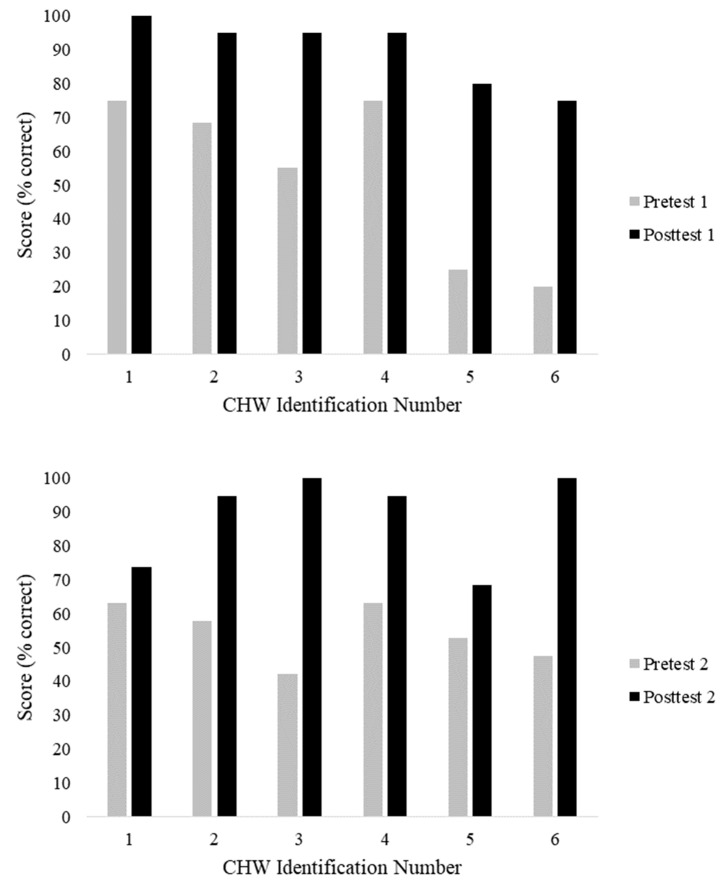
We provided a 12-month weekly, telehealth (videoconference) medication training for CHWs who led 6-month diabetes programs for low-income Latino(a)s in community clinics. We measured participant HbA1c (primary outcome), blood pressure, and body mass index (BMI) changes. We evaluated CHW knowledge via two pre/post-tests: medication adverse events/side effects (TEST-1, months 1-6) and dosing, titration, and emergencies (TEST-2, months 7-12). We assessed CHW training application by their ability to identify patient, provider, and healthcare system medication barriers.
Participants' (n = 55) HbA1c improved (9.0% (75 mmol/mol) to 7.8% (62 mmol/mol) ( = 0.001)). Blood pressure and BMI changes were not significant. CHWs improved their knowledge: TEST-1: 10.5-18.2/20.0 ( = 0.002), TEST-2: 10.3-17.3/19.0 ( = 0.0019). CHWs identified 984 patients (n = 610), providers (n = 151), and healthcare systems (n = 223) medication barriers during the 12-month training.
Providing a telehealth-based, diabetes medication training program for CHWs allowed a personalized approach to identify barriers to care at several levels, which was associated with significant participant HbA1c reductions and improved CHW knowledge. This is a promising cost-effective, culturally sensitive strategy to improve diabetes care. Larger longitudinal evaluations are needed to fully understand the impact of CHW medication training.
糖尿病是发病和死亡的主要原因。社区卫生工作者(CHW)在改善患者预后方面发挥了重要作用。然而,CHW培训主要侧重于糖尿病的一般概念而非药物治疗。为CHW提供易于获取的糖尿病药物治疗培训有可能提高患者的理解、个性化护理和依从性,从而改善预后。
评估通过远程医疗为CHW提供的糖尿病药物治疗培训对患者预后的影响,以糖化血红蛋白(HbA1c)变化来衡量。
我们为在社区诊所为低收入拉丁裔开展为期6个月糖尿病项目的CHW提供了为期12个月的每周一次远程医疗(视频会议)药物治疗培训。我们测量了参与者的HbA1c(主要结局)、血压和体重指数(BMI)变化。我们通过两次前后测试评估CHW的知识:药物不良事件/副作用(测试1,第1至6个月)以及给药、滴定和紧急情况(测试2,第7至12个月)。我们通过CHW识别患者、提供者和医疗保健系统药物治疗障碍的能力来评估CHW培训的应用情况。
参与者(n = 55)的HbA1c有所改善(从9.0%(75 mmol/mol)降至7.8%(62 mmol/mol),P = 0.001)。血压和BMI变化不显著。CHW的知识得到了提高:测试1:从10.5/20.0提高到18.2/20.0(P = 0.002),测试2:从10.3/19.0提高到17.3/19.0(P = 0.0019)。在为期12个月的培训期间,CHW识别出984例患者(n = 610)、提供者(n = 151)和医疗保健系统(n = 223)的药物治疗障碍。
为CHW提供基于远程医疗的糖尿病药物治疗培训项目,能够采用个性化方法识别多个层面的护理障碍,这与参与者HbA1c显著降低以及CHW知识的提高相关。这是一种有前景的具有成本效益且对文化敏感的改善糖尿病护理的策略。需要进行更大规模的纵向评估以充分了解CHW药物治疗培训的影响。