The Perinatal Institute and Section of Neonatology, Perinatal and Pulmonary Biology, Cincinnati Children's Hospital Medical Center, 3333 Burnet Avenue, MLC 7009, Cincinnati, OH, 45229, USA.
Department of Pediatrics, University of Cincinnati College of Medicine, Cincinnati, OH, USA.
Sci Rep. 2020 Sep 15;10(1):15072. doi: 10.1038/s41598-020-71914-x.
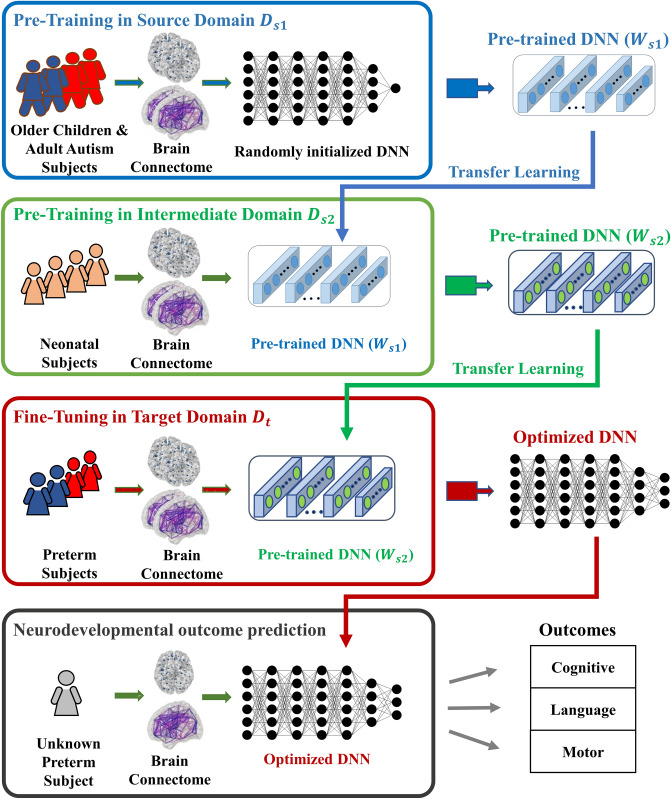
Survivors following very premature birth (i.e., ≤ 32 weeks gestational age) remain at high risk for neurodevelopmental impairments. Recent advances in deep learning techniques have made it possible to aid the early diagnosis and prognosis of neurodevelopmental deficits. Deep learning models typically require training on large datasets, and unfortunately, large neuroimaging datasets with clinical outcome annotations are typically limited, especially in neonates. Transfer learning represents an important step to solve the fundamental problem of insufficient training data in deep learning. In this work, we developed a multi-task, multi-stage deep transfer learning framework using the fusion of brain connectome and clinical data for early joint prediction of multiple abnormal neurodevelopmental (cognitive, language and motor) outcomes at 2 years corrected age in very preterm infants. The proposed framework maximizes the value of both available annotated and non-annotated data in model training by performing both supervised and unsupervised learning. We first pre-trained a deep neural network prototype in a supervised fashion using 884 older children and adult subjects, and then re-trained this prototype using 291 neonatal subjects without supervision. Finally, we fine-tuned and validated the pre-trained model using 33 preterm infants. Our proposed model identified very preterm infants at high-risk for cognitive, language, and motor deficits at 2 years corrected age with an area under the receiver operating characteristic curve of 0.86, 0.66 and 0.84, respectively. Employing such a deep learning model, once externally validated, may facilitate risk stratification at term-equivalent age for early identification of long-term neurodevelopmental deficits and targeted early interventions to improve clinical outcomes in very preterm infants.
极早产儿(即妊娠 32 周以下)的幸存者仍然存在神经发育障碍的高风险。深度学习技术的最新进展使得早期诊断和预测神经发育缺陷成为可能。深度学习模型通常需要在大型数据集上进行训练,但遗憾的是,具有临床结果注释的大型神经影像学数据集通常是有限的,尤其是在新生儿中。迁移学习是解决深度学习中数据不足这一基本问题的重要步骤。在这项工作中,我们开发了一种多任务、多阶段的深度迁移学习框架,该框架使用大脑连接组和临床数据融合,对极早产儿 2 岁校正年龄时多种异常神经发育(认知、语言和运动)结局进行早期联合预测。该框架通过执行监督学习和无监督学习,最大限度地提高了模型训练中可用的有注释和无注释数据的价值。我们首先使用 884 名年龄较大的儿童和成人受试者以监督方式对深度神经网络原型进行预训练,然后在没有监督的情况下对 291 名新生儿受试者重新进行训练。最后,我们使用 33 名早产儿对预训练模型进行微调并验证。我们提出的模型使用接受者操作特征曲线下的面积为 0.86、0.66 和 0.84,分别识别出了在 2 岁校正年龄时认知、语言和运动缺陷风险高的极早产儿。一旦经过外部验证,采用这种深度学习模型可能有助于在胎龄相等时进行风险分层,以便早期识别长期神经发育缺陷,并对极早产儿进行早期干预以改善临床结局。