Biomedical Image Computing Group, School of Computer Science and Engineering, University of New South Wales (UNSW), Sydney, New South Wales, Australia.
Department of Radiology, Brigham and Women's Hospital, Harvard Medical School, Boston, Massachusetts, USA.
Hum Brain Mapp. 2024 Aug 15;45(12):e70008. doi: 10.1002/hbm.70008.
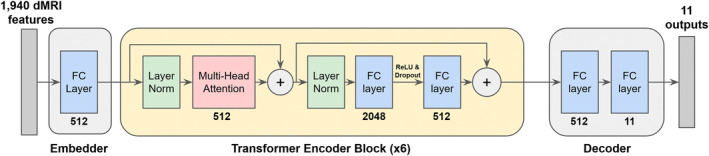
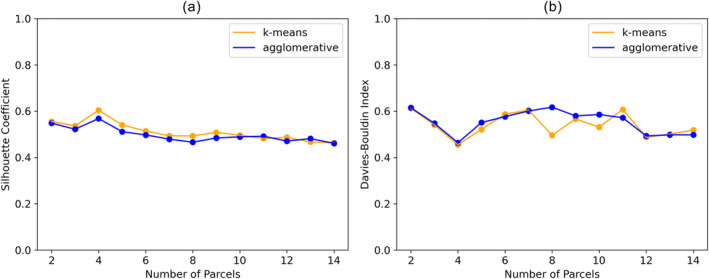
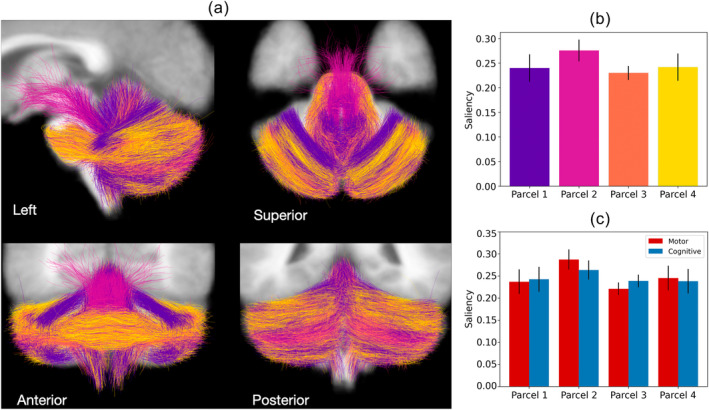
Parcellation of human cerebellar pathways is essential for advancing our understanding of the human brain. Existing diffusion magnetic resonance imaging tractography parcellation methods have been successful in defining major cerebellar fibre tracts, while relying solely on fibre tract structure. However, each fibre tract may relay information related to multiple cognitive and motor functions of the cerebellum. Hence, it may be beneficial for parcellation to consider the potential importance of the fibre tracts for individual motor and cognitive functional performance measures. In this work, we propose a multimodal data-driven method for cerebellar pathway parcellation, which incorporates both measures of microstructure and connectivity, and measures of individual functional performance. Our method involves first training a multitask deep network to predict various cognitive and motor measures from a set of fibre tract structural features. The importance of each structural feature for predicting each functional measure is then computed, resulting in a set of structure-function saliency values that are clustered to parcellate cerebellar pathways. We refer to our method as Deep Multimodal Saliency Parcellation (DeepMSP), as it computes the saliency of structural measures for predicting cognitive and motor functional performance, with these saliencies being applied to the task of parcellation. Applying DeepMSP to a large-scale dataset from the Human Connectome Project Young Adult study (n = 1065), we found that it was feasible to identify multiple cerebellar pathway parcels with unique structure-function saliency patterns that were stable across training folds. We thoroughly experimented with all stages of the DeepMSP pipeline, including network selection, structure-function saliency representation, clustering algorithm, and cluster count. We found that a 1D convolutional neural network architecture and a transformer network architecture both performed comparably for the multitask prediction of endurance, strength, reading decoding, and vocabulary comprehension, with both architectures outperforming a fully connected network architecture. Quantitative experiments demonstrated that a proposed low-dimensional saliency representation with an explicit measure of motor versus cognitive category bias achieved the best parcellation results, while a parcel count of four was most successful according to standard cluster quality metrics. Our results suggested that motor and cognitive saliencies are distributed across the cerebellar white matter pathways. Inspection of the final k = 4 parcellation revealed that the highest-saliency parcel was most salient for the prediction of both motor and cognitive performance scores and included parts of the middle and superior cerebellar peduncles. Our proposed saliency-based parcellation framework, DeepMSP, enables multimodal, data-driven tractography parcellation. Through utilising both structural features and functional performance measures, this parcellation strategy may have the potential to enhance the study of structure-function relationships of the cerebellar pathways.
人类小脑通路的分割对于深入了解人类大脑至关重要。现有的扩散磁共振成像束流追踪分割方法在定义主要小脑纤维束方面取得了成功,而仅依赖于纤维束结构。然而,每条纤维束都可能传递与小脑的多个认知和运动功能相关的信息。因此,考虑纤维束对个体运动和认知功能表现测量的潜在重要性,可能对分割有益。在这项工作中,我们提出了一种基于多模态数据驱动的小脑通路分割方法,该方法结合了微观结构和连通性的度量,以及个体功能表现的度量。我们的方法首先训练一个多任务深度网络,从一组纤维束结构特征中预测各种认知和运动测量值。然后计算每个结构特征对预测每个功能测量值的重要性,从而得到一组结构-功能显着性值,这些值将被聚类以分割小脑通路。我们将我们的方法称为深度多模态显着性分割(DeepMSP),因为它计算了结构测量值预测认知和运动功能表现的显着性,这些显着性被应用于分割任务。将 DeepMSP 应用于来自人类连接组计划青年研究的大规模数据集(n=1065),我们发现可以识别具有独特结构-功能显着性模式的多个小脑通路包裹体,这些模式在训练折叠中是稳定的。我们彻底地实验了 DeepMSP 管道的所有阶段,包括网络选择、结构-功能显着性表示、聚类算法和聚类数量。我们发现,一维卷积神经网络架构和变压器网络架构在耐力、力量、阅读解码和词汇理解的多任务预测方面表现相当,这两种架构都优于全连接网络架构。定量实验表明,具有运动与认知类别偏差显式度量的提议低维显着性表示形式获得了最佳的分割结果,而根据标准聚类质量指标,包裹体数量为 4 时最成功。我们的结果表明,运动和认知显着性分布在小脑白质通路中。对最终 k=4 分割的检查表明,最高显着性包裹体对运动和认知表现评分的预测最为显着,包括中脑和上脑桥的部分。我们提出的基于显着性的分割框架 DeepMSP,实现了多模态、数据驱动的束流追踪分割。通过利用结构特征和功能表现度量,这种分割策略有可能增强对小脑通路结构-功能关系的研究。