The Department of Cell Biology and Molecular Genetics, The University of Maryland, College Park, MD, 20742, USA.
The Department of General Pathology, Federal University of Minas Gerais, Belo Horizonte, MG, Brazil.
Cell Mol Immunol. 2021 Mar;18(3):579-587. doi: 10.1038/s41423-020-00541-3. Epub 2020 Sep 15.
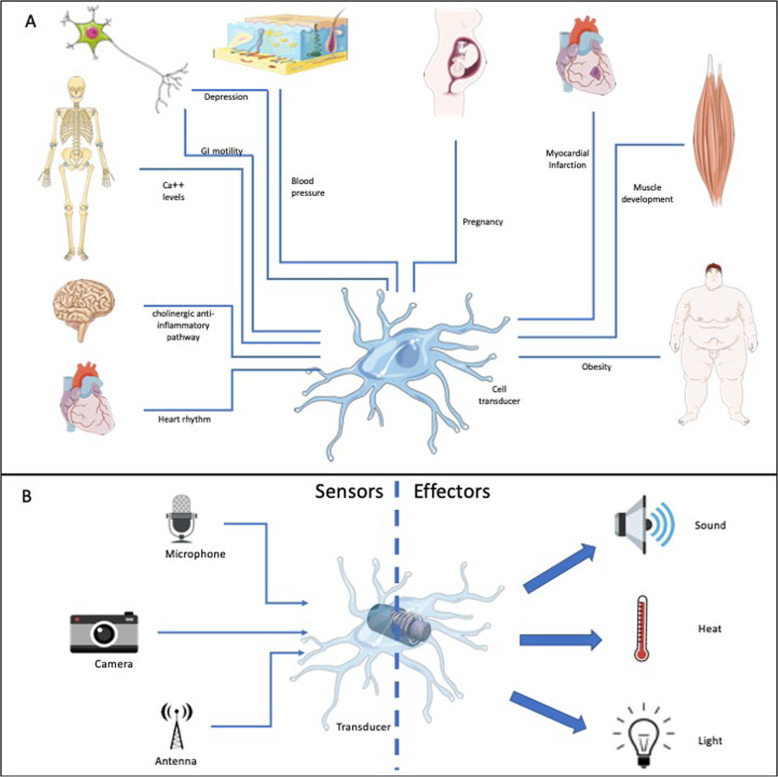
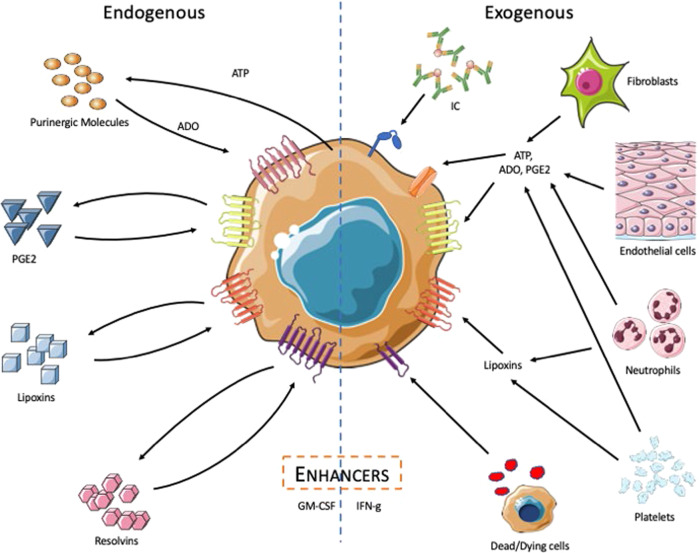
There have been many chapters written about macrophage polarization. These chapters generally focus on the role of macrophages in orchestrating immune responses by highlighting the T-cell-derived cytokines that shape these polarizing responses. This bias toward immunity is understandable, given the importance of macrophages to host defense. However, macrophages are ubiquitous and are involved in many different cellular processes, and describing them as immune cells is undoubtedly an oversimplification. It disregards their important roles in development, tissue remodeling, wound healing, angiogenesis, and metabolism, to name just a few processes. In this chapter, we propose that macrophages function as transducers in the body. According to Wikipedia, "A transducer is a device that converts energy from one form to another." The word transducer is a term used to describe both the "sensor," which can interpret a wide range of energy forms, and the "actuator," which can switch voltages or currents to affect the environment. Macrophages are able to sense a seemingly endless variety of inputs from their environment and transduce these inputs into a variety of different response outcomes. Thus, rather than functioning as immune cells, they should be considered more broadly as cellular transducers that interpret microenvironmental changes and actuate vital tissue responses. In this chapter, we will describe some of the sensory stimuli that macrophages perceive and the responses they make to these stimuli to achieve their prime directive, which is the maintenance of homeostasis.
关于巨噬细胞极化已经有很多章节进行了描述。这些章节通常侧重于巨噬细胞在协调免疫反应中的作用,突出了塑造这些极化反应的 T 细胞衍生细胞因子。鉴于巨噬细胞对宿主防御的重要性,这种对免疫的偏向是可以理解的。然而,巨噬细胞无处不在,参与许多不同的细胞过程,将它们描述为免疫细胞无疑是过于简单化了。它忽略了它们在发育、组织重塑、伤口愈合、血管生成和代谢等许多过程中的重要作用。在本章中,我们提出巨噬细胞在体内充当信号转导器。根据维基百科的定义,“传感器是一种将能量从一种形式转换为另一种形式的设备。”传感器这个词既可以用来描述能够解释各种能量形式的“传感器”,也可以用来描述能够将电压或电流转换为影响环境的“执行器”。巨噬细胞能够感知来自其环境的看似无穷无尽的各种输入,并将这些输入转化为各种不同的反应结果。因此,它们的功能与其说是免疫细胞,不如说是更广泛的细胞信号转导器,能够解释微环境的变化并引发重要的组织反应。在本章中,我们将描述巨噬细胞感知到的一些感觉刺激以及它们对这些刺激的反应,以实现它们的主要指令,即维持内稳态。