Hu Ying, Zhang Xinfang, Gong Cuixue, Li Jianzhao
Department of Blood Transfusion, Qilu Hospital Huantai Branch, Zibo, Shandong 256400, P.R. China.
Clinical Laboratory, Qilu Hospital Huantai Branch, Zibo, Shandong 256400, P.R. China.
Exp Ther Med. 2020 Nov;20(5):15. doi: 10.3892/etm.2020.9141. Epub 2020 Aug 26.
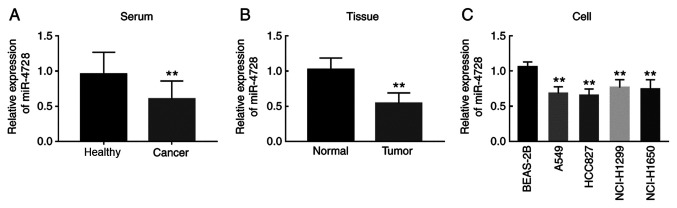
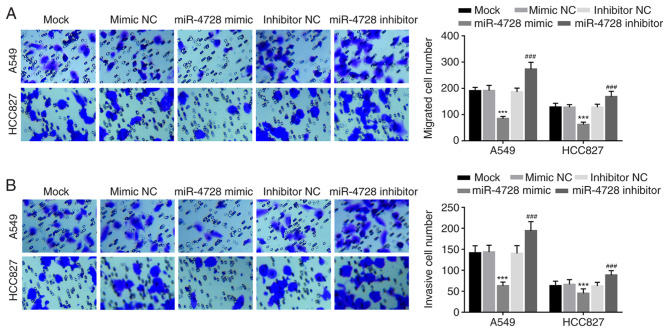
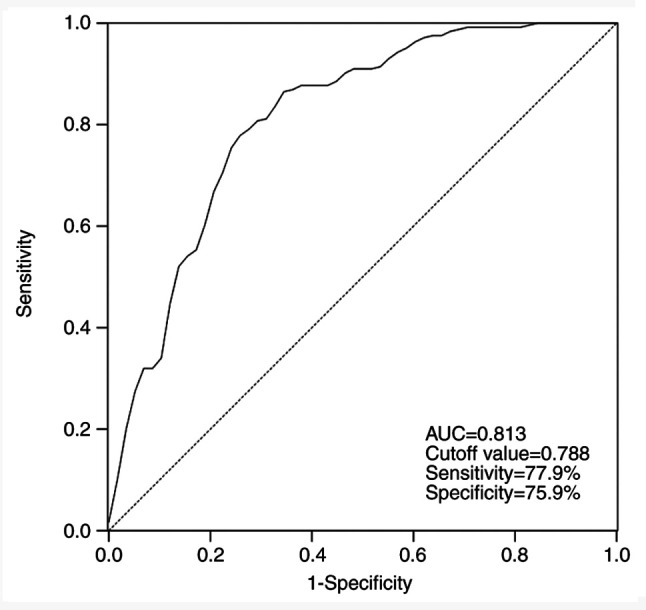
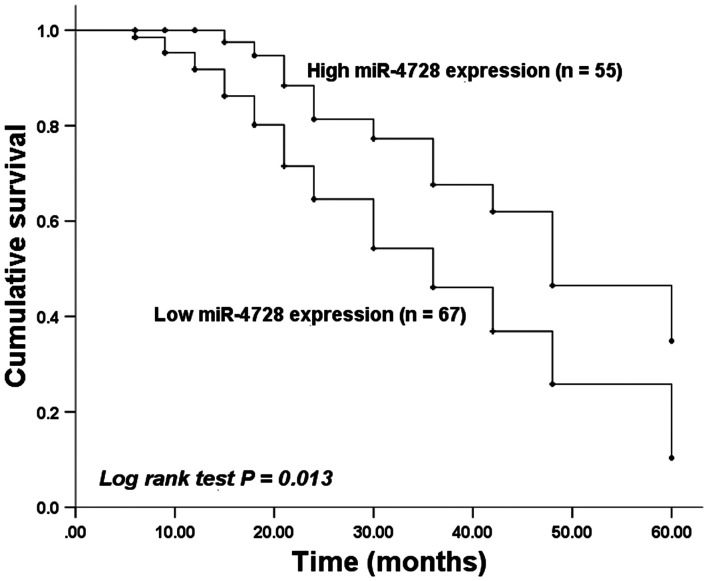
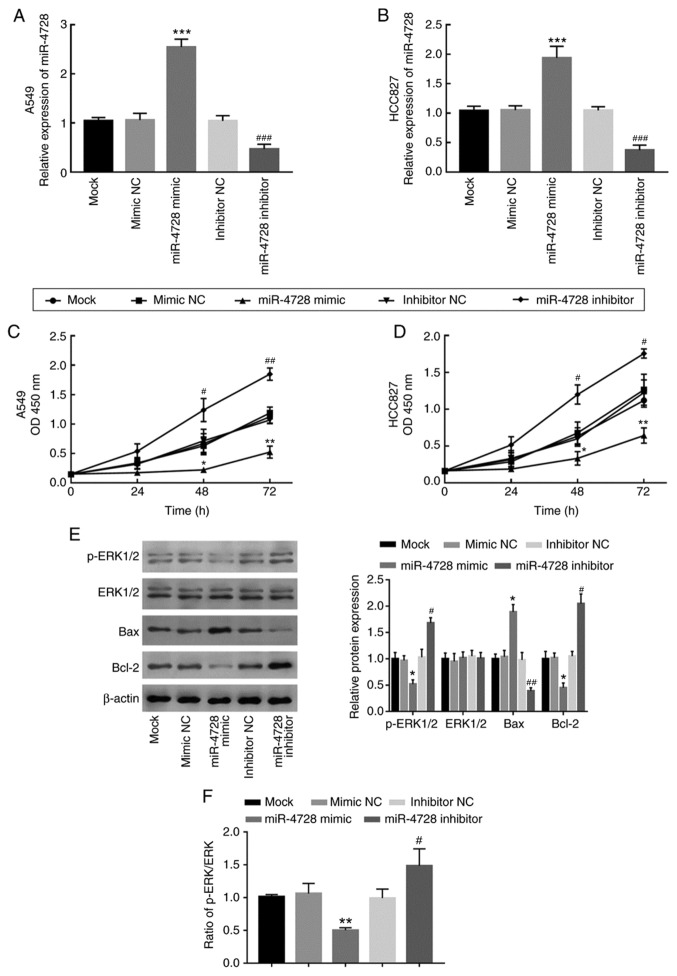
Non-small cell lung cancer (NSCLC) is a common malignant tumor with poor prognosis and an increasing number of cases. MicroRNA (miR)-4728 is related with the progression of various types of cancer, and is dysregulated in NSCLC, which indicates that miR-4728 may serve as a biomarker for NSCLC. The present study aimed to investigate the clinical significance of miR-4728 in NSCLC diagnosis and prognosis, and to explore the biological function of miR-4728 in NSCLC progression. Serum and tissue samples were collected from 122 patients with NSCLC. By conducting reverse transcription-quantitative PCR, the Cell Counting Kit-8 assay and Transwell assays, the expression of miR-4728 and its effect on NSCLC cell proliferation, migration and invasion were investigated. The diagnostic value of miR-4728 was evaluated by plotting a receiver operating characteristic curve, and Kaplan-Meier and Cox regression analyses were conducted to assess the prognostic value of miR-4728. miR-4728 was significantly downregulated in NSCLC serum and tissue samples compared with healthy controls, with a relatively high diagnostic accuracy and ability to predict poor overall survival time in patients with NSCLC. By conducting gain- and loss-of-function experiments, the results indicated that miR-4728 knockdown significantly promoted NSCLC cell proliferation, migration and invasion compared with the inhibitor negative control (NC) group. By contrast, miR-4728 overexpression displayed the opposite effect on NSCLC cell proliferation, migration and invasion. The present study indicated that miR-4728 was downregulated in NSCLC and may serve as a candidate diagnostic and prognostic biomarker. NSCLC cell proliferation, migration and invasion were inhibited by miR-4728 overexpression compared with the mimic NC group, which suggested that miR-4728 may serve as a therapeutic target for NSCLC.
非小细胞肺癌(NSCLC)是一种常见的恶性肿瘤,预后较差且病例数不断增加。微小RNA(miR)-4728与多种癌症的进展相关,且在NSCLC中表达失调,这表明miR-4728可能作为NSCLC的生物标志物。本研究旨在探讨miR-4728在NSCLC诊断和预后中的临床意义,并探索miR-4728在NSCLC进展中的生物学功能。收集了122例NSCLC患者的血清和组织样本。通过逆转录定量PCR、细胞计数试剂盒-8检测和Transwell检测,研究了miR-4728的表达及其对NSCLC细胞增殖、迁移和侵袭的影响。通过绘制受试者工作特征曲线评估miR-4728的诊断价值,并进行Kaplan-Meier和Cox回归分析以评估miR-4728的预后价值。与健康对照相比,NSCLC血清和组织样本中miR-4728显著下调,具有相对较高的诊断准确性和预测NSCLC患者总生存时间较差的能力。通过进行功能获得和功能丧失实验,结果表明与抑制剂阴性对照(NC)组相比,miR-4728敲低显著促进了NSCLC细胞的增殖、迁移和侵袭。相比之下,miR-4728过表达对NSCLC细胞的增殖、迁移和侵袭表现出相反的作用。本研究表明,miR-4728在NSCLC中下调,可能作为候选的诊断和预后生物标志物。与模拟NC组相比,miR-4728过表达抑制了NSCLC细胞的增殖、迁移和侵袭,这表明miR-4728可能作为NSCLC的治疗靶点。