Department of Microbiology, University of Granada, Spain.
Nat Prod Rep. 2021 Jan 1;38(1):130-239. doi: 10.1039/d0np00027b. Epub 2020 Sep 16.
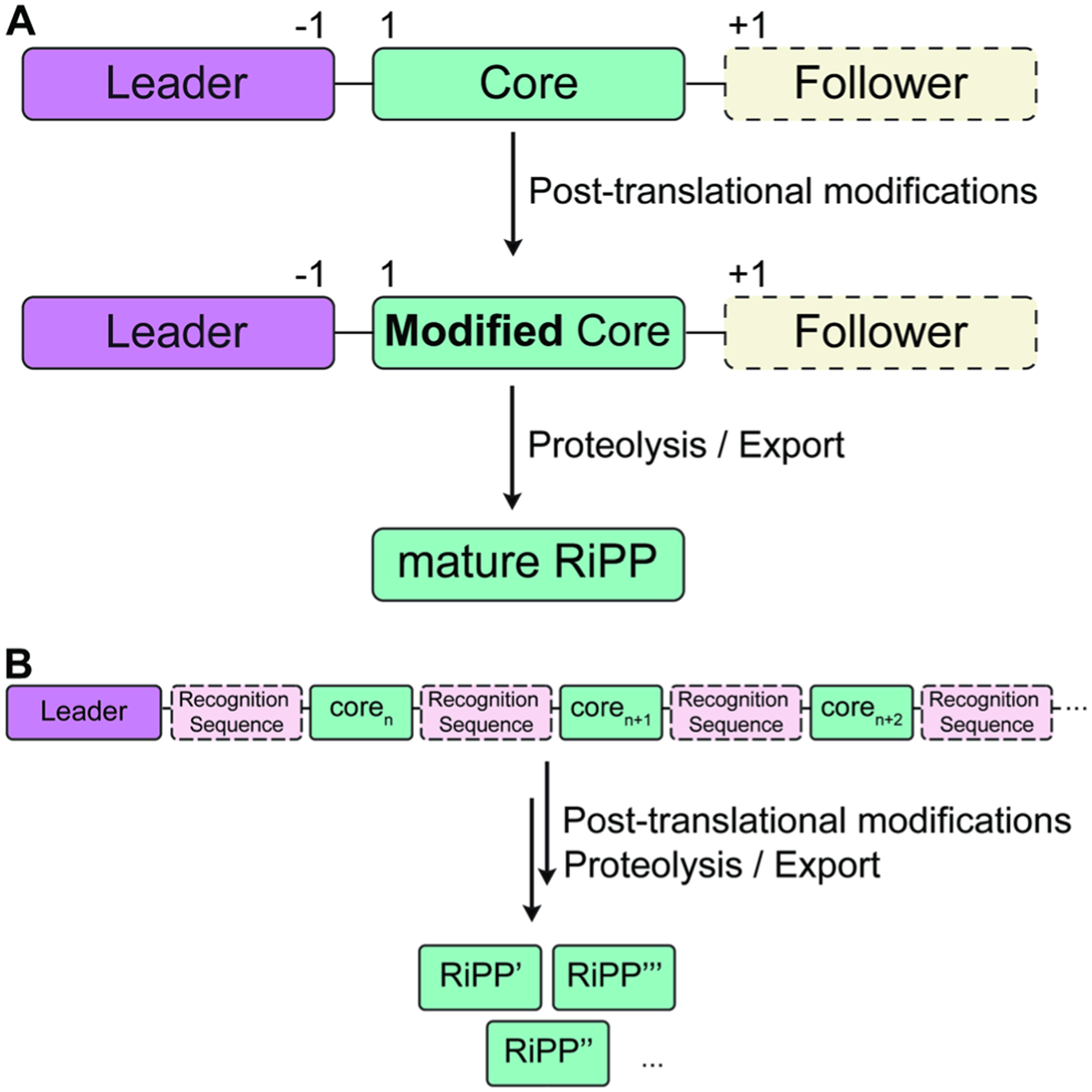
Covering: up to June 2020Ribosomally-synthesized and post-translationally modified peptides (RiPPs) are a large group of natural products. A community-driven review in 2013 described the emerging commonalities in the biosynthesis of RiPPs and the opportunities they offered for bioengineering and genome mining. Since then, the field has seen tremendous advances in understanding of the mechanisms by which nature assembles these compounds, in engineering their biosynthetic machinery for a wide range of applications, and in the discovery of entirely new RiPP families using bioinformatic tools developed specifically for this compound class. The First International Conference on RiPPs was held in 2019, and the meeting participants assembled the current review describing new developments since 2013. The review discusses the new classes of RiPPs that have been discovered, the advances in our understanding of the installation of both primary and secondary post-translational modifications, and the mechanisms by which the enzymes recognize the leader peptides in their substrates. In addition, genome mining tools used for RiPP discovery are discussed as well as various strategies for RiPP engineering. An outlook section presents directions for future research.
截至 2020 年 6 月
核糖体合成和翻译后修饰肽(RiPPs)是一大类天然产物。2013 年,一个由社区驱动的综述描述了 RiPP 生物合成中新兴的共性以及它们为生物工程和基因组挖掘提供的机会。自那时以来,人们在理解自然界组装这些化合物的机制方面取得了巨大进展,在为广泛的应用工程改造它们的生物合成机制方面取得了巨大进展,并且使用专门为此类化合物开发的生物信息学工具发现了全新的 RiPP 家族。第一届 RiPPs 国际会议于 2019 年举行,会议参与者撰写了这篇综述,描述了自 2013 年以来的新进展。该综述讨论了已发现的新 RiPP 类,我们对主要和次要翻译后修饰安装的理解的进展,以及酶识别其底物中引导肽的机制。此外,还讨论了用于 RiPP 发现的基因组挖掘工具以及各种 RiPP 工程策略。展望部分提出了未来研究的方向。