Clinical Psychology Department, Leiden University, Leiden, The Netherlands.
Department of Psychiatry and Medical Psychology, University of Navarra, Pamplona, Spain.
PLoS One. 2020 Sep 16;15(9):e0238131. doi: 10.1371/journal.pone.0238131. eCollection 2020.
The recommendations of experts who write review articles are a critical determinant of the adaptation of new treatments by clinicians. Several types of reviews exist (narrative, systematic, meta-analytic), and some of these are more vulnerable to researcher bias than others. Recently, the interest in nutritional interventions in psychiatry has increased and many experts, who are often active researchers on this topic, have come to strong conclusions about the benefits of a healthy diet on depression. In a young and active field of study, we aimed to investigate whether the strength of an author's conclusion is associated with the type of review article they wrote.
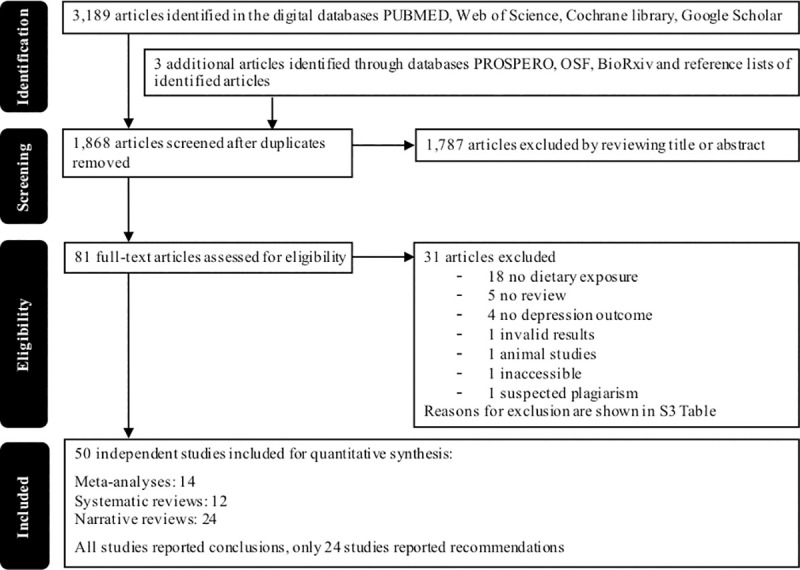
Systematic searches were performed in PubMed, Web of Science, Cochrane Database of Systematic Reviews, and Google Scholar for narrative reviews and systematic reviews with and without meta-analyses on the effects of diet on depression (final search date: May 30th, 2020). Conclusions were extracted from the abstract and discussion section and rated as strong, moderate, or weak by independent raters who were blind to study type. A benchmark on legitimate conclusion strength was based on a GRADE assessment of the highest level of evidence. This systematic review was registered with PROSPERO, number CRD42020141372.
24 narrative reviews, 12 systematic reviews, and 14 meta-analyses were included. In the abstract, 33% of narrative reviews and 8% of systematic reviews came to strong conclusions, whereas no meta-analysis did. Narrative reviews were 8.94 (95% CI: 2.17, 36.84) times more likely to report stronger conclusions in the abstract than systematic reviews with and without meta-analyses. These findings were similar for conclusions in the discussion section. Narrative reviews used 45.6% fewer input studies and were more likely to be written by authors with potential conflicts of interest. A study limitation is the subjective nature of the conclusion classification system despite high inter-rater agreements and its confirmation outside of the review team.
We have shown that narrative reviews come to stronger conclusions about the benefits of a healthy diet on depression despite inconclusive evidence. This finding empirically underscores the importance of a systematic method for summarizing the evidence of a field of study. Journal editors may want to reconsider publishing narrative reviews before meta-analytic reviews are available.
撰写综述文章的专家的建议是临床医生采用新治疗方法的关键决定因素。有几种类型的综述(叙述性、系统性、荟萃分析),其中一些比其他综述更容易受到研究人员偏见的影响。最近,人们对精神病学中的营养干预措施产生了浓厚的兴趣,许多经常积极研究这个主题的专家就健康饮食对抑郁症的益处得出了明确的结论。在一个年轻而活跃的研究领域,我们旨在研究作者结论的力度是否与他们撰写的综述文章类型有关。
在 PubMed、Web of Science、Cochrane 系统评价数据库和 Google Scholar 中进行了系统搜索,以查找关于饮食对抑郁症影响的叙述性综述和有或没有荟萃分析的系统综述(最后搜索日期:2020 年 5 月 30 日)。结论从摘要和讨论部分中提取出来,并由独立的评估人员根据盲法对研究类型进行评估,分为强、中、弱。基于对最高证据水平的 GRADE 评估,设定了合法结论强度的基准。本系统评价已在 PROSPERO 注册,编号为 CRD42020141372。
共纳入 24 篇叙述性综述、12 篇系统性综述和 14 篇荟萃分析。在摘要中,33%的叙述性综述和 8%的系统性综述得出了强有力的结论,而没有荟萃分析得出了结论。与有和没有荟萃分析的系统综述相比,叙述性综述在摘要中报告更强有力结论的可能性高 8.94 倍(95%CI:2.17,36.84)。讨论部分的结论也是如此。叙述性综述使用的输入研究少 45.6%,并且更有可能由有潜在利益冲突的作者撰写。研究的局限性是尽管评估者之间的一致性很高,但结论分类系统具有主观性,并且无法在审查小组之外进行确认。
尽管证据尚无定论,但我们已经表明,叙述性综述对健康饮食对抑郁症的益处得出了更强有力的结论。这一发现从经验上强调了系统方法总结研究领域证据的重要性。期刊编辑可能希望在有荟萃分析评论之前重新考虑发表叙述性评论。