College of Emergency Preparedness, Homeland Security, and Cybersecurity, University at Albany, State University of New York, Albany, New York, United States of America.
Department of Sociology, University of California Irvine, Irvine, California, United States of America.
PLoS One. 2020 Sep 16;15(9):e0238491. doi: 10.1371/journal.pone.0238491. eCollection 2020.
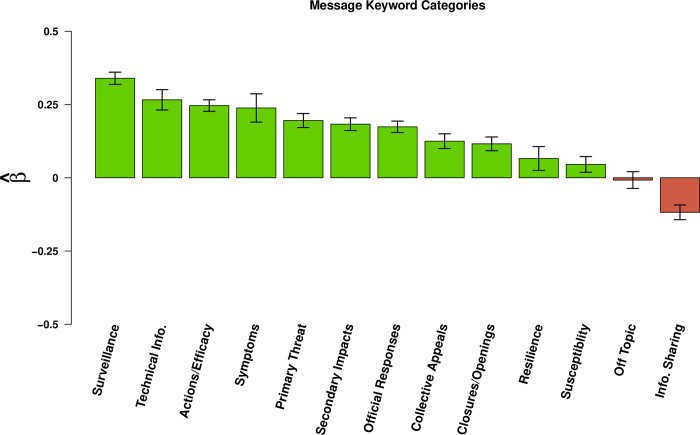
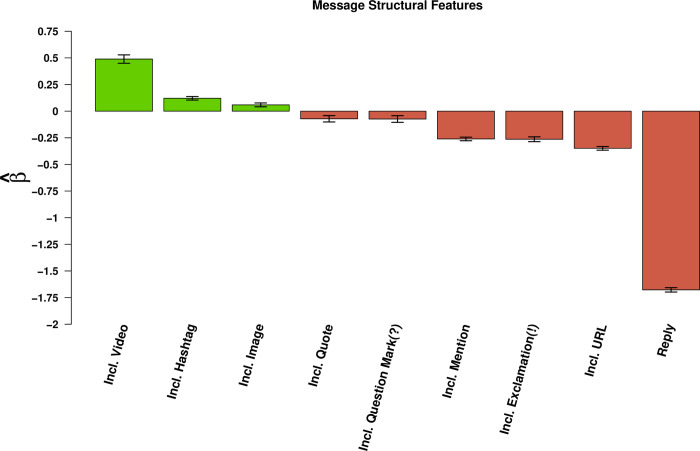
As the most visible face of health expertise to the general public, health agencies have played a central role in alerting the public to the emerging COVID-19 threat, providing guidance for protective action, motivating compliance with health directives, and combating misinformation. Social media platforms such as Twitter have been a critical tool in this process, providing a communication channel that allows both rapid dissemination of messages to the public at large and individual-level engagement. Message dissemination and amplification is a necessary precursor to reaching audiences, both online and off, as well as inspiring action. Therefore, it is valuable for organizational risk communication to identify strategies and practices that may lead to increased message passing among online users. In this research, we examine message features shown in prior disasters to increase or decrease message retransmission under imminent threat conditions to develop models of official risk communicators' messages shared online from February 1, 2020-April 30, 2020. We develop a lexicon of keywords associated with risk communication about the pandemic response, then use automated coding to identify message content and message structural features. We conduct chi-square analyses and negative binomial regression modeling to identify the strategies used by official risk communicators that respectively increase and decrease message retransmission. Findings show systematic changes in message strategies over time and identify key features that affect message passing, both positively and negatively. These results have the potential to aid in message design strategies as the pandemic continues, or in similar future events.
作为公众眼中最能代表医学专业知识的形象,卫生机构在向公众发出新冠病毒这一新兴威胁的警报、为采取防护措施提供指导、促使公众遵守卫生指令以及打击错误信息方面发挥了核心作用。Twitter 等社交媒体平台在这一过程中是一个至关重要的工具,为信息的传播提供了一个渠道,使信息能迅速传播给广大公众和个人。信息的传播和放大是接触受众的必要前提,无论是线上还是线下,也可以激发行动。因此,对于组织的风险沟通来说,确定可能导致在线用户之间更多信息传递的策略和做法是有价值的。在这项研究中,我们研究了在先前灾害中显示的信息特征,以增加或减少在迫在眉睫的威胁情况下的信息再传播,从而为 2020 年 2 月 1 日至 2020 年 4 月 30 日期间在网上分享的官方风险沟通者的信息开发模型。我们创建了一个与大流行病应对的风险沟通相关的关键词词汇表,然后使用自动编码来识别信息内容和信息结构特征。我们进行了卡方分析和负二项回归建模,以确定官方风险沟通者分别增加和减少信息再传播的策略。研究结果表明,随着时间的推移,信息策略发生了系统性的变化,并确定了影响信息传递的关键特征,无论是积极的还是消极的。这些结果有可能在大流行病持续或类似的未来事件中为信息设计策略提供帮助。