Feinhandler Ian, Cilento Benjamin, Beauvais Brad, Harrop Jordan, Fulton Lawrence
Department of Geography and Political Sciences, Front Range Community College, Longmont, CO 80501, USA.
Memorial Hermann Hospital, Houston, TX 77024, USA.
Healthcare (Basel). 2020 Sep 14;8(3):339. doi: 10.3390/healthcare8030339.
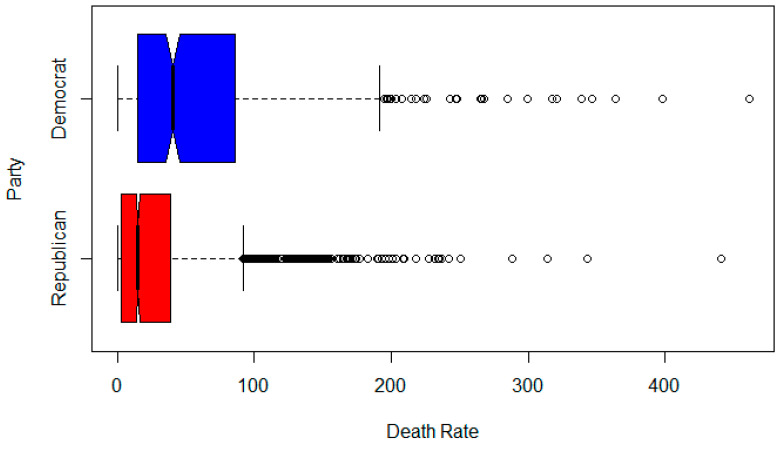
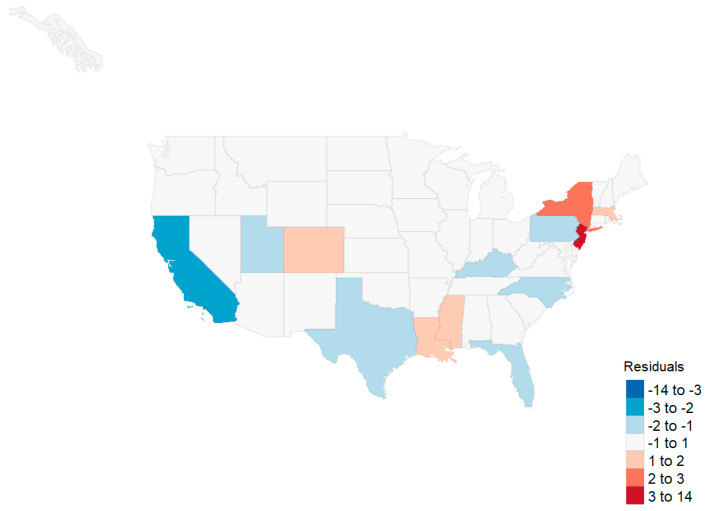
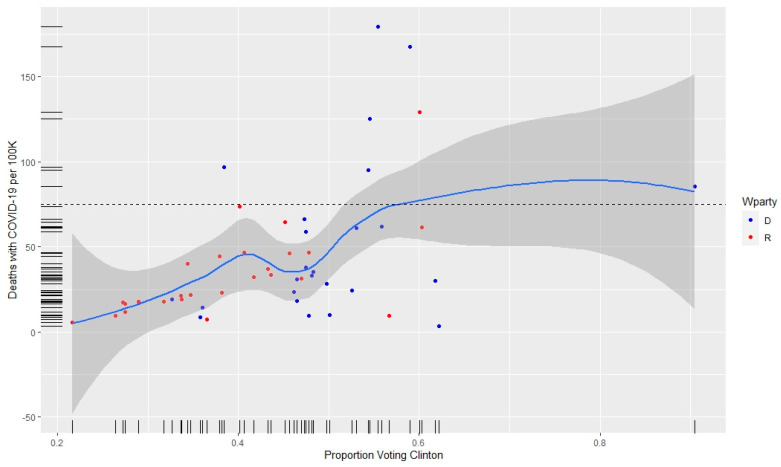
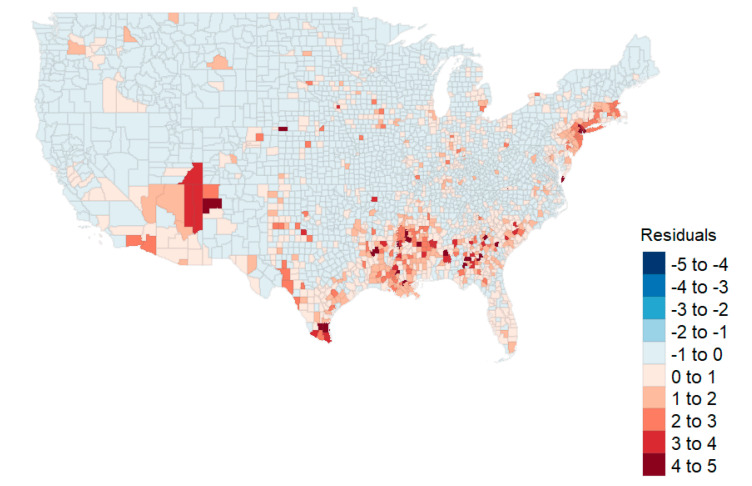
Coronavirus (COVID-19) is a potentially fatal viral infection. This study investigates geography, demography, socioeconomics, health conditions, hospital characteristics, and politics as potential explanatory variables for death rates at the state and county levels. Data from the Centers for Disease Control and Prevention, the Census Bureau, Centers for Medicare and Medicaid, Definitive Healthcare, and USAfacts.org were used to evaluate regression models. Yearly pneumonia and flu death rates (state level, 2014-2018) were evaluated as a function of the governors' political party using a repeated measures analysis. At the state and county level, spatial regression models were evaluated. At the county level, we discovered a statistically significant model that included geography, population density, racial and ethnic status, three health status variables along with a political factor. A state level analysis identified health status, minority status, and the interaction between governors' parties and health status as important variables. The political factor, however, did not appear in a subsequent analysis of 2014-2018 pneumonia and flu death rates. The pathogenesis of COVID-19 has a greater and disproportionate effect within racial and ethnic minority groups, and the political influence on the reporting of COVID-19 mortality was statistically relevant at the county level and as an interaction term only at the state level.
冠状病毒(COVID-19)是一种具有潜在致命性的病毒感染。本研究调查地理、人口统计学、社会经济学、健康状况、医院特征和政治因素,将其作为州和县级死亡率的潜在解释变量。来自疾病控制与预防中心、人口普查局、医疗保险和医疗补助中心、Definitive Healthcare以及USAfacts.org的数据被用于评估回归模型。使用重复测量分析,将年度肺炎和流感死亡率(州级,2014 - 2018年)作为州长政党的函数进行评估。在州和县级层面,评估了空间回归模型。在县级,我们发现了一个具有统计学意义的模型,该模型包括地理、人口密度、种族和民族状况、三个健康状况变量以及一个政治因素。州级分析确定健康状况、少数群体状况以及州长政党与健康状况之间的相互作用为重要变量。然而,在随后对2014 - 2018年肺炎和流感死亡率的分析中,政治因素并未出现。COVID-19的发病机制在种族和少数民族群体中产生了更大且不成比例的影响,并且政治因素对COVID-19死亡率报告的影响在县级具有统计学相关性,而在州级仅作为一个交互项具有相关性。