School of Biotechnology and Biomolecular Sciences, The University of New South Wales, Sydney, 2052, Australia.
Australian Centre for Astrobiology, University of New South Wales, Sydney, Australia.
Microbiome. 2020 Sep 16;8(1):135. doi: 10.1186/s40168-020-00910-0.
Shark Bay, Australia, harbours one of the most extensive and diverse systems of living microbial mats that are proposed to be analogs of some of the earliest ecosystems on Earth. These ecosystems have been shown to possess a substantial abundance of uncultivable microorganisms. These enigmatic microbes, jointly coined as 'microbial dark matter' (MDM), are hypothesised to play key roles in modern microbial mats.
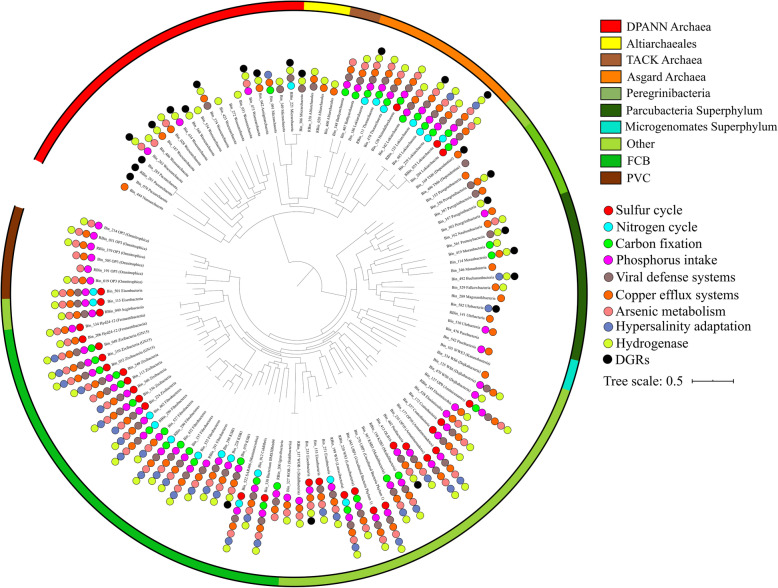
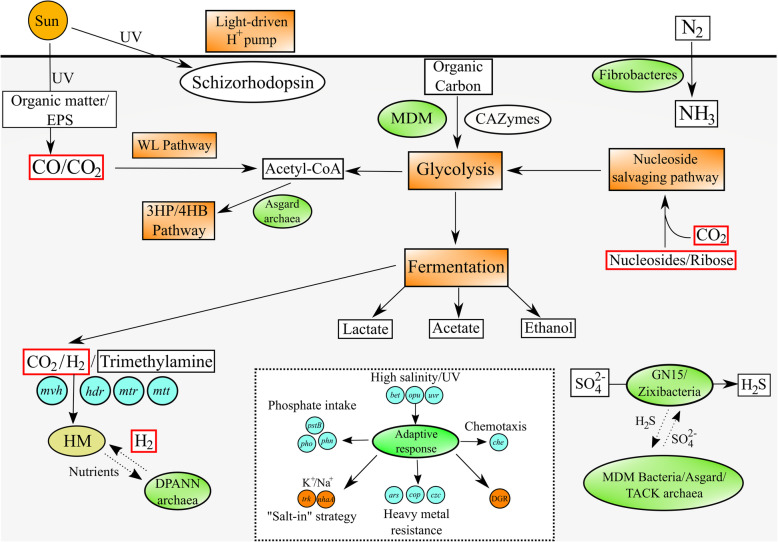
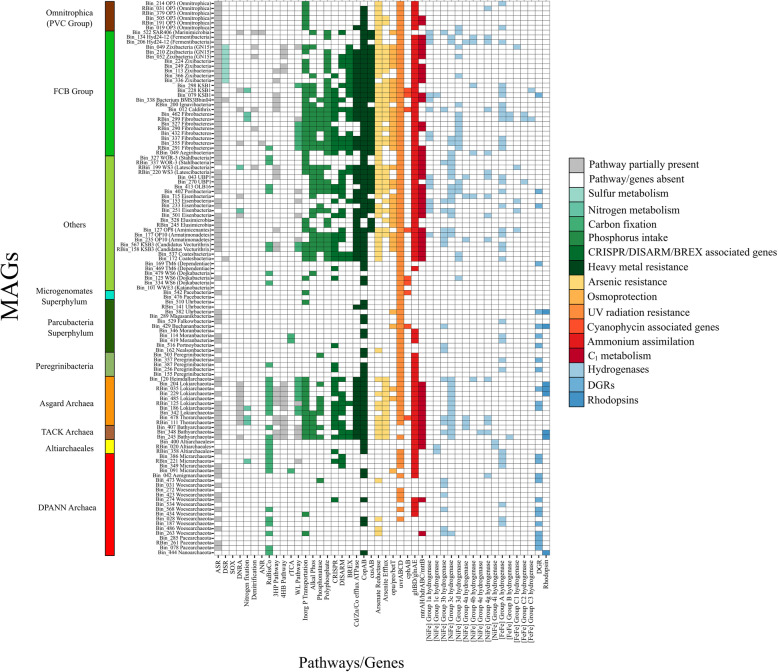
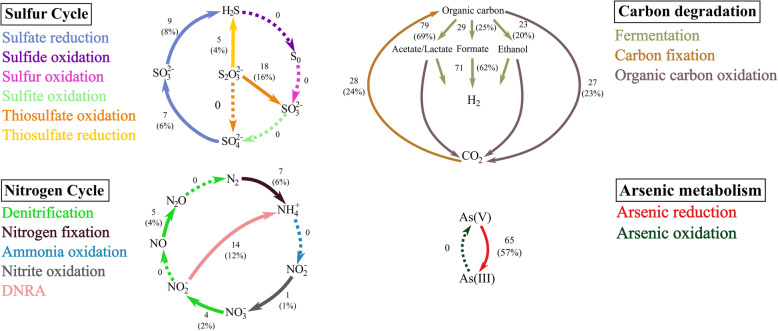
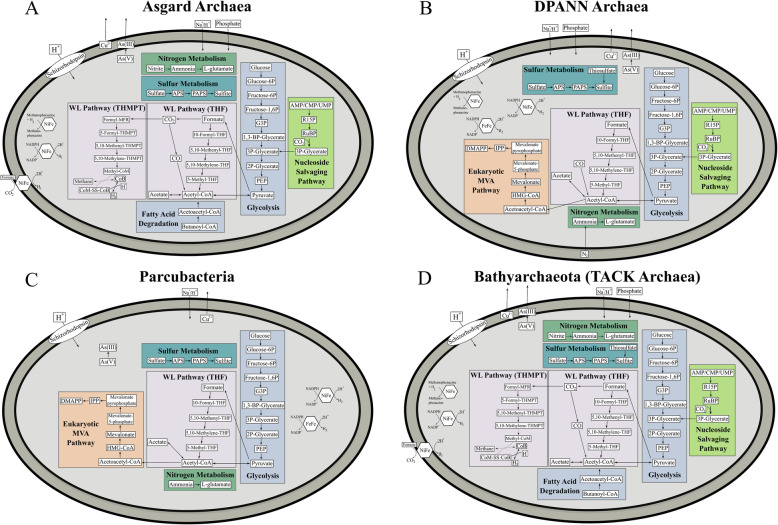
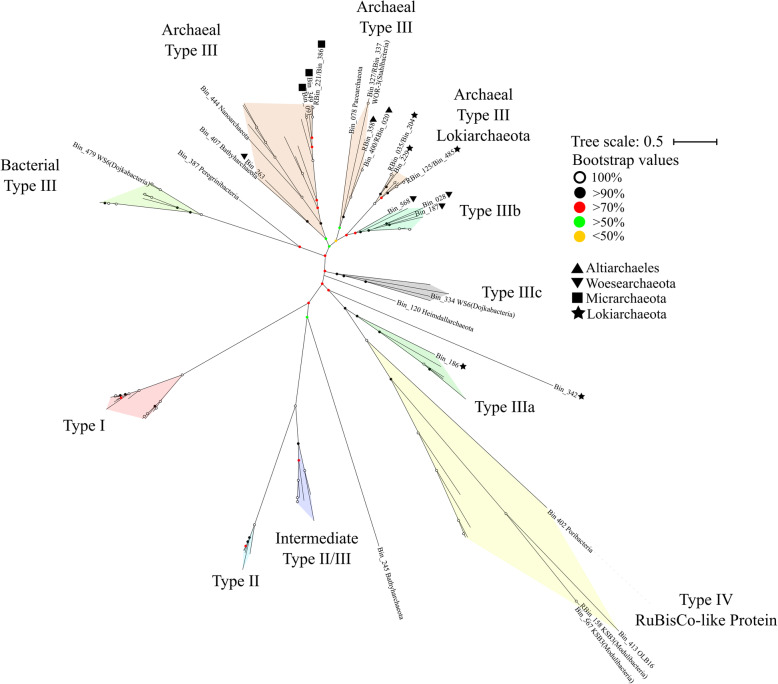
We reconstructed 115 metagenome-assembled genomes (MAGs) affiliated to MDM, spanning 42 phyla. This study reports for the first time novel microorganisms (Zixibacterial order GN15) putatively taking part in dissimilatory sulfate reduction in surface hypersaline settings, as well as novel eukaryote signature proteins in the Asgard archaea. Despite possessing reduced-size genomes, the MDM MAGs are capable of fermenting and degrading organic carbon, suggesting a role in recycling organic carbon. Several forms of RuBisCo were identified, allowing putative CO incorporation into nucleotide salvaging pathways, which may act as an alternative carbon and phosphorus source. High capacity of hydrogen production was found among Shark Bay MDM. Putative schizorhodopsins were also identified in Parcubacteria, Asgard archaea, DPANN archaea, and Bathyarchaeota, allowing these members to potentially capture light energy. Diversity-generating retroelements were prominent in DPANN archaea that likely facilitate the adaptation to a dynamic, host-dependent lifestyle.
This is the first study to reconstruct and describe in detail metagenome-assembled genomes (MAGs) affiliated with microbial dark matter in hypersaline microbial mats. Our data suggests that these microbial groups are major players in these systems. In light of our findings, we propose H, ribose and CO/CO as the main energy currencies of the MDM community in these mat systems. Video Abstract.
澳大利亚鲨鱼湾拥有最广泛和最多样化的微生物席生活系统之一,这些系统被认为是地球上一些最早生态系统的类似物。这些生态系统被证明拥有大量无法培养的微生物。这些神秘的微生物,共同被称为“微生物暗物质”(MDM),被假设在现代微生物席中发挥关键作用。
我们重建了 115 个与 MDM 相关的宏基因组组装基因组(MAG),跨越 42 个门。本研究首次报道了新的微生物(Zixibacterial 目 GN15)在表面高盐环境中可能参与异化硫酸盐还原,以及 Asgard 古菌中的新真核生物特征蛋白。尽管 MDM MAG 拥有缩小的基因组,但它们能够发酵和降解有机碳,表明它们在有机碳循环中发挥作用。几种形式的 RuBisCo 被鉴定出来,允许假设的 CO 掺入核苷酸挽救途径,这可能作为替代的碳和磷源。在鲨鱼湾 MDM 中发现了高容量的氢气产生。在 Parcubacteria、Asgard 古菌、DPANN 古菌和 Bathyarchaeota 中也鉴定出了假定的 schizorhodopsins,使这些成员能够潜在地捕获光能。多样性产生 retroelements 在 DPANN 古菌中很突出,可能有助于适应动态的、依赖宿主的生活方式。
这是首次重建和详细描述与高盐微生物席中微生物暗物质相关的宏基因组组装基因组(MAG)的研究。我们的数据表明,这些微生物群体是这些系统的主要参与者。鉴于我们的发现,我们提出 H、核糖和 CO/CO 作为这些基质系统中 MDM 群落的主要能量货币。视频摘要。