National Institute for Health Innovation, School of Population Health, University of Auckland, Auckland, New Zealand.
Department of Medicine, University of Otago, Dunedin, New Zealand.
PLoS One. 2020 Sep 17;15(9):e0238977. doi: 10.1371/journal.pone.0238977. eCollection 2020.
Early childhood is a critical period for the development of obesity, with new approaches to prevent obesity in this age group needed. We designed and piloted the 3 Pillars Study (3PS), a healthy lifestyle programme informed by attachment theory for parents of preschool-aged children.
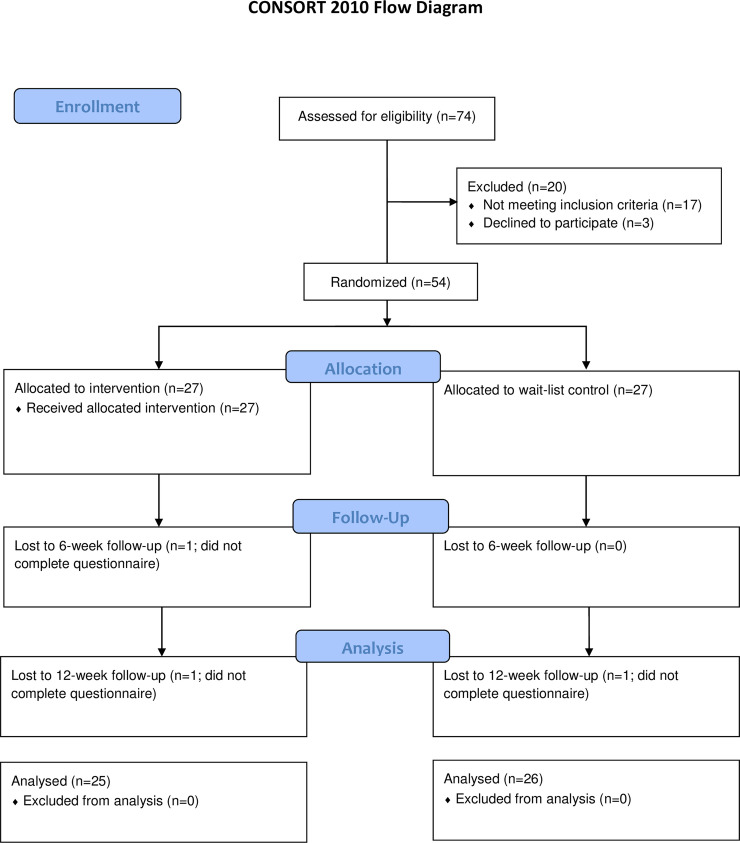
A 2-arm, randomised controlled pilot study was conducted to assess the effectiveness of 3PS, a 6-week programme involving a half-day workshop plus 6-week access to a study website. The programme was designed to promote routines around healthy lifestyle behaviours, including sleep, limited screen use, and family meals, within the context of positive, reciprocal parent-child interactions. Parents (n = 54) of children aged 2-4 years who regularly exceeded screen use recommendations (≥1 hour per day), were randomised to the 3PS programme (n = 27) or a wait-list control group (n = 27). Child screen time at 6 weeks was the primary endpoint. Frequency of family meals, parent feeding practices, diet quality, sleep, Child Routine Inventory (to assess predictability of commonly occurring routines), and household chaos were also assessed. Study data were collected online at baseline, 6 weeks, and 12 weeks via REDCap.
No group differences were observed for changes from baseline in screen time (primary endpoint), feeding behaviour scores, Child Routine Inventory scores, or total night time sleep duration at 6 and 12 weeks, although all measures improved in the hypothesised direction in the 3PS group. Compared with controls, the intervention group demonstrated significant improvements from baseline in household chaos scores (i.e. a reduction in chaos) and a number of measures of sleep outcomes, indicating improved sleep continuity. The programme was highly acceptable to parents.
A relational approach appears promising as a novel way to promote healthy lifestyle behaviours associated with the prevention of childhood obesity in children aged 2-4 years. A larger study is warranted.
儿童早期是肥胖发展的关键时期,因此需要针对该年龄段的肥胖预防采取新的方法。我们设计并试行 3 支柱研究(3PS),这是一个基于依恋理论的学龄前儿童家长健康生活方式计划。
我们进行了一项 2 臂随机对照试验,以评估 3PS 的有效性,该方案为期 6 周,包括半天的研讨会和 6 周的研究网站访问,旨在促进健康生活方式行为的常规性,包括睡眠、限制屏幕使用和家庭用餐,这些行为都是在积极、互惠的亲子互动背景下进行的。参与者为经常超过屏幕使用推荐时间(每天≥1 小时)的 2-4 岁儿童的父母,他们被随机分配到 3PS 方案组(n=27)或候补对照组(n=27)。6 周时的儿童屏幕时间是主要终点。家庭用餐频率、家长喂养行为、饮食质量、睡眠、儿童常规清单(评估常见日常活动的可预测性)和家庭混乱度也进行了评估。研究数据通过 REDCap 在基线、6 周和 12 周时在线收集。
在屏幕时间(主要终点)、喂养行为评分、儿童常规清单评分或 6 周和 12 周的总夜间睡眠时间方面,两组之间从基线开始的变化没有差异,尽管所有措施在 3PS 组中都朝着假设的方向改善。与对照组相比,干预组在家庭混乱度评分(即混乱程度降低)和多项睡眠结果指标方面,与基线相比有显著改善,表明睡眠连续性得到改善。该方案受到家长的高度认可。
一种基于关系的方法似乎是一种有前途的新方法,可以促进与预防 2-4 岁儿童肥胖相关的健康生活方式行为。需要进行更大规模的研究。