Akhbari Pouria, Richardson Sarah J, Morgan Noel G
Islet Biology Exeter (IBEx), Institute of Biomedical and Clinical Science, College of Medicine and Health, University of Exeter, Exeter EX2 5DW, UK.
Microorganisms. 2020 Sep 15;8(9):1419. doi: 10.3390/microorganisms8091419.
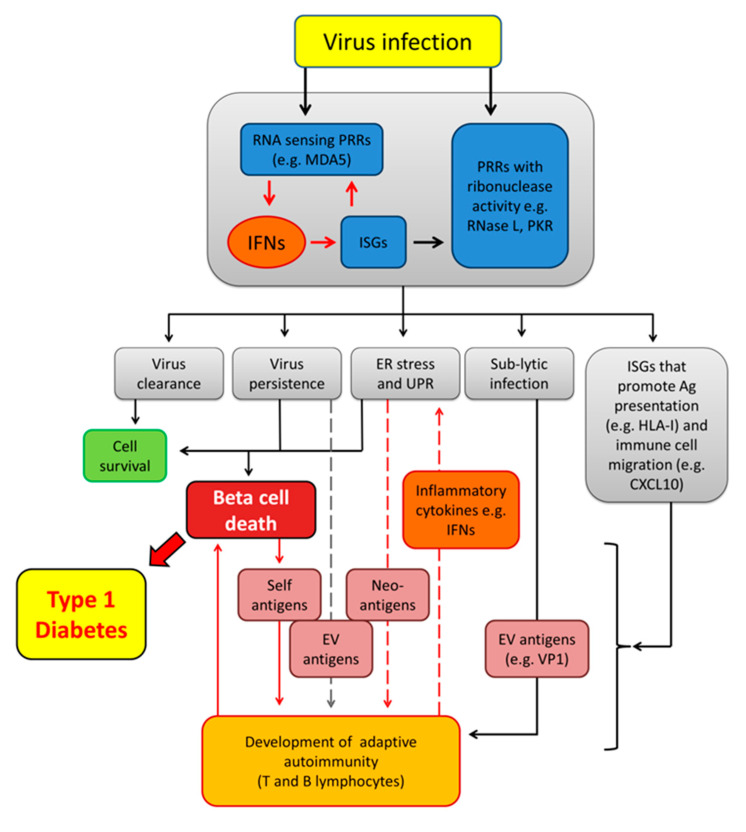
Enteroviruses (EVs) have long been implicated in the pathogenesis of type 1 diabetes (T1D), and accumulating evidence has associated virus-induced autoimmunity with the loss of pancreatic beta cells in T1D. Inflammatory cytokines including interferons (IFN) form a primary line of defence against viral infections, and their chronic elevation is a hallmark feature of many autoimmune diseases. IFNs play a key role in activating and regulating innate and adaptive immune responses, and to do so they modulate the expression of networks of genes and transcription factors known generically as IFN stimulated genes (ISGs). ISGs in turn modulate critical cellular processes ranging from cellular metabolism and growth regulation to endoplasmic reticulum (ER) stress and apoptosis. More recent studies have revealed that IFNs also modulate gene expression at an epigenetic as well as post-transcriptional and post-translational levels. As such, IFNs form a key link connecting the various genetic, environmental and immunological factors involved in the initiation and progression of T1D. Therefore, gaining an improved understanding of the mechanisms by which IFNs modulate beta cell function and survival is crucial in explaining the pathogenesis of virally-induced T1D. This should provide the means to prevent, decelerate or even reverse beta cell impairment.
长期以来,肠道病毒(EVs)一直被认为与1型糖尿病(T1D)的发病机制有关,越来越多的证据表明,病毒诱导的自身免疫与T1D中胰腺β细胞的丧失有关。包括干扰素(IFN)在内的炎性细胞因子构成了抵御病毒感染的第一道防线,它们的长期升高是许多自身免疫性疾病的一个标志性特征。IFN在激活和调节先天性和适应性免疫反应中起关键作用,为此它们调节通常被称为IFN刺激基因(ISG)的基因和转录因子网络的表达。ISG反过来又调节从细胞代谢和生长调节到内质网(ER)应激和细胞凋亡等关键细胞过程。最近的研究表明,IFN还在表观遗传以及转录后和翻译后水平上调节基因表达。因此,IFN形成了一个关键环节,将参与T1D发生和发展的各种遗传、环境和免疫因素联系起来。因此,更好地了解IFN调节β细胞功能和存活的机制对于解释病毒诱导的T1D的发病机制至关重要。这应该提供预防、减缓甚至逆转β细胞损伤的方法。