Pharmaceutical Sciences Postgraduate Research Program, Universidade Federal do Paraná, Curitiba, Brazil.
Laboratory of Pharmacology, Department of Drug Sciences, Faculty of Pharmacy, University of Porto, Porto, Portugal.
PLoS One. 2020 Sep 18;15(9):e0238910. doi: 10.1371/journal.pone.0238910. eCollection 2020.
Current evidence on fecal microbiota transplantation for inflammatory bowel disease is inconclusive. We conducted a systematic review to gather evidence on the efficacy and safety of fecal microbiota transplantation for inflammatory bowel disease.
Systematic searches were conducted in PubMed, Scopus, and Web of Science. Clinical remission was considered as the primary endpoint. Pairwise meta-analyses were performed for the randomized controlled studies (Mantel Haenszel, random effects model). Proportion meta-analyses, accounting for weighted pooled rates reported in the interventional studies, were conducted using the mixed effects model. Subgroup analyses considering the type of stool, donor type, and disease subtype were also performed. Cumulative meta-analyses to assess further needs of evidence were conducted.
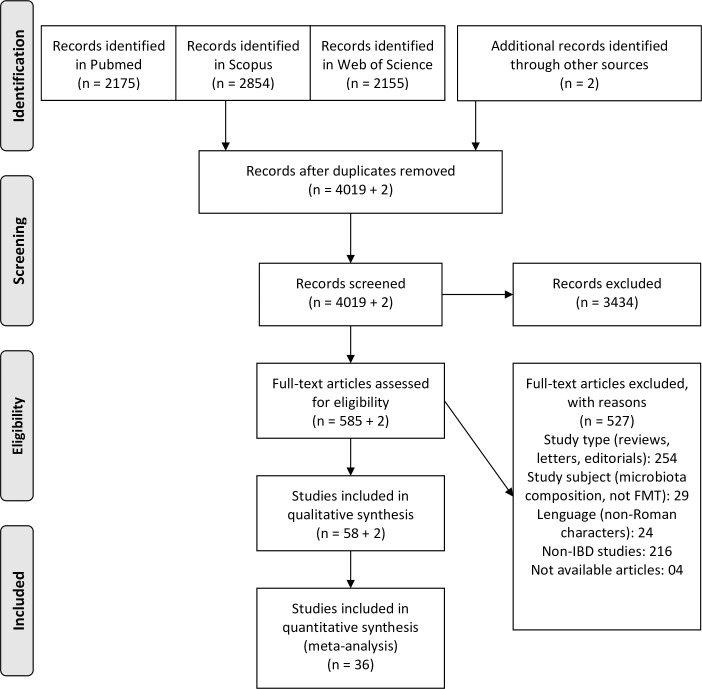
Sixty studies were included, from which 36 could be synthesized in the quantitative analyses. Pairwise meta-analyses of six controlled trials showed significant differences in favor of fecal microbiota transplantation compared with placebo (clinical remission: RR 1.70 [95% CI 1.12, 2.56]; clinical response: RR 1.68 [95% CI 1.04, 2.72]). An overall clinical remission of 37%, overall clinical response of 54%, and a prevalence of 29% of adverse events were found for the interventional studies. Frozen fecal material and universal donors were related to better efficacy outcomes. In addition, Crohn's disease patients seemed to benefit more from the procedure.
The comparative analyses demonstrated that frozen fecal material from universal donors may be related to a higher rate of clinical remission, especially for Crohn's disease.
目前关于粪便微生物群移植治疗炎症性肠病的证据尚无定论。我们进行了系统评价,以收集粪便微生物群移植治疗炎症性肠病的疗效和安全性证据。
在 PubMed、Scopus 和 Web of Science 中进行系统检索。临床缓解被视为主要终点。对随机对照研究进行了成对荟萃分析(Mantel Haenszel,随机效应模型)。使用混合效应模型对干预研究中报告的加权汇总率进行了比例荟萃分析。还进行了考虑粪便类型、供体类型和疾病亚型的亚组分析。进行了累积荟萃分析,以评估进一步的证据需求。
共纳入 60 项研究,其中 36 项可进行定量分析。六项对照试验的成对荟萃分析显示,粪便微生物群移植与安慰剂相比有显著差异(临床缓解:RR 1.70 [95%CI 1.12, 2.56];临床反应:RR 1.68 [95%CI 1.04, 2.72])。干预研究的总体临床缓解率为 37%,总体临床反应率为 54%,不良反应发生率为 29%。冷冻粪便材料和通用供体与更好的疗效结果相关。此外,克罗恩病患者似乎从该程序中获益更多。
比较分析表明,来自通用供体的冷冻粪便材料可能与更高的临床缓解率相关,特别是对克罗恩病。