Jani Anant, Liyanage Harshana, Hoang Uy, Moore Lucy, Ferreira Filipa, Yonova Ivelina, Tzortziou Brown Victoria, de Lusignan Simon
Oxford Martin School, University of Oxford, Oxford, United Kingdom.
Nuffield Department of Primary Care Health Sciences, University of Oxford, Oxford, UK.
BMJ Open. 2020 Sep 18;10(9):e037681. doi: 10.1136/bmjopen-2020-037681.
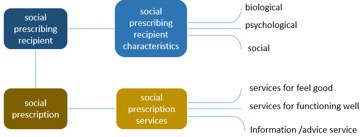
Social prescribing aims to address social determinants of health, which account for 80%-90% of health outcomes, but the evidence base behind it is limited due to a lack of data linkingsocial prescribing activity and outcomes.
The objective of the quantitative component of this feasibility studyisto identify the characteristics of individuals who receive social prescriptions and describe the use and estimate the impact of social prescribing; the latter will be done on a homeless subgroup. We will use the Oxford Royal College of General Practitioners (RCGP) Research and Surveillance Centre (RSC) primary care sentinel network, whose general practicescover a population of over 4 000 000 patients. Social prescribing data will be extracted onall recorded patients for 5 years up to 31 January 2020. The objective for the qualitative component of the study isto explore approaches to understand the contextual factors that will have influenced our quantitative findings to identify mechanisms to encourage adoption of social prescribing in primary care while improving data quality. Itwill comprise up to three 90-120 minute advisory group meetings for six to eight participants. Participants will be recruited based on their experience of delivering primary care within Oxfordshire and Surrey. The advisory group outputs will be analysed using framework analysis and will be used to create a survey instrument consisting of statements that surveyees, who will consist of primary care practitioners within the RCGP RSC, can agree or disagree with.
All RCGP RSC data are pseudonymised at the point of data extraction. No personally identifiable data are required for this investigation. This protocol follows the Good Reporting of a Mixed Methods Study checklist. The study results will be published in a peer-reviewed journal and the dataset will be available to other researchers.
社会处方旨在解决健康的社会决定因素,这些因素占健康结果的80%-90%,但由于缺乏将社会处方活动与结果相联系的数据,其背后的证据基础有限。
本可行性研究定量部分的目的是确定接受社会处方的个体特征,描述社会处方的使用情况并评估其影响;后者将在无家可归亚组中进行。我们将使用牛津皇家全科医师学院(RCGP)研究与监测中心(RSC)的初级保健哨点网络,其全科医疗覆盖超过400万患者。将提取截至2020年1月31日的5年内所有记录患者的社会处方数据。该研究定性部分的目的是探索方法,以理解可能影响我们定量研究结果的背景因素,确定在改善数据质量的同时鼓励在初级保健中采用社会处方的机制。它将包括最多三次为期90-120分钟的咨询小组会议,每次会议有六至八名参与者。参与者将根据他们在牛津郡和萨里郡提供初级保健的经验招募。咨询小组的产出将使用框架分析法进行分析,并将用于创建一份调查问卷,问卷由陈述语句组成,调查对象为RCGP RSC内的初级保健从业者,他们可以对这些陈述表示同意或不同意。
所有RCGP RSC数据在提取时都进行了假名化处理。本次调查不需要个人身份识别数据。本方案遵循混合方法研究的良好报告清单。研究结果将发表在同行评审期刊上,数据集将可供其他研究人员使用。