Department of Emergency Psychiatry and Acute Care, CHU Montpellier, Montpellier, France.
PSNREC, Univ Montpellier, INSERM, CHU de Montpellier, Montpellier, France.
Transl Psychiatry. 2020 Sep 18;10(1):313. doi: 10.1038/s41398-020-00995-z.
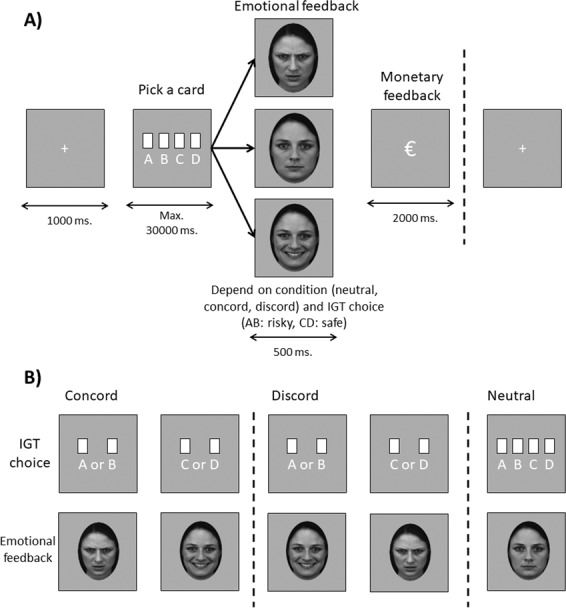
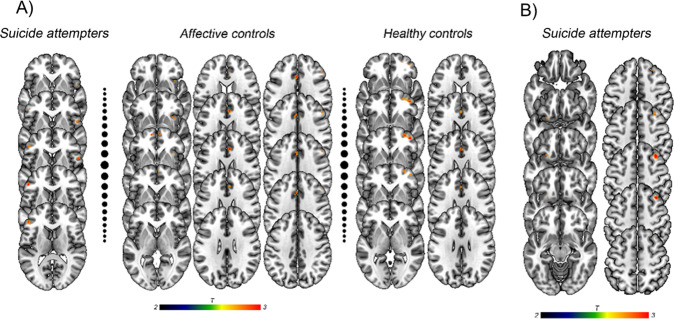
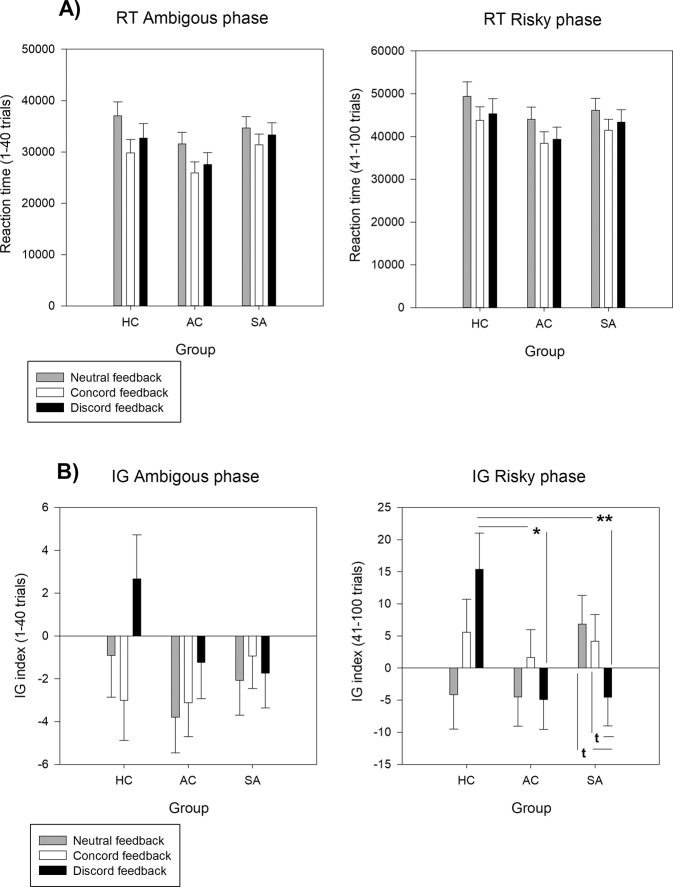
Emotional feedback, such as faces showing emotions, can influence decision making. Decision making and emotional face processing, mainly mediated by the prefrontal and cingulate cortices, are impaired in suicide attempters. Here, we used functional MRI (fMRI) to study prefrontal activation in suicide attempters during a modified version of the Iowa Gambling Task (IGT) that included emotional face feedback. We randomly distributed the 116 euthymic women (n = 45 suicide attempters, n = 41 affective controls with history of depression without suicide attempt, and n = 30 healthy controls) included in the study in three emotional IGT groups: concordant (safe and risky choices followed by happy and angry faces, respectively), discordant (safe and risky choices followed by angry and happy faces, respectively), and neutral condition (safe and risky choices followed by neutral faces). Considering the two IGT phases (ambiguous and risky), we then analyzed five regions of interest during the risky vs. safe choices: orbitofrontal (OFC), anterior cingulate (ACC), ventrolateral (VLPFC), medial (MPFC) and dorsal prefrontal (DPFC) cortices. We found: (1) impaired decision making and increased DPFC and OFC activation in suicide attempters vs. controls in the discordant condition during the risky phase; (2) reduced VLPFC activation in suicide attempters in the concordant condition during the ambiguous phase; and (3) decreased OFC, ACC and DPFC activation in both control groups in the concordant condition during the ambiguous phase. Suicide attempters showed prefrontal alterations during reward-learning decision making with emotional feedback. Suicide attempters may guide their decisions to avoid social negative feedback despite the expected outcome.
情绪反馈,如表情展示情绪,可以影响决策。决策和情绪面孔处理主要由前额叶和扣带回皮层介导,在自杀未遂者中受损。在这里,我们使用功能磁共振成像(fMRI)研究了在包括情绪面孔反馈的改良爱荷华赌博任务(IGT)中,自杀未遂者的前额叶激活情况。我们随机将研究中包括的 116 名心境稳定的女性(n=45 名自杀未遂者、n=41 名有抑郁史但无自杀企图的情感对照组和 n=30 名健康对照组)分为三个情绪 IGT 组:一致(安全和风险选择后分别为快乐和愤怒面孔)、不一致(安全和风险选择后分别为愤怒和快乐面孔)和中性条件(安全和风险选择后分别为中性面孔)。考虑到 IGT 的两个阶段(模糊和风险),我们随后在风险与安全选择期间分析了五个感兴趣的区域:眶额皮质(OFC)、前扣带皮质(ACC)、腹外侧前额叶皮质(VLPFC)、内侧前额叶皮质(MPFC)和背侧前额叶皮质(DPFC)。我们发现:(1)在风险阶段的不一致条件下,与对照组相比,自杀未遂者的决策能力受损,DPFC 和 OFC 激活增加;(2)在模糊阶段的一致条件下,自杀未遂者的 VLPFC 激活减少;(3)在模糊阶段的一致条件下,两个对照组的 OFC、ACC 和 DPFC 激活减少。自杀未遂者在具有情绪反馈的奖励学习决策中表现出前额叶改变。尽管有预期的结果,自杀未遂者可能会引导他们的决策来避免社会负面反馈。