Office of the President, Ballou Hall, Tufts University, Medford, MA, 02155, USA.
Eur J Hum Genet. 2021 Mar;29(3):387-395. doi: 10.1038/s41431-020-00726-4. Epub 2020 Sep 18.
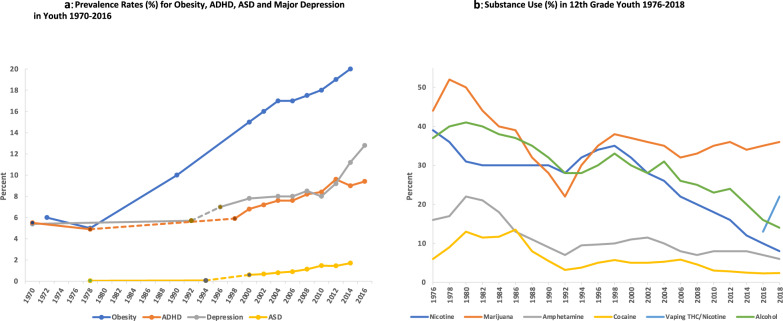
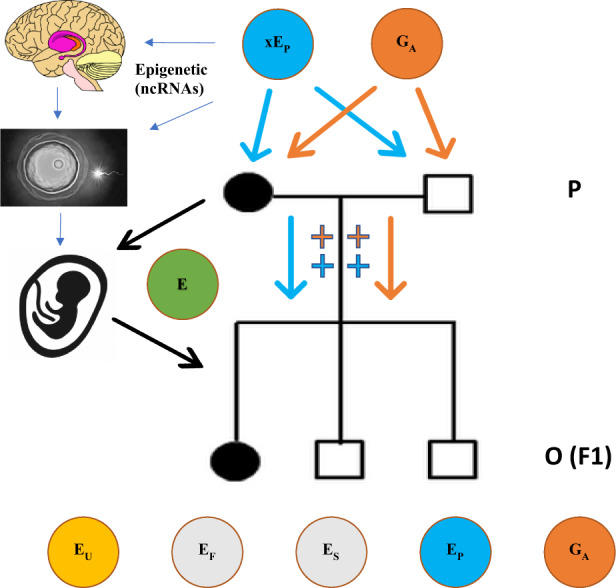
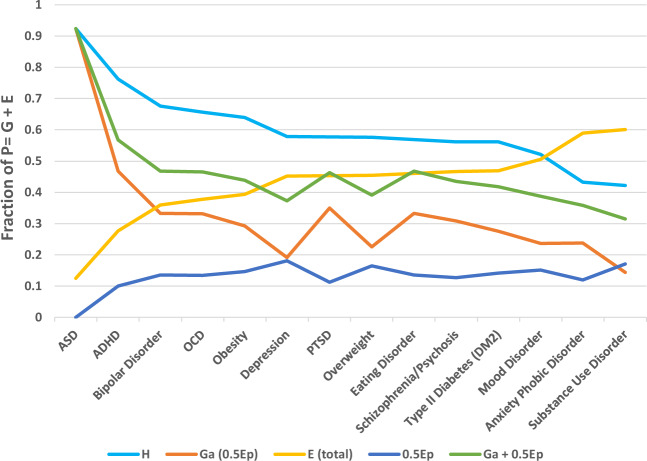
Prevalence rates of mental health disorders in children and adolescents have increased two to threefold from the 1990s to 2016. Some increase in prevalence may stem from changing environmental conditions in the current generation which interact with genes and inherited genetic variants. Current measured genetic variant effects do not explain fully the familial clustering and high heritability estimates in the population. Another model considers environmental conditions shifting in the previous generation, which altered brain circuits epigenetically and were transmitted to offspring via non-DNA-based mechanisms (intergenerational and transgenerational effects). Parental substance use, poor diet and obesity are environmental factors with known epigenetic intergenerational and transgenerational effects, that regulate set points in brain pathways integrating sensory-motor, reward and feeding behaviors. Using summary statistics for eleven neuropsychiatric and three metabolic disorders from 128,989 families, an epigenetic effect explains more of the estimated heritability when a portion of parental environmental effects are transmitted to offspring alongside additive genetic variance.
儿童和青少年精神健康障碍的患病率自 20 世纪 90 年代以来增加了两到三倍。患病率的某些增加可能源于当前这一代人的环境条件发生了变化,这些变化与基因和遗传变异相互作用。目前测量的遗传变异效应并不能完全解释人群中家族聚集和高遗传度的估计。另一种模式认为,上一代的环境条件发生了变化,这些变化通过非基于 DNA 的机制(代际和跨代效应)在表观遗传上改变了大脑回路,并传递给后代。父母的物质使用、不良饮食和肥胖是具有已知表观遗传代际和跨代效应的环境因素,它们调节整合感觉运动、奖励和进食行为的大脑通路的设定点。利用来自 128989 个家庭的 11 种神经精神疾病和 3 种代谢疾病的汇总统计数据,当一部分父母环境效应与加性遗传变异一起传递给后代时,表观遗传效应可以解释更多的遗传度估计。