LaserLaB and Department of Physics and Astronomy, Vrije Universiteit Amsterdam, Amsterdam, The Netherlands.
J Microsc. 2021 Mar;281(3):214-223. doi: 10.1111/jmi.12964. Epub 2020 Oct 10.
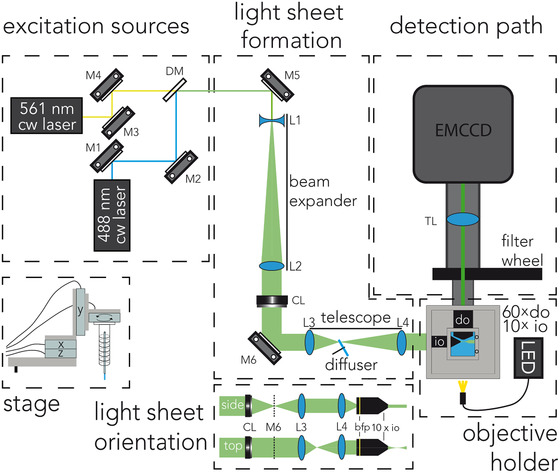
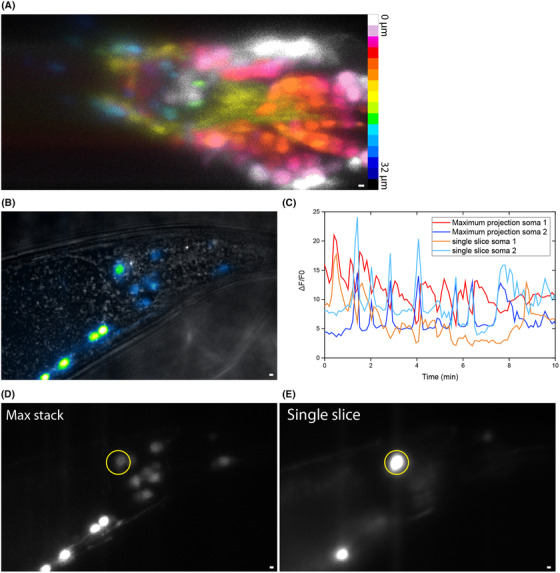
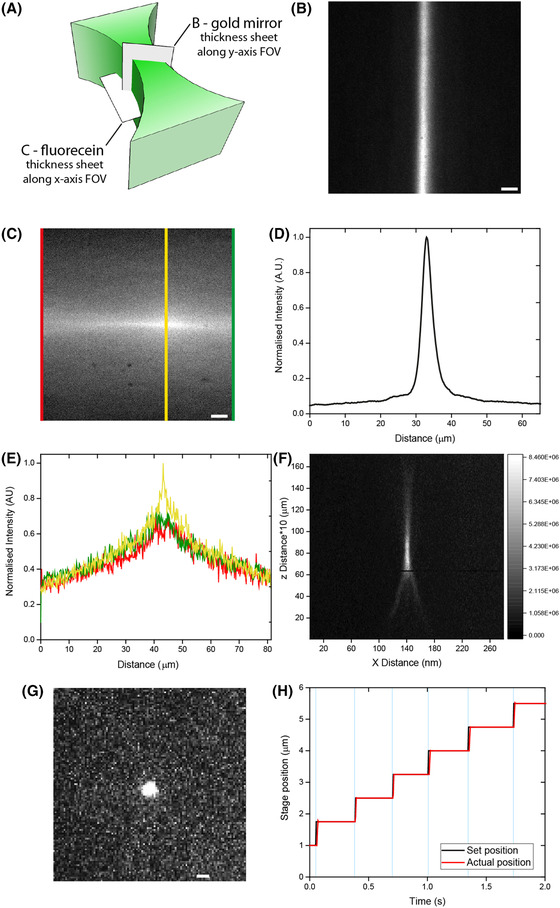
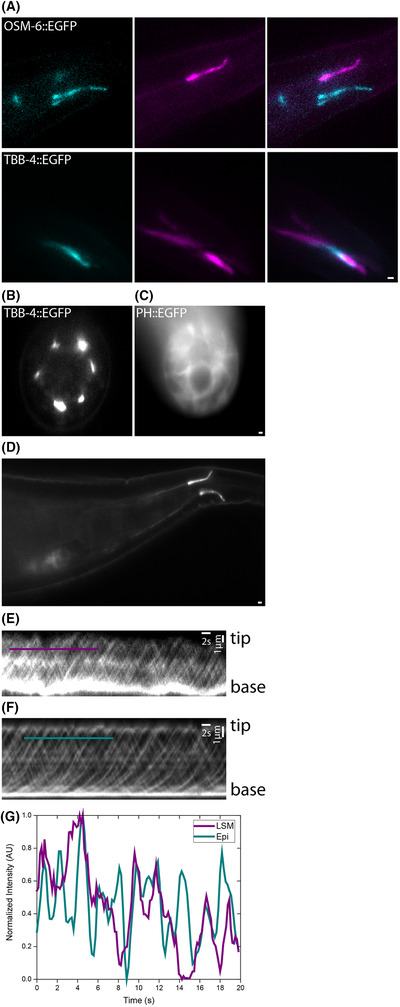
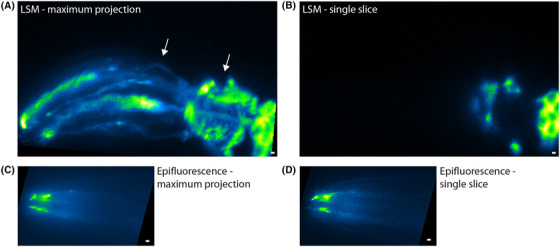
Live observation of biological phenomena in the context of living organisms can provide important insights in the mechanisms of these phenomena. However, the spatially complex and dynamic physiology of multicellular organisms can be a challenging environment to make observations with fluorescence microscopy. Due to the illumination of out-of-focus planes, confocal and particularly widefield fluorescence microscopy suffer from low signal-to-background ratio (SBR), photo toxicity and bleaching of fluorescent probes. In light-sheet microscopy (LSM), solely the focal plane of the detection objective is illuminated, minimising out-of-focus fluorescence and photobleaching, thereby enhancing SBR, allowing for low laser intensities and longer acquisition periods. Here we present a straightforward light-sheet microscope with a 1.0-NA detection objective and a fast sample-positioning stage that allows for four degrees of freedom. By imaging the sensory cilia and nervous system of living young adult C. elegans, we demonstrate that the instrument is well suited for relatively fast, volumetric imaging of larger (hundreds of micrometres cubed) living samples. These experiments demonstrate that such an instrument provides a valuable addition to commonly used widefield and confocal fluorescence microscopes. LAY DESCRIPTION: In fluorescence microscopy, sharp images can only be obtained when the light obtained from the section of the image that is in focus is not overwhelmed by light emerging from elsewhere. In this paper, we present a light-sheet fluorescence microscope, based on the OpenSPIM initiative, with a magnification of 90× and a sensitive sample positioning stage that allows for fast controlled linear movement and rotation. In a light-sheet microscope (LSM), the sample is illuminated from the side, compared to the direction of detection, limiting illumination only to the part of the sample that is imaged in the focal plane (general resources: Wikipedia or MicroscopyU). This does not only limit background noise, but also reduces damage to the sample due to phototoxicity. This makes a LSM particularly suitable for imaging living samples at high resolution, in three dimensions, over long periods of time. Our instrument was specifically designed for imaging adult C. elegans nematodes. We show here how the instrument compares to a standard epifluorescence microscope, imaging neuronal structures in the animals. The instrument proved well suited for fast volumetric imaging of larger cellular structures such as C. elegans neuronal cell bodies. Our experiments show that the instrument provides a valuable addition to widefield and confocal fluorescence microscopes commonly used to image adult C. elegans.
在活生物体的背景下对生物现象进行实时观察,可以深入了解这些现象的机制。然而,多细胞生物体的空间复杂且动态的生理学特性使得使用荧光显微镜进行观察具有挑战性。由于离焦平面的照明,共聚焦和宽场荧光显微镜的信号背景比(SBR)低,对荧光探针有光毒性和漂白作用。在光片显微镜(LSM)中,仅检测物镜的焦平面被照明,从而最小化离焦荧光和漂白,从而提高 SBR,允许使用低激光强度和更长的采集时间。在这里,我们介绍了一种具有 1.0-NA 检测物镜和快速样品定位台的简单光片显微镜,该定位台允许四个自由度。通过对活体年轻成年秀丽隐杆线虫的感觉纤毛和神经系统进行成像,我们证明该仪器非常适合对较大(数百立方微米)的活体样本进行相对快速的体积成像。这些实验表明,这种仪器是常用的宽场和共聚焦荧光显微镜的有价值的补充。
在荧光显微镜中,只有当从聚焦部分获取的光不被来自其他地方的光淹没时,才能获得清晰的图像。在本文中,我们提出了一种基于 OpenSPIM 计划的光片荧光显微镜,放大倍数为 90×,并且具有灵敏的样品定位台,可以进行快速的受控线性运动和旋转。在光片显微镜(LSM)中,与检测方向相比,从侧面对样品进行照明,仅将照明限制在聚焦平面中成像的样品部分(一般资源:维基百科或显微镜 U)。这不仅限制了背景噪声,而且还减少了由于光毒性对样品的损害。这使得 LSM 特别适合于在高分辨率,三维空间中长时间对活样本进行成像。我们的仪器是专门为成像成年秀丽隐杆线虫线虫而设计的。在这里,我们展示了该仪器如何与标准的落射荧光显微镜相比,对动物的神经元结构进行成像。该仪器非常适合对较大的细胞结构(例如秀丽隐杆线虫神经元胞体)进行快速体积成像。我们的实验表明,该仪器是常用的成像成年秀丽隐杆线虫的宽场和共聚焦荧光显微镜的有价值的补充。