Section of Minimally Invasive Surgery, Department of Surgery, Washington University School of Medicine, St Louis, MO.
Section of Minimally Invasive Surgery, Department of Surgery, Washington University School of Medicine, St Louis, MO.
J Am Coll Surg. 2020 Dec;231(6):670-678. doi: 10.1016/j.jamcollsurg.2020.08.768. Epub 2020 Sep 17.
The COVID-19 pandemic travel restrictions triggered a rapid alteration in the interview process for fellowships this spring. We describe our initial experience with virtual interviews for Advanced Gastrointestinal (GI) Minimally Invasive Surgery Fellowships and assess the value and limitations via a post-interview applicant survey.
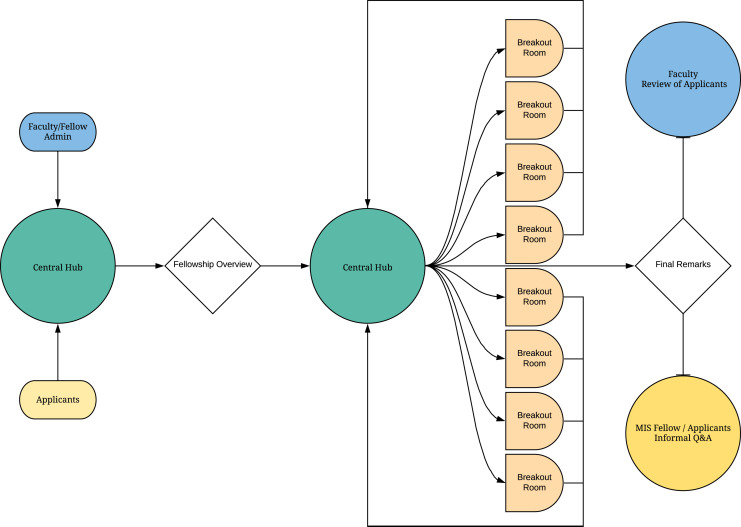
Twenty candidates were interviewed via Zoom teleconferencing during March and April 2020 using combined group and breakout rooms. An anonymous post-interview Likert and free text survey was sent to candidates with questions regarding feasibility, appropriateness, and acceptability of this method.
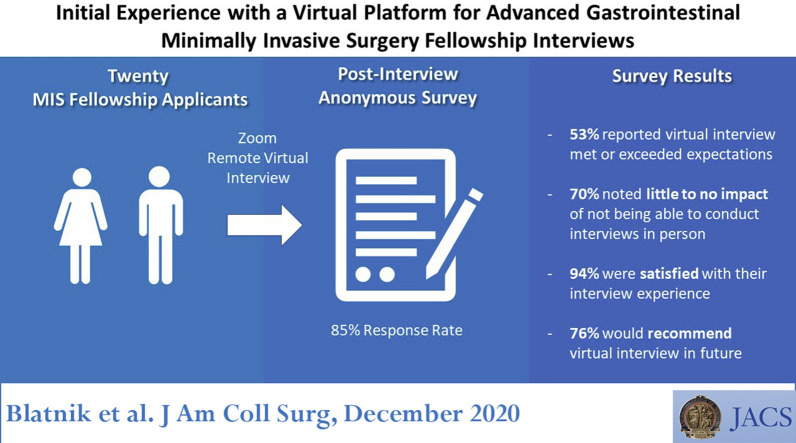
Seventeen of 20 candidates (85%) responded to the survey. The candidates rated ease of interaction with the program director, faculty surgeons, and the current fellow highly: 94%, 83%, and 89%, respectively. The majority (53%) stated the virtual interviews exceeded or met expectations. Only a minority, 12%, reported the virtual platform was short of expectations. Approximately 70% noted little to no impact of not being able to conduct these interviews in-person and not being able to physically see the program institution. Overall, 94% were satisfied with their experience, and only 6% were neutral, with no respondents reporting dissatisfaction. Finally, 76% would recommend a virtual interview in the future. Most negative open response comments were secondary to issues with software rather than the lack of the in-person traditional interviews.
The use of a remote teleconferencing platform provides a favorable method for conducting fellowship interviews and results in a high degree of candidate satisfaction. Virtual interviews will likely be increasingly substituted for in-person interviews across the spectrum of medical training.
新冠疫情旅行限制导致今年春季 fellowship面试流程迅速改变。我们描述了在远程视频会议上进行高级胃肠微创手术 fellowship面试的初步经验,并通过面试后申请人调查评估这种方法的价值和局限性。
2020 年 3 月至 4 月期间,使用 Zoom 电话会议,采用小组和分组讨论室相结合的方式对 20 名候选人进行了面试。我们向候选人发送了一份匿名的面试后李克特量表和自由文本调查,询问他们对这种方法的可行性、适当性和可接受性的看法。
20 名候选人中的 17 名(85%)回复了调查。候选人对与项目主任、外科教员和现任研究员互动的便利性评价很高:分别为 94%、83%和 89%。大多数(53%)表示虚拟面试超出或满足了他们的期望。只有少数(12%)表示虚拟平台低于他们的期望。大约 70%的人表示,无法亲自进行这些面试,无法实地参观项目机构,对他们的影响很小。总体而言,94%的人对他们的面试体验感到满意,只有 6%的人持中立态度,没有人表示不满意。最后,76%的人表示将来会推荐虚拟面试。大多数负面的开放回复评论主要是由于软件问题,而不是缺乏传统的面对面面试。
使用远程电话会议平台为进行研究员面试提供了一种有利的方法,并导致候选人高度满意。虚拟面试可能会越来越多地替代医学培训各个领域的面对面面试。