Rhodes Heather X, Petersen Kirklen, Biswas Saptarshi
Trauma, Grand Strand Medical Center, Myrtle Beach, USA.
Cureus. 2020 Aug 17;12(8):e9811. doi: 10.7759/cureus.9811.
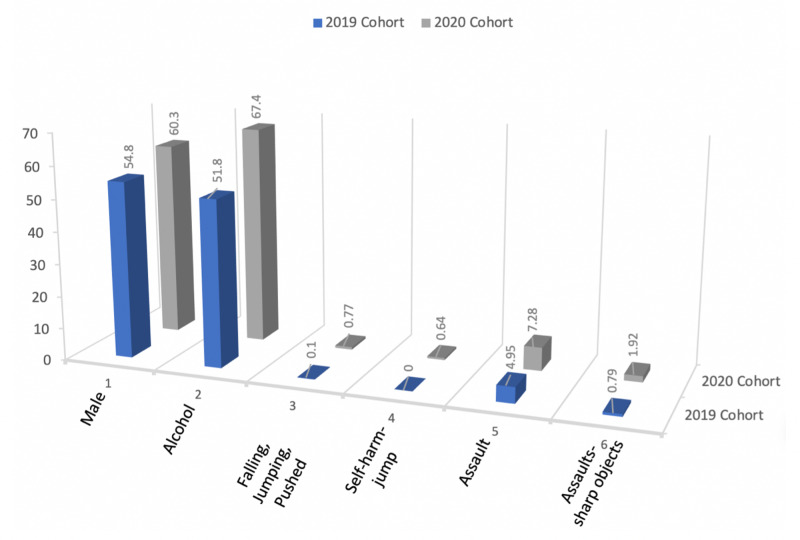
Background As the early peak phase in the coronavirus outbreak has intensified, stay at home mandates were advised requiring individuals to remain home to prevent community transmission of the disease. Further mandates escalated isolated environments such as school closures, social distancing, travel restrictions, closure of public gathering spaces, and business closures. As citizens were forced to stay home during the pandemic, the crisis created unique trends in trauma referrals, which consisted of atypical trends in injuries related to trauma. Methods A retrospective review of all trauma registry patients presenting to a rural American College of Surgeons (ACS) verified Level I trauma center with associated trauma activation before and during the Coronavirus 2019 (COVID-19) pandemic, integral dates January 1, 2020, to May 1, 2020. A comparison was made regarding trauma trends based on the previous year (January 1, 2019, to May 1, 2019). The data collected included patient characteristics, grouping by trauma activation, injury type, injury severity score (ISS), alcohol screen, drug screen, and mode of injury. Results A statistically significant increase was found largely among males (p = 0.02) with positive alcohol screens (p < 0.001). The statistically significant mode of injury among this trauma population included falling, jumping, pushed (p = 0.02); self-harm-jump (p = 0.01); assault (p = 0.03); and assault with sharp object (p = 0.036). Conclusions Although overall trauma volume was reduced preceding and during the COVID-19 stay at home mandates, a significant increase in specific trauma trends were observed, such as falls, jumps, and pushed; self-harm-jumps; assaults; and assaults with sharp objects. Largely, the trauma trends were among men with higher levels of alcohol than previously reported.
背景 随着冠状病毒爆发初期的高峰阶段加剧,建议实施居家令,要求个人留在家中以防止疾病的社区传播。进一步的指令扩大了隔离环境,如学校关闭、社交距离、旅行限制、公共集会场所关闭和企业停业。在疫情期间,公民被迫留在家中,这场危机在创伤转诊方面产生了独特的趋势,其中包括与创伤相关的非典型损伤趋势。
方法 对2020年1月1日至2020年5月1日期间,所有前往美国农村外科医生学会(ACS)认证的一级创伤中心就诊且伴有创伤激活的创伤登记患者进行回顾性研究。将其与前一年(2019年1月1日至2019年5月1日)的创伤趋势进行比较。收集的数据包括患者特征、按创伤激活分组、损伤类型、损伤严重程度评分(ISS)、酒精筛查、药物筛查和损伤方式。
结果 在酒精筛查呈阳性的男性中发现了统计学上的显著增加(p = 0.02)。在这一创伤人群中,具有统计学意义的损伤方式包括跌倒、跳跃、推搡(p = 0.02);自残性跳跃(p = 0.01);袭击(p = 0.03);以及锐器袭击(p = 0.036)。
结论 尽管在COVID - 19居家令实施之前和期间,总体创伤量有所减少,但观察到特定创伤趋势有显著增加,如跌倒、跳跃和推搡;自残性跳跃;袭击;以及锐器袭击。很大程度上,创伤趋势主要出现在酒精摄入量高于先前报告水平的男性中。